Will Civilization Collapse by 2040? The World3 Model FAQ
March 4, 2026 · By Michael Rodriguez
In 1972, a group of MIT scientists fed the world's data into a computer the size of a bedroom and pressed run. The machine's answer — that industrial civilization would begin declining around 2040 — was dismissed as alarmist nonsense. Fifty-four years later, the data isn't laughing anymore. These are the questions readers ask most about the Club of Rome's prediction, the World3 model, and what Countdown to Collapse: The 2040 Crisis reveals about the evidence.
Q1: What is the World3 model and what did it predict?
The Computer That Saw the Future: In 1972, seventeen researchers at MIT's Systems Dynamics Group built World3 — a computer simulation that modeled the interactions between five fundamental variables: population growth, food production, industrial output, pollution, and natural resource consumption. The model was commissioned by the Club of Rome, an international group of scientists, economists, and industrialists concerned about long-term global trends.
World3 ran multiple scenarios. The "standard run" — assuming no major policy changes — predicted that industrial output per capita would peak around 2020, food production would plateau and begin declining in the 2030s, and population would start dropping by the 2040s. This wasn't prophecy. It was mathematics: exponential growth on a finite planet eventually hits limits, and when interconnected systems hit those limits simultaneously, the result is not gradual slowdown but cascading failure.
The results were published as The Limits to Growth, which sold thirty million copies and became one of the most controversial scientific publications in history. Economists attacked it. Oil companies funded counter-studies. Politicians ignored it. But the model kept running — and as Countdown to Collapse documents in detail, the real world kept tracking its predictions with uncomfortable precision.
Q2: Did KPMG really confirm the collapse prediction?
The Analyst Who Checked the Math: In 2021, Gaya Herrington — a sustainability analyst at KPMG, one of the world's largest consulting firms — decided to test the World3 model against fifty years of actual data. She pulled numbers from the UN, the World Bank, NOAA, and the BP Statistical Review. She plotted them against each of World3's original scenarios.
Her conclusion, published in the Yale Journal of Industrial Ecology, was stark: two scenarios matched the data. One was "Comprehensive Technology" — the optimistic path where innovation solves everything. The other was "Business As Usual 2" — the path that ends in civilizational decline. The problem? BAU2 fit the data slightly better. And the key difference between the two scenarios — whether technology deployment happens fast enough to offset resource depletion — won't become clear until the late 2020s.
Herrington was careful to note that her findings weren't a death sentence. But she also couldn't hide what the numbers showed. As Countdown to Collapse explores, the window between "we can still fix this" and "it's too late" is measured not in decades but in years.
Q3: What are the first visible signs of the collapse the model predicted?
The Cascade Has Already Started: World3 predicted a specific sequence: rising resource extraction costs → agricultural strain → industrial output stagnation → population decline. That sequence is now observable in real-world data.
Consider the evidence documented in Countdown to Collapse: China's population peaked in 2022 and began declining — the first peacetime population drop in the world's most populous nation. The Colorado River, which provides water to forty million Americans, has been in deficit for over two decades. The 2022 global fertilizer crisis — triggered by the Ukraine war but amplified by decades of soil depletion — gave the world a preview of what happens when food production systems hit resource walls.
None of these crises are isolated. That's the critical insight of systems dynamics: in an interconnected civilization, a fertilizer shortage in one region becomes a food price spike everywhere. A demographic decline in China becomes a manufacturing crisis in Europe. A water shortage in the American Southwest becomes an agricultural crisis that ripples through global grain markets. The model predicted these interconnections. Reality is confirming them.
Q4: Didn't economists prove the Limits to Growth wrong?
The Myth of the Debunking: The most common criticism came from economists who argued that the model ignored market mechanisms — that rising prices would drive substitution, innovation, and efficiency. The famous Simon-Ehrlich bet of 1980, where economist Julian Simon wagered that commodity prices would fall (and won), is often cited as proof.
But as Countdown to Collapse reveals, this narrative is misleading. The Limits to Growth never predicted resource depletion by 2000 — that was a straw man built by critics. The model predicted peak and decline in the 2020s-2040s. And Simon won his bet partly because he chose a period when new oil fields were still being discovered and mineral extraction technology was improving — exactly the kind of short-term trend that masks long-term depletion.
The Sussex critique, the World Bank's dismissal, the Reagan-era counter-narrative — all of these attacked a simplified version of the model rather than engaging with its actual predictions. The model didn't say "resources will run out by Tuesday." It said "the cost of extracting resources will rise until industrial systems can no longer sustain themselves." That prediction is now visible in everything from deepwater drilling costs to rare earth mineral prices.
Q5: How does World3 differ from climate change predictions?
Broader Than Climate: Climate models focus on one variable — greenhouse gas concentrations and their effects on temperature, weather, and sea levels. World3 is fundamentally different because it models five interconnected variables simultaneously: population, food production, industrial output, pollution (which includes but isn't limited to climate change), and natural resource reserves.
This distinction matters because it reveals a counterintuitive truth: even if we solved climate change tomorrow, the other variables could still drive collapse. Demographic decline, soil depletion, freshwater exhaustion, and mineral scarcity each represent independent threats that interact with each other in ways that single-variable models can't capture.
The World3 model shows something that climate activists rarely acknowledge: the energy transition itself requires enormous mineral resources — lithium, cobalt, copper, rare earths — that face their own depletion curves. Solving one crisis can accelerate another. That's why Countdown to Collapse argues for systems thinking rather than single-issue activism.
Q6: Is technology enough to prevent collapse?
The Innovation Trap: World3 included a "Comprehensive Technology" scenario that tested whether technological innovation alone could prevent decline. The answer was yes — but only under extremely optimistic assumptions: resource efficiency doubling every generation, pollution per unit of output dropping by 90%, and agricultural yields continuing to rise indefinitely.
The book examines these assumptions against reality. Moore's Law is reaching physical limits. Nuclear fusion remains perpetually "twenty years away." Autonomous vehicles — once promised as a transportation revolution — have retreated from ambitious timelines. Solar and wind energy are scaling impressively but face storage and grid integration challenges that require their own resource inputs.
The deeper problem is what engineers call the "rebound effect": efficiency gains tend to increase total consumption rather than reduce it. A car that uses half the fuel gets driven twice as far. A factory that produces goods with less energy produces more goods. Technology isn't a solution unless paired with deliberate constraints on total throughput — which brings us back to the politically difficult territory of economic restructuring.
Q7: What should I actually do about this?
Three Scales of Action: Countdown to Collapse outlines actions at personal, community, and political scales — because individual change without systemic change is a hobby, not a strategy.
Personal: Reduce consumption (not recycle — reduce). Build practical skills that don't depend on complex supply chains. Diversify your food sources. Understand your local water system. These aren't survivalist fantasies — they're insurance against supply chain disruptions that are already becoming more frequent.
Community: Support local food production. Create or join mutual aid networks. Invest in community energy projects. The resilience that matters isn't individual — it's collective. Denmark's wind energy revolution didn't start with national policy; it started with farming cooperatives building turbines.
Political: The book identifies five key policies that systems modelers agree would shift the trajectory: carbon pricing with dividend, circular economy mandates, agricultural soil restoration programs, universal education access (the single most effective population stabilizer), and financial system reform that values long-term sustainability over quarterly returns. None of these are utopian. All of them are implemented somewhere in the world already. The question is whether they can scale fast enough.
---📖 Get the Full Story
Discover the complete investigation in Countdown to Collapse: The 2040 Crisis
📦 Buy on Amazon 📖 Read Free ChapterAvailable Now
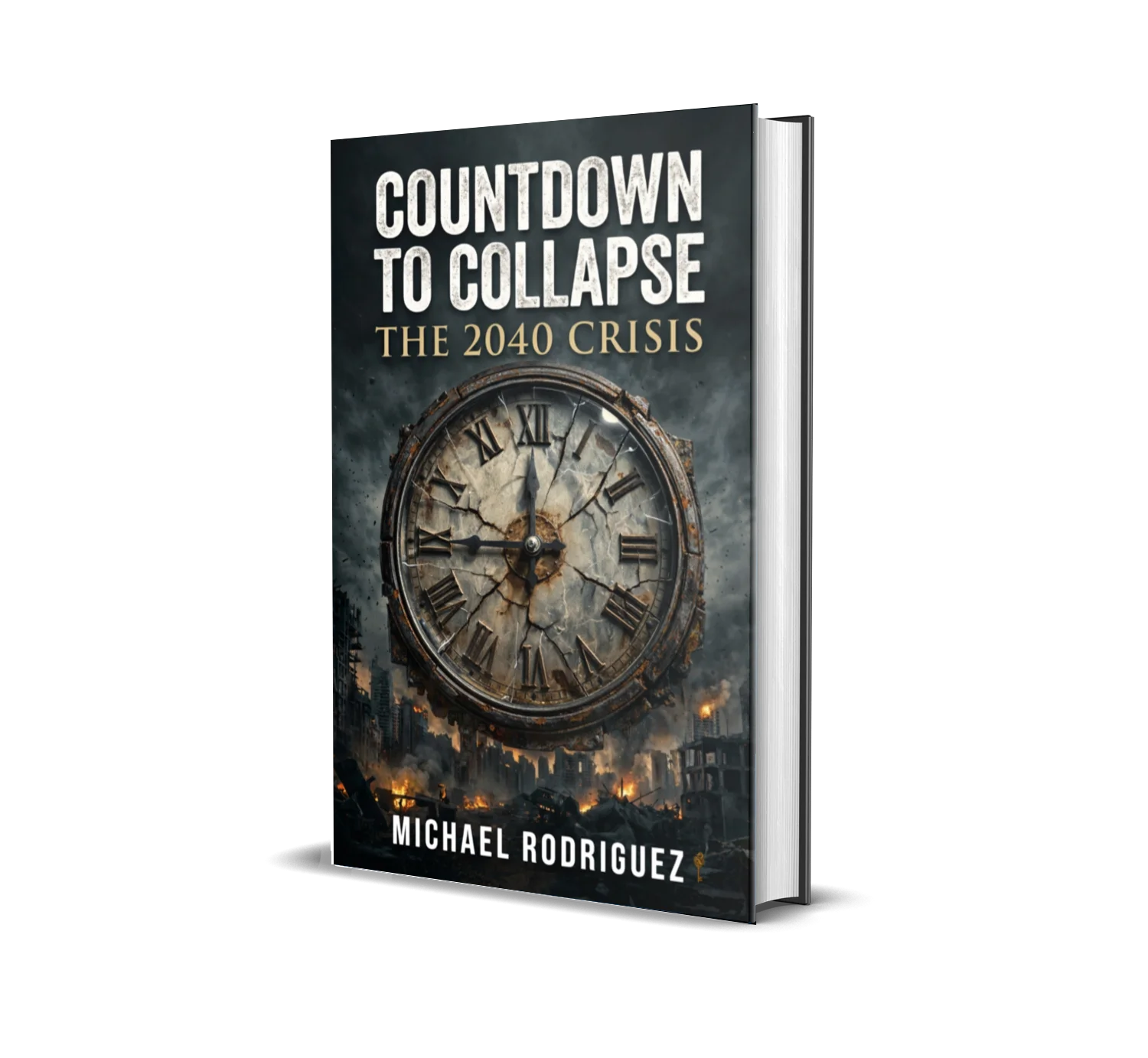
Libraries: OverDrive, Hoopla, BorrowBox
📘 ISBN: 9798233347986 (Hardcover) | 9798233521980 (eBook)
Published: March 2026 | Resource Economics Press
---About this Investigation: This FAQ draws from the research behind Countdown to Collapse: The 2040 Crisis, including analysis of the original World3 model data, Gaya Herrington's 2021 KPMG validation study, and cross-referencing with UN, World Bank, and NOAA datasets spanning five decades.
Share This Article
📚 Related Articles
📕 Related Books
Subscribe to Newsletter
Get updates on new books, exclusive content, and free chapters from Michael Rodriguez.