The PayPal Mafia
Silicon Valley’s Secret Power Brokers
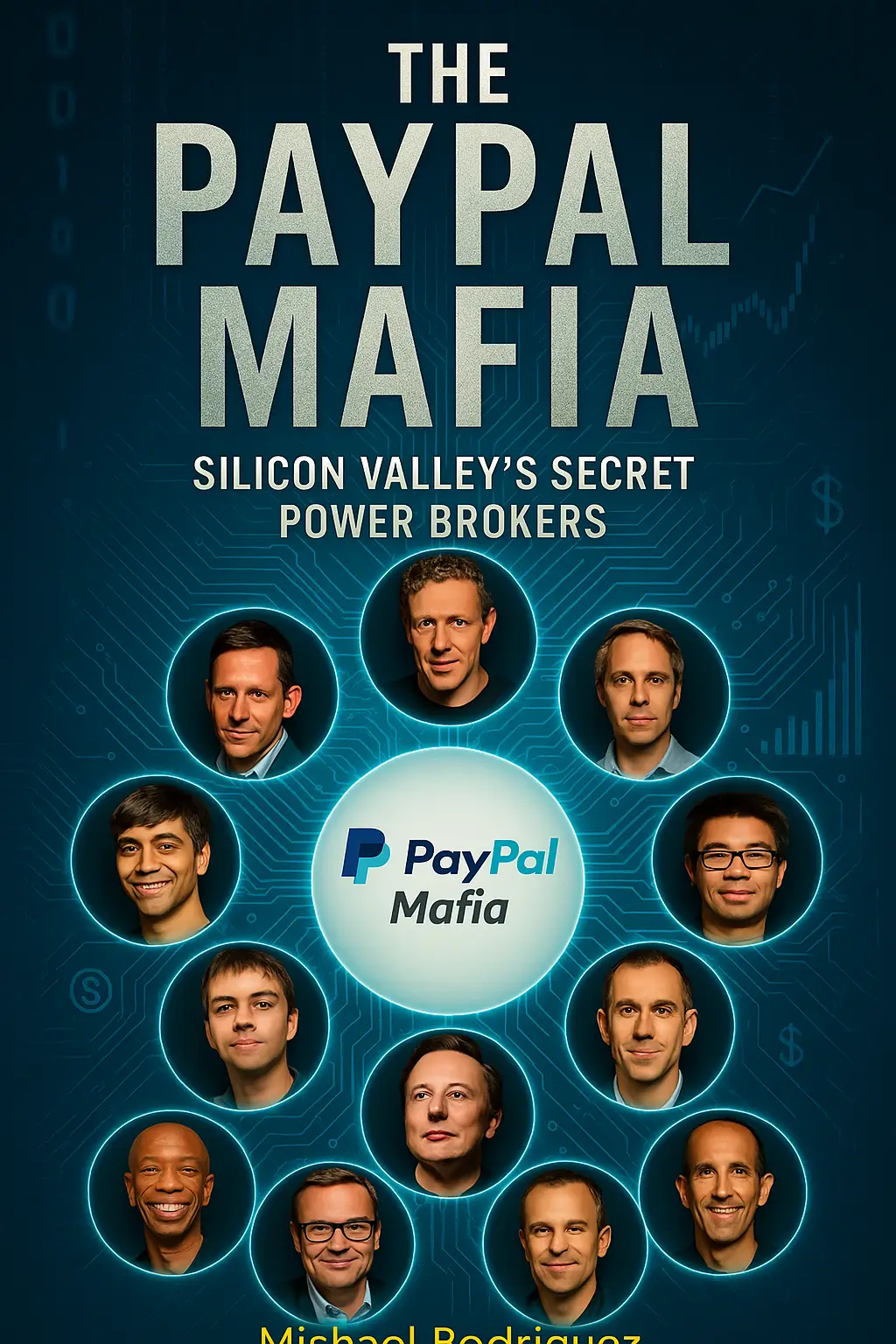
By Michael Rodriguez
First edition: January 2025 Published by Resource Economics Press New York • London • Singapore
ISBN: 9798230937104 (eBook)
About the Book
In November 2007, Fortune magazine ran a cover image that would later become canonical: thirteen men in tracksuits, gold chains, and unlit cigars, posed inside a San Francisco gentleman’s club. The caption was a joke — Meet the PayPal Mafia — but the underlying claim turned out to be the most under-reported organizational story in modern Silicon Valley. The men in that photograph, plus another dozen who didn’t make the shoot, would go on to found or seed-fund Tesla, SpaceX, Palantir, LinkedIn, YouTube, Yelp, Affirm, Yammer, and Founders Fund.
“The PayPal Mafia” traces how a 50-person engineering team at a payments company most users now barely remember became, over two decades, the most concentrated source of operating talent, founding capital, and political donor influence in American technology. The book reconstructs the original Confinity-X.com merger of March 2000, the post-IPO and post-eBay diaspora of 2002-2005, the Series A investments that turned PayPal stock proceeds into the early ownership of Facebook (Thiel’s $500,000 in August 2004), Tesla, and SpaceX — and the political pivot that, twenty years later, placed PayPal alumni at the center of the second Trump administration.
It draws on SEC S-1 filings (PayPal 2002, LinkedIn 2011, Facebook 2012, Palantir 2020, Affirm 2021), FEC donor records, Founders Fund and Sequoia portfolio histories, Sebastian Mallaby’s “The Power Law” (2022), and the on-the-record interviews these founders have given over twenty years to Fortune, Forbes, Wired, and The All-In Podcast.
What You’ll Discover
📸 The 2007 Fortune Photograph
The full context of the cover shoot — who was in the picture, who was deliberately excluded, and why the “mafia” framing was a joke that no one ever managed to walk back.
💸 Confinity, X.com, and the March 2000 Merger
How Peter Thiel and Max Levchin’s cryptography startup met Elon Musk’s online bank, why the merger nearly fell apart, and the boardroom coup of September 2000 that ended with Musk on a flight to Australia and Thiel as CEO.
🛒 The eBay Acquisition and the $1.5 Billion Diaspora
What the October 2002 sale to eBay actually paid out, who left within 18 months, and the early-stage check-writing pattern that turned PayPal stock into seed capital for Tesla, LinkedIn, YouTube, and Yelp.
🛰️ SpaceX, Tesla, and the Concentration Bet
Musk’s allocation of his PayPal proceeds — $100 million to SpaceX (2002), $70 million across the early Tesla rounds beginning 2004, and the structural decisions that left him personally on the hook through both companies’ near-bankruptcies in 2008.
🛡️ Palantir, In-Q-Tel, and the Intelligence Pipeline
Palantir’s 2003 founding with $2 million in In-Q-Tel seed money (the CIA’s venture arm), the DOD contracts that grew through the 2010s, and the September 2020 direct listing on NYSE at a $20+ billion valuation.
💼 Founders Fund and the Pattern of Reinvestment
The Founders Fund partnership that Thiel, Ken Howery, and Luke Nosek launched in 2005, and the recurring pattern of PayPal alumni leading or co-leading rounds at one another’s later companies.
🇺🇸 Vance, Masters, and the 2024 Pivot
The political donation timeline from 2016 onward, the founding of Anduril (Palmer Luckey, Trae Stephens — Thiel’s right hand at Founders Fund), and the Sacks-Musk-Thiel triangle inside the second Trump administration.
Key Revelations
- November 13, 2007 — Fortune’s “PayPal Mafia” cover story by Jeffrey M. O’Brien, the article that crystallized the term.
- December 1998 — Confinity founded by Peter Thiel, Max Levchin, and Luke Nosek; original product was Palm Pilot cryptography.
- March 2000 — Confinity merges with Elon Musk’s X.com; combined company renamed PayPal in 2001.
- October 3, 2002 — eBay acquires PayPal for approximately $1.5 billion in stock.
- August 2004 — Peter Thiel makes the $500,000 angel investment in Facebook that becomes the founding outside check, valuing Facebook at $4.9 million.
- 2003 — Palantir founded; receives ~$2 million seed from In-Q-Tel, the Central Intelligence Agency’s venture arm.
- June 13, 2016 — Microsoft announces acquisition of LinkedIn for $26.2 billion in cash.
- October 9, 2006 — Google announces acquisition of YouTube for $1.65 billion in stock; YouTube was founded by PayPal alumni Steve Chen, Chad Hurley, and Jawed Karim.
- September 30, 2020 — Palantir direct-lists on NYSE under ticker PLTR; first-day market cap roughly $21 billion.
- 2022 Senate cycle — Peter Thiel donates approximately $15 million to JD Vance (Ohio) and another $15 million to Blake Masters (Arizona), at the time the largest individual contributions to single Senate races in US history.
Fact-Check: Key Claims Verified
The PayPal Mafia is investigative nonfiction. Every central claim is drawn from SEC filings, FEC donor records, contemporaneous business reporting in Fortune, Forbes, Wired, and the Wall Street Journal, the founders’ own published memoirs and interviews, and academic histories of the venture capital industry.
| Claim | Status | Verified Source |
|---|---|---|
| The Fortune "PayPal Mafia" cover ran November 13, 2007 | ✅ Confirmed | Fortune Magazine archives; Robin Twomey photograph credit |
| eBay acquired PayPal for ~$1.5 billion in stock, closing October 3, 2002 | ✅ Confirmed | eBay 8-K filing (October 2002); SEC EDGAR; press releases |
| Peter Thiel's $500,000 angel check into Facebook in August 2004 | ✅ Confirmed | Facebook S-1 (February 2012); David Kirkpatrick, "The Facebook Effect" (2010) |
| Palantir received In-Q-Tel seed funding at its 2003 founding | ✅ Confirmed | Palantir S-1 (August 2020); CIA In-Q-Tel public portfolio |
| Microsoft-LinkedIn acquisition, $26.2 billion, announced June 13, 2016 | ✅ Confirmed | Microsoft 8-K filing; LinkedIn proxy statement; Reuters |
| Google-YouTube acquisition, $1.65 billion in stock, announced October 9, 2006 | ✅ Confirmed | Google 8-K filing; YouTube founders' SEC disclosures |
| Thiel donated ~$15 million to JD Vance's 2022 Senate campaign | ✅ Confirmed | FEC filings, Protect Ohio Values PAC; OpenSecrets |
| Confinity founded December 1998 by Thiel, Levchin, and Nosek | ✅ Confirmed | PayPal S-1 filing (2002); Eric M. Jackson, "The PayPal Wars" (2004) |
About the Author
Michael Rodriguez is an investigative nonfiction author who covers Silicon Valley operating networks, venture capital structure, and the intersection of technology and political power. For The PayPal Mafia, he worked from the original PayPal S-1 filing (2002), the LinkedIn (2011), Facebook (2012), Palantir (2020), and Affirm (2021) IPO disclosures, FEC contribution records via the Center for Responsive Politics, Sebastian Mallaby’s history of the venture capital industry “The Power Law” (2022), Eric M. Jackson’s first-person account “The PayPal Wars” (2004), and twenty years of on-the-record interviews these founders have given to Fortune, Forbes, Wired, and the All-In and Acquired podcasts.
His methodology combines forensic reading of SEC filings (S-1 sections on principal stockholders and related-party transactions are particularly load-bearing), FEC donor-network mapping, and reconstruction of cap tables across the eight major companies the network seeded — to argue that the PayPal alumni are best understood not as a “mafia” but as a small, durable partnership that has compounded operational capital across two decades and is now compounding political capital as well.
Rodriguez is the author of several investigations in this series, available at michaelrodriguezbooks.com.