Countdown to Collapse: The 2040 Crisis
By Michael Rodriguez
First Edition, 2026
Published by Resource Economics Press
New York • London • Singapore
ISBN: 9798233347986 (Hardcover)
ISBN: 9798233521980 (eBook)
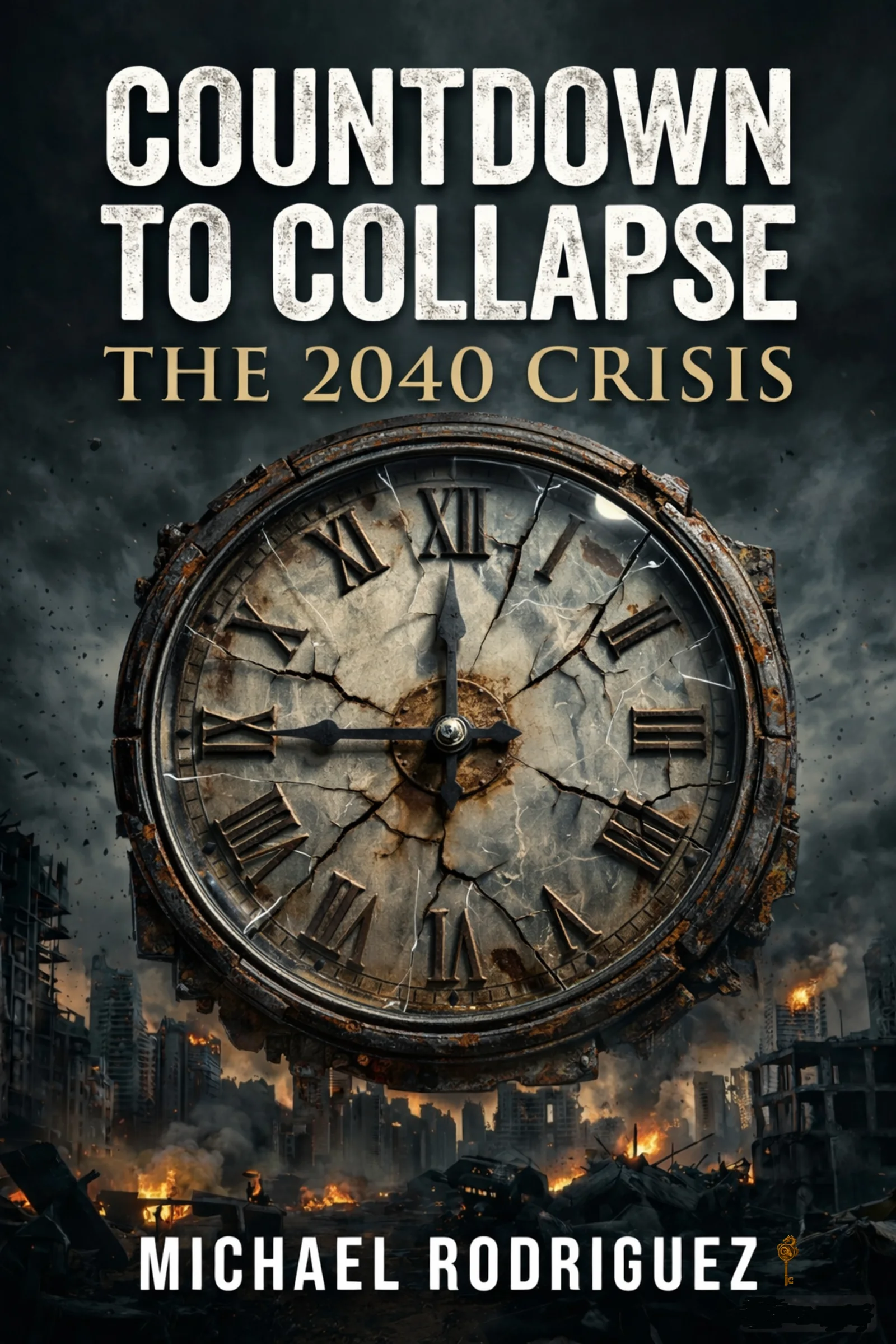
About the Book
In 1972, seventeen MIT scientists fed every data point they could find into a computer the size of a room. Population growth. Industrial output. Food production. Pollution levels. Natural resource reserves. They pressed run and waited.
The machine told them civilization would begin collapsing around 2040.
Nobody listened. The oil companies called it nonsense. Economists dismissed it as doom-mongering. Politicians filed it away and never looked back.
Then in 2021, a KPMG analyst named Gaya Herrington pulled fifty years of real-world data and ran the numbers again. Her conclusion made her career — and should have terrified everyone who read it: the original model wasn’t just close. It was tracking almost perfectly with the worst-case scenario.
Rodriguez spent a year following the data trail from that 1972 mainframe to today’s collapsing aquifers, aging populations, and fracturing supply chains. He interviewed systems dynamics researchers, dug through declassified resource assessments, and mapped the connections between China’s demographic cliff, the American Southwest’s water wars, and the 2022 global fertilizer crisis that most people have already forgotten.
What he found isn’t a prediction. It’s a pattern — and the pattern says we’re running out of road.
What You’ll Discover
⏳ The Model That Saw Everything Coming
How seventeen MIT scientists built World3 — a computer simulation that predicted population overshoot, resource depletion, and economic contraction decades before the data confirmed it. Why the Club of Rome’s warning was buried — and why it matters now more than ever.
📉 The KPMG Analyst Who Proved Them Right
Gaya Herrington’s 2021 study compared fifty years of real-world data against the original scenarios. Her findings: we’re tracking the “Business As Usual 2” path — the one that leads to declining food production and economic contraction starting in the 2030s.
🏛️ Why Civilizations Collapse (And Never See It Coming)
From the Bronze Age Collapse to the fall of Rome, from Easter Island to the Maya — the recurring pattern of overshoot, complexity, and sudden failure. What history’s dead civilizations tell us about our own.
🔬 Three Futures: Technology, Degrowth, or Collapse
The three scenarios from the original model — Comprehensive Technology, Stabilized World, and Business As Usual — examined against current evidence. Which path are we actually on, and can we still switch tracks?
🌍 The Crises Already Unfolding
China’s demographic cliff. The Colorado River running dry. The 2022 fertilizer shortage that nearly starved millions. The interconnected cascade of failures that transforms local problems into global catastrophe.
🛠️ What Could Still Save Us — And What You Can Do
Concrete policy changes, technological breakthroughs, and personal actions that could alter the trajectory. Denmark’s energy revolution. Rwanda’s plastic ban. The five key policies that systems modelers say would actually work.
Key Revelations
- The World3 model’s “standard run” predicted peak industrial output around 2020 and declining food production by the 2030s — both trends are now visible in real data
- Gaya Herrington’s KPMG validation found that Business As Usual 2 — the scenario ending in civilizational decline — fits the observed data better than any optimistic scenario
- The 2022 global fertilizer crisis was not an anomaly — it was a preview of the food system vulnerabilities the model predicted fifty years ago
- China’s population peaked in 2022 and is projected to halve by 2100, triggering the demographic cascade the model warned about
- The American Southwest’s water crisis, European heatwaves, and global supply chain disruptions aren’t separate problems — they’re interconnected symptoms of overshoot
- Technological solutions alone cannot prevent decline unless deployed alongside deliberate resource management and economic restructuring
This isn’t apocalypse fiction. This is mathematics, validated by fifty years of data, written for anyone who wants to understand what’s actually happening — and what choices remain.
About the Author
Michael Rodriguez is an independent researcher and nonfiction writer specializing in economic systems, civilizational risk, and the intersection of technology and sustainability. His previous works include the internationally acclaimed Dark Money Empire, along with The Rigged Game, The Dopamine Dealers, Bilderberg Exposed, The AI Emperor, and Digital Dollar Dystopia.
For Countdown to Collapse, Rodriguez spent a year tracing the data trail from the Club of Rome’s original 1972 study through Gaya Herrington’s 2021 KPMG validation, combining systems dynamics research with demographic analysis, resource depletion data, and on-the-ground reporting from climate-stressed regions.
His investigative methodology combines academic research with forensic analysis and accessible storytelling, making complex systems understandable to general readers while maintaining analytical rigor.
Get Your Copy Today
Libraries & Digital Collections
Available through OverDrive, Hoopla, and BorrowBox at participating libraries. Contact your local library to request digital access.
Share This Book
Subscribe to Newsletter
Stay informed about Rodriguez’s latest investigations and upcoming books:
Get Exclusive Updates
Join thousands of readers receiving exclusive analysis on civilizational risk, economic systems, and the hidden forces shaping our future.
Subscribe Now