Digital Dollar Dystopia
How CBDCs Will End Financial Freedom
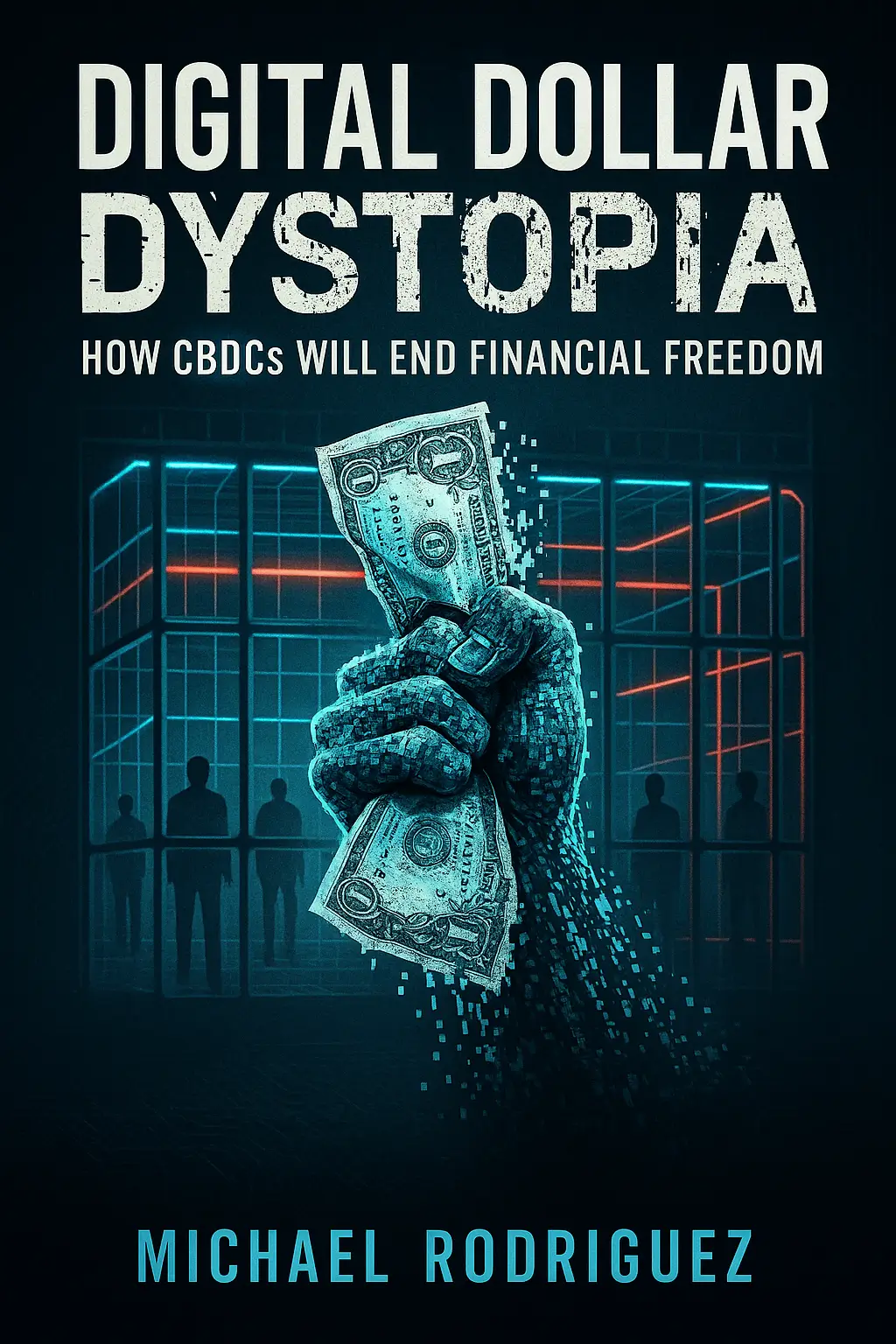
By Michael Rodriguez
First edition: May 2025 Published by Resource Economics Press New York • London • Singapore
ISBN: 9798231699490 (eBook)
About the Book
On October 20, 2020, the Central Bank of the Bahamas launched the Sand Dollar — the world’s first fully deployed central bank digital currency. Two years later, the Atlantic Council’s CBDC Tracker counted 35 countries actively exploring digital currencies. By 2024 the figure had reached 134 countries representing 98% of global GDP. The most consequential rollout has been quiet: the People’s Bank of China’s e-CNY, which moved from a four-city pilot in April 2020 to over 260 million provisioned wallets and approximately 7 trillion yuan in cumulative transaction volume by mid-2024.
“Digital Dollar Dystopia” is an account of what these systems actually do — separating the central bank marketing materials (“controlled anonymity,” “financial inclusion,” “payment efficiency”) from the operational architecture revealed in the BIS papers, the Project Hamilton technical report from MIT and the Boston Fed, and the European Central Bank’s digital euro Investigation Phase documents. The book argues that the question is no longer whether CBDCs will be built — they are being built, at scale — but what programmability features are designed into them and which entities hold the keys to those features.
It covers China’s e-CNY pilot expansion, the Bahamas, Nigeria, and Jamaica live deployments, Sweden’s e-krona pilot at the Riksbank, the ECB’s digital euro architecture as it was published in October 2023, the Federal Reserve’s Project Hamilton conclusions from February 2022, the BIS Innovation Hub’s Project mBridge cross-border settlement platform that reached minimum viable product status in June 2024, and the US state-level CBDC bans starting with Florida’s HB 7049 in May 2023.
It draws on the BIS quarterly papers on CBDC design, the Atlantic Council CBDC Tracker dataset, the People’s Bank of China e-CNY White Paper (July 2021), the ECB’s published digital euro design choices, the Project Hamilton final report (Boston Fed & MIT DCI, February 2022), Florida HB 7049 statutory text, and the Federal Reserve’s Money and Payments discussion paper (January 2022).
What You’ll Discover
🏖️ October 2020 — Bahamas Sand Dollar
The world’s first live retail CBDC, the Central Bank of the Bahamas technical architecture, and what the first three years of usage data actually show about adoption.
🇨🇳 China’s e-CNY: From Pilot to Scale
The April 2020 four-city pilot (Shenzhen, Suzhou, Xiongan, Chengdu), the 2022 expansion to 23 cities, the 260+ million provisioned wallets, and the “controlled anonymity” model that lets the PBOC see every transaction.
🇪🇺 The Digital Euro Investigation Phase
The October 2023 ECB design report, the privacy thresholds for online versus offline payments, the proposed €3,000 holding limit, and the European Parliament’s amendments to the draft legislation.
🇺🇸 Project Hamilton and the Federal Reserve
The February 2022 Boston Fed + MIT Digital Currency Initiative technical report demonstrating two CBDC architectures capable of 1.7 million transactions per second — and the conclusion that the technology is solved while the policy is not.
🌉 BIS Project mBridge — Cross-Border CBDC
The China-Hong Kong-Thailand-UAE-Saudi Arabia settlement platform, the June 2024 minimum-viable-product milestone, and the structural challenge to SWIFT and dollar correspondent banking.
⚖️ Florida HB 7049 and the State Pushback
The May 12, 2023 Florida statute that amended UCC §9-102 and §1-201 to exclude CBDCs from the definition of “money” — and the roughly twenty US states that have introduced parallel legislation.
🔐 The Programmability Question
What programmable money can actually do — expiry dates (tested in the Suzhou pilot), purchase-category restrictions, geographic limits, sanctions enforcement at the protocol level — and which of these features appear in the published design documents.
Key Revelations
- October 20, 2020 — Central Bank of the Bahamas launches the Sand Dollar, the world’s first nationwide live CBDC.
- April 2020 — People’s Bank of China begins e-CNY pilots in Shenzhen, Suzhou, Xiongan, and Chengdu; expands to 23 cities by 2022.
- 134 countries — Atlantic Council CBDC Tracker count as of 2024, up from 35 in May 2020.
- ~7 trillion yuan — cumulative e-CNY transaction volume reported by the PBOC through mid-2024.
- October 25, 2021 — Nigeria launches the eNaira; first-year adoption among the lowest of any major payment system rollout.
- February 2022 — Project Hamilton final report (Boston Fed + MIT DCI) demonstrates a two-tier CBDC architecture capable of 1.7M transactions per second with finality under two seconds.
- October 18, 2023 — ECB publishes “A Stocktake on the Digital Euro,” moving from investigation to preparation phase.
- May 12, 2023 — Florida HB 7049 signed by Governor DeSantis, amending UCC definitions to exclude CBDCs from “money.”
- June 5, 2024 — BIS Innovation Hub announces Project mBridge has reached “minimum viable product” status with five participating central banks.
- May 23, 2024 — US House passes H.R. 5403, the CBDC Anti-Surveillance State Act, prohibiting the Federal Reserve from issuing a retail CBDC.
Fact-Check: Key Claims Verified
Digital Dollar Dystopia is investigative nonfiction. Every central claim is drawn from primary central bank publications (the e-CNY White Paper, the ECB digital euro design reports, the Project Hamilton technical report), the Atlantic Council CBDC Tracker dataset, statutory texts of US state-level CBDC legislation, and the BIS Quarterly Review papers on CBDC design.
| Claim | Status | Verified Source |
|---|---|---|
| Bahamas Sand Dollar launched October 20, 2020 | ✅ Confirmed | Central Bank of the Bahamas press release; IMF Country Report No. 21/249 |
| 134 countries exploring CBDCs as of 2024, up from 35 in May 2020 | ✅ Confirmed | Atlantic Council CBDC Tracker; BIS Working Paper No. 1147 (2023) |
| China's e-CNY pilots began in four cities in April 2020 | ✅ Confirmed | People's Bank of China e-CNY White Paper (July 2021); Xinhua coverage |
| Nigeria eNaira launched October 25, 2021, first African retail CBDC | ✅ Confirmed | Central Bank of Nigeria announcement; IMF Working Paper WP/23/104 |
| Project Hamilton report published February 2022; 1.7M tps demonstrated | ✅ Confirmed | Boston Fed + MIT Digital Currency Initiative joint report (February 3, 2022) |
| Florida HB 7049 signed May 12, 2023, amending UCC to exclude CBDCs | ✅ Confirmed | Florida Legislature; FL Statute Chapter 671 (UCC General Provisions) amendments |
| BIS Project mBridge reached MVP status June 5, 2024 | ✅ Confirmed | BIS Innovation Hub press release; mBridge consortium announcements |
| H.R. 5403 (CBDC Anti-Surveillance State Act) passed the House May 23, 2024 | ✅ Confirmed | US House Roll Call Vote No. 230 (118th Congress, 2nd session) |
About the Author
Michael Rodriguez is an investigative nonfiction author who covers monetary infrastructure, payment systems, and the political economy of financial surveillance. For Digital Dollar Dystopia, he worked from the People’s Bank of China e-CNY White Paper (July 2021), the European Central Bank’s digital euro Investigation Phase reports (October 2023), the Federal Reserve’s Money and Payments discussion paper (January 2022), the Project Hamilton final technical report from the Boston Fed and MIT Digital Currency Initiative (February 2022), the Bank for International Settlements Innovation Hub publications on Project mBridge, the Atlantic Council’s CBDC Tracker dataset (Q3 2024 update), the statutory texts of Florida HB 7049 and the federal CBDC Anti-Surveillance State Act, and live retail CBDC implementation reports from the Central Bank of the Bahamas and the Central Bank of Nigeria.
His methodology combines technical reading of CBDC architecture documents (focusing on programmability features, identity layer design, and central-bank operator privileges), comparative analysis across the three live retail CBDCs and the eight major pilots, and legislative tracking of the state-level and federal pushback in the US. The book argues that the policy question is no longer whether CBDCs will exist — they exist — but what surveillance and programmability features the issuing central banks build into the protocol layer, and whether those features can be turned off once installed.
Rodriguez is the author of several investigations in this series, available at michaelrodriguezbooks.com.
Get Your Copy Today
Share This Book
Uncover the Hidden Economics of Power
Stay Ahead of Digital Currency Developments
Join thousands of readers who receive exclusive analysis on CBDCs, financial surveillance, and protecting your economic freedom.