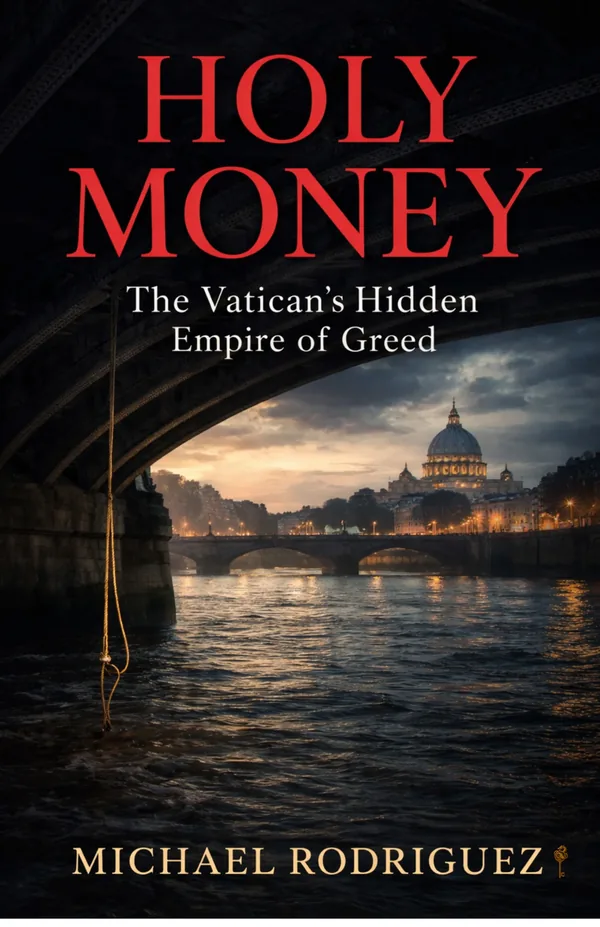
Holy Money: The Vatican’s Hidden Empire of Greed
By Michael Rodriguez
First Edition, April 2026 Published by Resource Economics Press New York • London
ISBN: 9798235823143 (Hardcover) ISBN: 9798235034396 (eBook)
About the Book
On the morning of June 18, 1982, a postal worker crossing Blackfriars Bridge in London spotted something hanging from the scaffolding beneath the arch. A man — middle-aged, well-dressed — swung in the river breeze with twelve pounds of bricks stuffed into his trouser pockets and £15,000 in cash distributed across his suit. His name was Roberto Calvi. He was chairman of Italy’s largest private bank. The Vatican Bank was his biggest client.
Holy Money: The Vatican’s Hidden Empire of Greed is the definitive account of how the Catholic Church built, weaponized, and — perhaps — is finally reforming the most secretive financial institution in the Western world.
Beginning with Napoleon’s seizure of Rome in 1798 and the Vatican’s desperate turn to the Rothschild banking dynasty, Michael Rodriguez traces the arc of Vatican finance through two centuries of scandal, secrecy, and institutional self-preservation. From the financial genius who turned Mussolini’s cash settlement into a global investment empire, to the Archbishop from Al Capone’s Chicago suburb who ran the Vatican Bank like a private fiefdom, to the Mafia-connected financier who died of cyanide-laced coffee in an Italian prison — Holy Money is a character-driven investigation that reads like a financial thriller.
Because the truth is stranger than any fiction.
Drawing on court records, declassified CIA and Counter Intelligence Corps documents, MONEYVAL assessments, and Vatican financial reports, Rodriguez reveals not just what happened inside the Vatican Bank, but why it keeps happening — and what it means for the 1.4 billion Catholics who fund the machine with their donations.
This is not a conspiracy theory. This is the documented record.
What You’ll Discover
⛪ The Body Under the Bridge
Roberto Calvi — God’s Banker — found hanging beneath Blackfriars Bridge with twelve pounds of bricks and £15,000 in three currencies. No rust or paint residue on his shoes consistent with the scaffolding. A forged passport in his pocket. Five people eventually charged with his murder in Italy. All acquitted for lack of evidence. The investigation that followed exposed the Vatican’s deepest financial secrets.
🏦 The Rothschild Rescue
How Napoleon’s 1798 invasion bankrupted the papacy — and forced the most anti-Semitic institution in Europe to borrow its survival from the most famous Jewish banking dynasty in history. The arrangement that introduced the Vatican to modern finance and planted the seeds of its financial empire.
💼 The Invisible Empire
Bernardino Nogara — an obscure Italian mining engineer — transformed Mussolini’s 1929 Lateran Treaty payment into a global investment machine. He operated with one condition: absolute secrecy, no religious constraints on investment. By the time of his death, he had built the Vatican into a major shareholder in Italian industry, insurance, and real estate — and founded the institution that would become the IOR.
🎭 The Unholy Alliance
Michele Sindona laundered money for the Sicilian Mafia before becoming the Vatican’s trusted financial advisor. Archbishop Paul Marcinkus, the hulking Chicagoan, ran the Vatican Bank for twenty years while wanted by Italian prosecutors. Roberto Calvi built a network of Bahamas shell companies that connected the Vatican, the secret Masonic lodge P2, and organized crime — until the entire machine collapsed in a $1.3 billion disaster.
⚖️ The Price of Silence
The global clergy abuse crisis cost the Catholic Church over $4 billion in settlements — funded by the same secrecy culture that enabled the financial crimes. In December 2023, Cardinal Angelo Becciu became the first Vatican cardinal in history to be tried and convicted by a Vatican civil court, sentenced to 5 years and 6 months in prison for embezzlement. Pope Francis’s ambitious reform agenda — audits, account closures, a historic criminal trial — confronts an institution structurally resistant to change.
🔮 The Algorithm of Silence
Today’s Vatican Bank is substantially more compliant than it was in the Marcinkus era. MONEYVAL assessments show real progress. But structural contradictions remain: sovereign immunity, opacity, a culture of institutional self-preservation. And new threats — cryptocurrency, digital finance, decentralized shadow banking — may offer exactly the kind of plausible deniability that the old system relied on.
Key Revelations
-
The Vatican Bank (IOR) operated for most of its history with no published financial reports, no taxes paid, no external regulator — and by internal policy, destroyed its records every ten years. When MONEYVAL first assessed the Vatican in 2012, investigators described the Holy See’s anti-money-laundering framework as “largely non-compliant.”
-
Michele Sindona — the Vatican’s trusted financial advisor who managed billions in Church assets — was later revealed to have laundered Sicilian Mafia drug money, ordered the murder of his bankruptcy liquidator Giorgio Ambrosoli, and faked his own kidnapping to avoid extradition. He died in 1986 from cyanide-laced coffee delivered in his Italian prison cell; the source was never conclusively identified.
-
Archbishop Paul Marcinkus ran the Vatican Bank for twenty-two years while Italian magistrates sought him for questioning in the Banco Ambrosiano collapse — Italy’s largest bank failure, costing $1.3 billion and implicating the IOR as a major shareholder in Calvi’s fraudulent network. He retired to Arizona under diplomatic immunity and died in 2006 without ever testifying.
-
Forensic analysis of Roberto Calvi’s 2002 reinvestigation found no rust or paint residue on his shoes consistent with the scaffolding poles — ruling out self-hanging. Investigators concluded the physics of the scene ruled out suicide. The case remains officially unsolved.
-
Bernardino Nogara negotiated a single condition before taking over Vatican finances in 1929: he would operate free of any religious constraints on investment. The Vatican agreed. Within two decades, the Church held significant stakes in Italian real estate, insurance, chemicals, and textiles — an empire built on the $92 million settlement that Mussolini paid to end the Roman Question.
-
The global clergy abuse crisis cost dioceses worldwide over $4 billion in settlements between 1950 and 2020 — a financial catastrophe funded not by insurance alone, but by the sale of church properties, school closures, and the liquidation of endowments built over generations by ordinary parishioners.
Fact-Check: Key Claims Verified
Holy Money is investigative nonfiction. Every central claim is drawn from court records, tribunal verdicts, declassified intelligence documents, and official financial assessments. The table below provides an independent verification of the book’s major factual assertions.
| Claim | Status | Verified Source |
|---|---|---|
| Roberto Calvi found hanging beneath Blackfriars Bridge on June 18, 1982 | ✅ Confirmed | City of London Police; Italian prosecutor filings; BBC archive |
| Calvi's pockets contained bricks and £15,000 in mixed currencies | ✅ Confirmed | Forensic Access Ltd. reinvestigation (Prof. Angela Gallop); NBC News (2005) |
| Calvi carried a forged passport at time of death | ✅ Confirmed | Metropolitan Police discovery; Crime & Investigation UK; Italian court records |
| Forensic reinvestigation found no rust or paint on Calvi's shoes consistent with the scaffolding poles | ✅ Confirmed | Forensic Access Ltd.; expert testimony, Rome trial (2005–2007) |
| Five defendants tried for Calvi's murder in Rome (2005–2007); all acquitted | ✅ Confirmed | Rome tribunal verdict, 2007; Compact Histories; Murder Map |
| Cardinal Angelo Becciu convicted December 16, 2023 — first cardinal tried and convicted by a Vatican civil court in history | ✅ Confirmed | Vatican City State tribunal; Catholic News Service; America Magazine |
| Becciu sentenced to 5 years and 6 months in prison for embezzlement and aggravated fraud | ✅ Confirmed | Vatican City State court verdict; Angelus News; Catholic Review |
| Becciu trial: 86 sessions, 69 witnesses, 600+ hours of testimony | ✅ Confirmed | Vatican tribunal official record; America Magazine; Diocese of Scranton |
| Vatican investment in London Chelsea property lost up to $200 million | ✅ Confirmed | Vatican tribunal findings, December 2023; CBS News |
| Vatican tribunal ordered confiscation of ~$181 million and $218 million in damages from convicted defendants | ✅ Confirmed | Catholic News Service; Diocese of Scranton report |
About the Author
Michael Rodriguez is an investigative nonfiction author specializing in the hidden financial systems that shape global power. His work exposes the intersection of institutional authority, secrecy, and corruption — from sovereign states to multinational corporations. Rodriguez draws on court records, declassified documents, and original research to reveal the stories that powerful institutions prefer to keep buried. His previous investigations include books on shadow banking networks, corporate financial fraud, and the hidden economics of geopolitical power. He is the author of several investigative books available at michaelrodriguezbooks.com.
Get Your Copy Today
Share This Book
Subscribe to Newsletter
Stay informed about Rodriguez’s latest investigations and upcoming books:
Get Exclusive Updates
Join thousands of readers receiving exclusive analysis on financial crime, institutional corruption, and the hidden forces shaping global power.
Subscribe Now