The BlackRock Empire
How a Financial Giant Controls the Global Economy
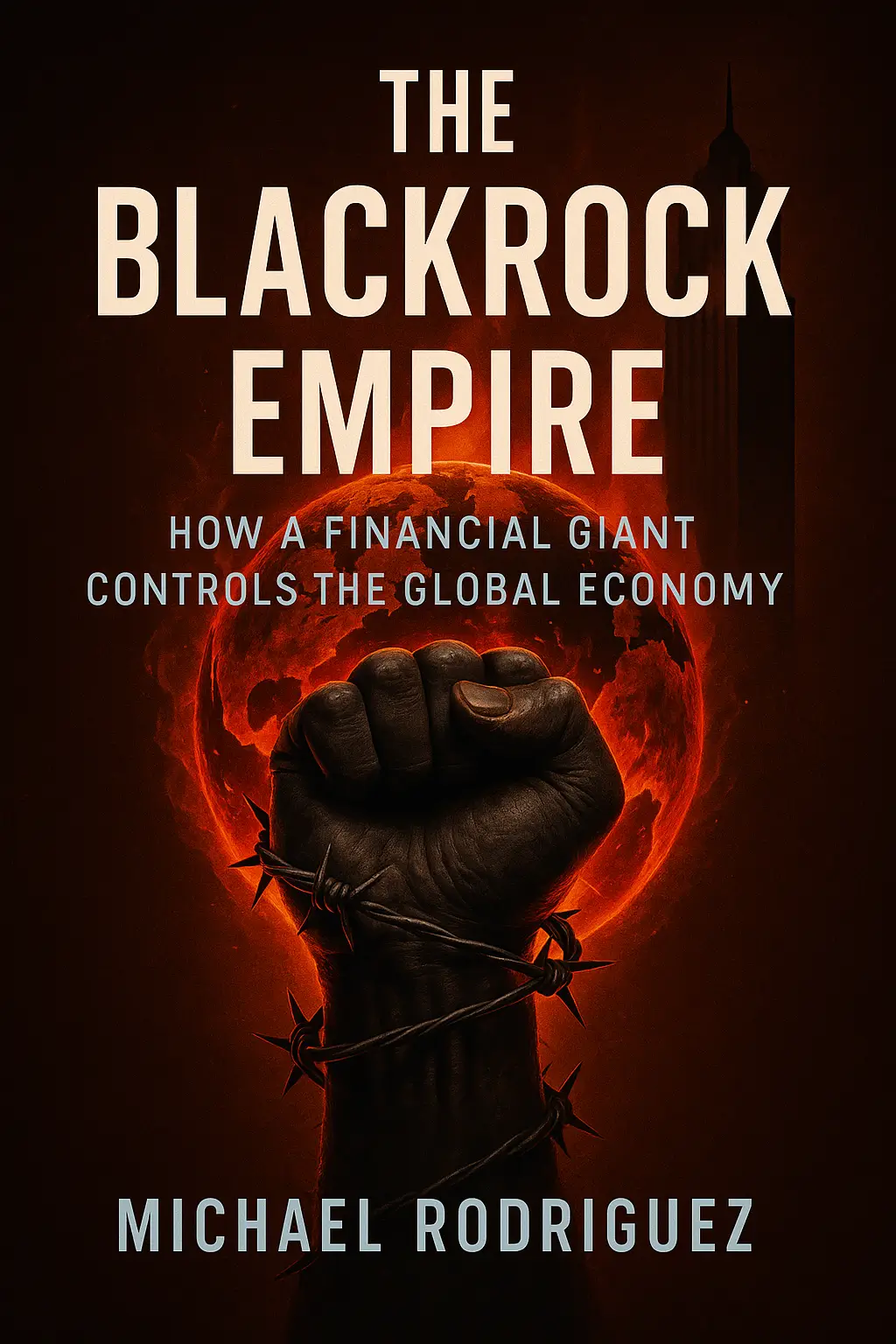
By Michael Rodriguez
First edition: April 2025 Published by Resource Economics Press New York • London • Singapore
ISBN: 9798230158646 (Hardcover) ISBN: 9798227106384 (eBook)
About the Book
In 1986, a 33-year-old Larry Fink lost approximately $100 million for First Boston after a single misjudged interest-rate hedge. He was effectively forced out. Two years later he co-founded a small bond shop on a single floor of Blackstone’s office. Forty years on, that shop manages more capital than the gross domestic product of every nation on Earth except two — and quietly owns voting stakes in nearly every public company an ordinary investor has ever heard of.
“The BlackRock Empire” traces how Larry Fink, Robert Kapito, Susan Wagner, Barbara Novick, Ben Golub, Ralph Schlosstein, Hugh Frater, and Keith Anderson built that machine — starting with the bond-pricing models nobody else could build, acquiring iShares from Barclays in the 2009 fire sale that gave them the ETF business outright, and embedding the Aladdin platform so deeply into the financial system that the firm’s own competitors, pension funds, and central banks now license it.
This is an investigation, not a panegyric. It draws on SEC 10-K and 10-Q filings, 13F quarterly holdings reports, Federal Reserve contract disclosures from the Maiden Lane and COVID-19 facilities, Larry Fink’s annual shareholder letters from 2012 onward, House Financial Services Committee testimony, and the academic literature on common ownership and proxy power. It does not argue that BlackRock is a conspiracy. It argues something more disturbing: that BlackRock is exactly what it appears to be — a publicly listed company doing legal business at a scale the regulatory framework was never designed to contain.
What You’ll Discover
💸 The $100 Million Loss That Built an Empire
How Fink’s career-ending hedge mistake at First Boston in 1986 became the founding obsession behind BlackRock’s risk-management business — and why every later acquisition traces back to that single trade.
🏛️ The 2009 Acquisition That Changed Everything
The $13.5 billion purchase of Barclays Global Investors in the depth of the financial crisis, which handed BlackRock the iShares ETF business and made it the world’s largest index manager overnight.
🤖 Aladdin: The Operating System of Global Finance
The Asset, Liability, Debt and Derivative Investment Network — what it does, who licenses it (including sovereign wealth funds and competitors), and why some regulators now treat it as systemic infrastructure rather than a private product.
🇺🇸 The Federal Reserve Contracts
Maiden Lane LLC (2008), the Term Asset-Backed Securities Loan Facility (2009), the Secondary Market Corporate Credit Facility (2020) — three separate occasions when the Fed handed crisis-era programs to a private asset manager that was also a market participant.
🗳️ The Big Three and the Proxy Vote
How BlackRock, Vanguard, and State Street between them now cast the swing vote on board elections, executive compensation, and ESG resolutions at roughly every company in the S&P 500.
🏘️ The Single-Family Rental Bet
The post-2010 thesis that institutional investors should own US single-family housing as an asset class — and what BlackRock’s actual exposure looks like once you separate the headlines from the 13F filings.
₿ Bitcoin, IBIT, and the Spot ETF
The January 2024 launch of the iShares Bitcoin Trust, the fastest ETF in history to cross $10 billion in assets, and what the filing reveals about how BlackRock thinks about asset classes it once publicly dismissed.
Key Revelations
- $100 million loss, 1986 — Fink’s interest-rate hedge miscalculation at First Boston, the proximate cause of his departure and the explicit motivation for building Aladdin two years later.
- March 1988 founding — BlackRock spun out of Blackstone with eight co-founders and a single floor of office space; Blackstone sold its stake by 1994 over a compensation dispute.
- $13.5 billion — the December 2009 price BlackRock paid Barclays for BGI, including iShares; the deal closed in 60 days and tripled BlackRock’s AUM in a single transaction.
- 2008 Maiden Lane mandate — the Federal Reserve Bank of New York selected BlackRock to manage the Bear Stearns and AIG toxic-asset vehicles in a no-bid contract.
- March 23, 2020 — the Fed appointed BlackRock to run the Secondary Market Corporate Credit Facility, which subsequently purchased iShares corporate bond ETFs as eligible securities.
- ~$20 trillion — the assets monitored on Aladdin in 2023, according to BlackRock’s own disclosures, including externally licensed clients.
- 20-25% of S&P 500 — combined Big Three (BlackRock + Vanguard + State Street) voting power, per Bebchuk and Hirst (2019) and Lazard’s annual proxy reviews.
- January 11, 2024 — IBIT (iShares Bitcoin Trust) began trading on NASDAQ and reached $10 billion AUM in 49 trading days, the fastest ETF launch on record.
- 2024 acquisitions — Global Infrastructure Partners ($12.5B) and Preqin ($3.2B), extending BlackRock’s reach into private markets and alternative-asset data infrastructure.
Fact-Check: Key Claims Verified
The BlackRock Empire is investigative nonfiction. Every central claim is drawn from SEC filings, Federal Reserve contract disclosures, BlackRock’s own annual reports and shareholder letters, congressional testimony transcripts, and peer-reviewed academic studies. The table below provides independent verification of the book’s major factual assertions.
| Claim | Status | Verified Source |
|---|---|---|
| BlackRock crossed $10 trillion AUM in Q3 2023; reached ~$11.5T by 2024 | ✅ Confirmed | BlackRock 10-K (2023, 2024); SEC EDGAR; Financial Times |
| BlackRock acquired Barclays Global Investors for $13.5 billion, closed December 2009 | ✅ Confirmed | BlackRock 8-K filing (June 11, 2009); Reuters; press releases of both firms |
| The Federal Reserve appointed BlackRock to manage Maiden Lane LLC (Bear Stearns assets) in 2008 | ✅ Confirmed | Federal Reserve Bank of New York Maiden Lane disclosures; GAO 2011 report |
| BlackRock managed the Fed's Secondary Market Corporate Credit Facility from March 2020 | ✅ Confirmed | Federal Reserve press release, March 23, 2020; BlackRock contract disclosures |
| iShares Bitcoin Trust (IBIT) launched January 11, 2024 — fastest ETF to $10B AUM | ✅ Confirmed | SEC S-1 filing; Bloomberg ETF data; CoinDesk |
| "Big Three" combined ownership of ~20-25% of S&P 500 voting power | ✅ Confirmed | Bebchuk & Hirst, "The Specter of the Giant Three" (2019); Lazard proxy review |
| BlackRock founded March 1988 as a Blackstone subsidiary with eight co-founders | ✅ Confirmed | Schwarzman, "What It Takes" (2019); BlackRock company history; Vault corporate profiles |
| BlackRock acquired Global Infrastructure Partners for $12.5 billion in 2024 | ✅ Confirmed | BlackRock press release, January 12, 2024; SEC 8-K filing |
About the Author
Michael Rodriguez is an investigative nonfiction author who covers the intersection of asset management, regulation, and political power. For The BlackRock Empire, he worked from primary documents that the firm itself files publicly but that few readers ever open: BlackRock’s annual 10-K reports, quarterly 10-Q filings, the 13F holdings reports disclosed every 45 days, Larry Fink’s annual shareholder and CEO letters from 2012 onward, Federal Reserve Bank of New York contract disclosures for the Maiden Lane vehicles and the 2020 corporate credit facilities, and transcripts of House Financial Services Committee and Senate Banking Committee hearings featuring BlackRock executives.
His methodology combines forensic reading of SEC filings, common-ownership analysis drawing on the academic literature (Bebchuk & Hirst, Azar, Schmalz), proxy-vote pattern review using ISS and Lazard data, and reconstruction of the Aladdin platform’s reach via vendor disclosures from licensee firms. The book argues less by accusation than by accumulation — laying out the public record until the scale becomes legible.
Rodriguez is the author of several investigations in this series, available at michaelrodriguezbooks.com.