Countdown to Collapse — Free Preview
Read the full Introduction below. Seventeen MIT scientists. One computer model. A fifty-year countdown that the world ignored. Subscribe below to get Chapter 1 free.
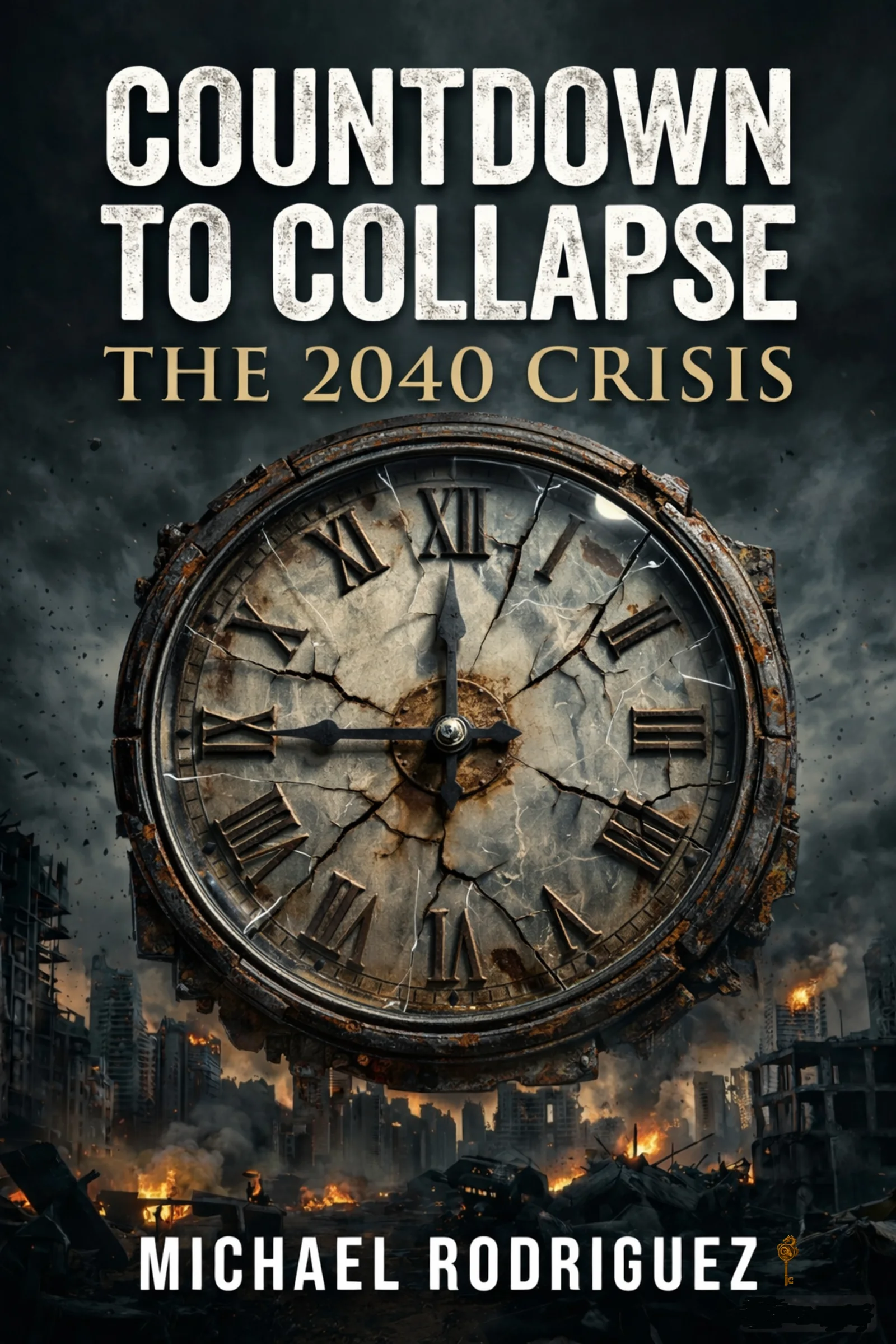
INTRODUCTION — The Clock Nobody Wanted to Read
In the basement of Building E52 at the Massachusetts Institute of Technology, sometime in the autumn of 1971, a computer the size of a small bedroom was grinding through equations that would make most economists lose sleep for the next half century. The machine was called a PDP-10. It had less computing power than the phone you’re probably holding right now. And the seventeen researchers feeding it punch cards — professors, systems dynamicists, economists, one philosopher — had been given a single question by a shadowy group of European industrialists known as the Club of Rome.
The question was simple. The answer was not.
“How long can human civilization continue to grow on a finite planet?”
They built a model. Called it World3. Fed it five variables: global population, food production per capita, industrial output per capita, persistent pollution, and non-renewable resource reserves. Then they let the simulation run forward from 1900 to 2100. What came out the other side — printed on reams of continuous-feed paper in smudged dot-matrix ink — looked like a bell curve. Civilization rising, peaking somewhere around the 2020s and 2030s, then bending downward. By 2040, the decline was unmistakable. By 2070, in the baseline scenario, it was catastrophic.
The team published their findings in 1972 under the title The Limits to Growth. It sold thirty million copies in thirty languages. And then — because this is how humans work — almost everyone decided to ignore it.
Politicians called it alarmist. Economists called it simplistic. Oil companies called it irrelevant. Julian Simon, the cornucopian economist who believed human ingenuity could overcome any resource constraint, called it “a piece of irresponsible nonsense.” The Club of Rome became a punchline at cocktail parties in Washington and Davos alike. The world moved on. Oil kept flowing. Babies kept being born. Factories kept belching. GDP kept climbing. And the World3 model gathered dust in an MIT archive, dismissed as a relic of 1970s doom-and-gloom environmentalism.
Fast forward to 2020. A woman named Gaya Herrington — not an activist, not a protester, but a sustainability analyst at KPMG, one of the Big Four accounting firms — sat down with the original World3 equations and asked a devastatingly practical question. She took fifty years of real-world data — actual population numbers, actual pollution measurements, actual industrial output figures — and overlaid them on the 1972 projections.
The curves matched.
Not perfectly, of course. Models never match reality perfectly. But the trajectory — the shape of the line, the inflection points, the timing of the peaks — lined up with disturbing precision against the scenario the original researchers had labeled “Business As Usual 2.” That was the collapse scenario. The one where industrial output peaks high, then crashes hard. The one where food production falters, pollution spirals, and the global population begins declining not because people choose to have fewer kids, but because they can’t feed the ones they already have.
Herrington published her paper in the Yale Journal of Industrial Ecology in 2021. It went viral on social media. It was covered by the BBC, the Guardian, VICE. And then — because this is still how humans work — most people scrolled past it and went back to arguing about cryptocurrency.
I’m not here to tell you the world is ending. I don’t know that. Nobody does. The World3 model is a model, not a prophecy, and models are by definition simplifications of an infinitely complex reality. What I am here to tell you is that the most rigorous, most validated, most stubbornly accurate long-range simulation of human civilization ever built is currently tracking the collapse scenario. And that the window for changing course — according to Herrington’s update — is narrowing at what she describes, with academic understatement, as “high speed.”
That should bother you. It bothers me.
I’m not an activist. I’m not a climate scientist. I read balance sheets for a living, and I’ve spent the last two decades writing about economic systems — how they work, how they break, and what happens to ordinary people when they do. What drew me to this topic wasn’t the environmentalism. It was the economics. Because what the World3 model really describes isn’t an environmental crisis or a population crisis or an energy crisis. It’s a systems crisis. It’s the moment when an economy — or a civilization — becomes so complex, so tightly coupled, so dependent on uninterrupted flows of energy and resources and credit and trust, that a disturbance in any one subsystem can cascade through the entire structure.
I first heard about the Limits to Growth study the way most people do — as a footnote in someone else’s argument. A throwaway reference in a blog post about resource depletion. I looked it up, expecting to find a dusty relic of 1970s doom-mongering, the intellectual equivalent of bell-bottoms and disco. What I found instead was a piece of work that had been vindicated by fifty years of data — and ignored by fifty years of policy.
The more I dug, the more unsettled I became. Not because the predictions were terrifying — though they are — but because the model’s framework made so much sense. It didn’t predict specific events. It didn’t say “oil will run out in 1995” (a common mischaracterization). It said that a system growing exponentially on a finite resource base will eventually overshoot that base’s carrying capacity, and that the consequences of overshoot are determined by the speed of the growth and the response time of the system. That’s not doomsaying. That’s math.
We’ve seen glimpses of this. The 2008 financial crisis. The 2020 pandemic supply chain collapse. The 2021 Texas power grid failure. The 2022 global fertilizer shock. Each one was a small-scale preview of what systemic breakdown looks like. Each one was contained — barely — by emergency interventions that won’t scale to civilizational level.
This book is about the big picture. The full model. The three scenarios — and the one we’re tracking. It’s about what collapse actually looks like in practice (spoiler: not Hollywood), what could still pull us off this trajectory, and what you — personally, financially, practically — can do about it.
Let’s start with the part nobody wants to hear. Empires don’t send warnings.
Or rather — and this is worse — they do send warnings. They send plenty of warnings. Earthquake tremors before the eruption. Falling crop yields before the famine. Debased coinage before the hyperinflation. The warnings are there. They’re always there. It’s just that nobody listens. Because the warnings are abstract and the benefits of continuing as usual are concrete. Because the people who sound the alarm are dismissed as alarmists. Because the costs of responding are borne now, while the costs of not responding are borne later, by someone else.
The seventeen scientists at MIT were sending a warning. In 1972. Over fifty years ago. Let’s find out what they were warning about.
📖 Want to read Chapter 1? Get it free.
Chapter 1: The Graveyard of Greatness — how the mightiest civilizations in history collapsed, from the Bronze Age to Rome. What their downfall reveals about our own fragile moment.
Enter your email below — receive Chapter 1 as EPUB instantly.
Already read Part 1? Get the full book:
Buy Full Book on Amazon