Holy Money — Free Preview
Read the full Introduction below. A body under a London bridge. Bricks in his pockets. £15,000 in cash. The Vatican Bank claims it knows nothing. Subscribe below to get the Introduction + Chapter 1 free as EPUB.
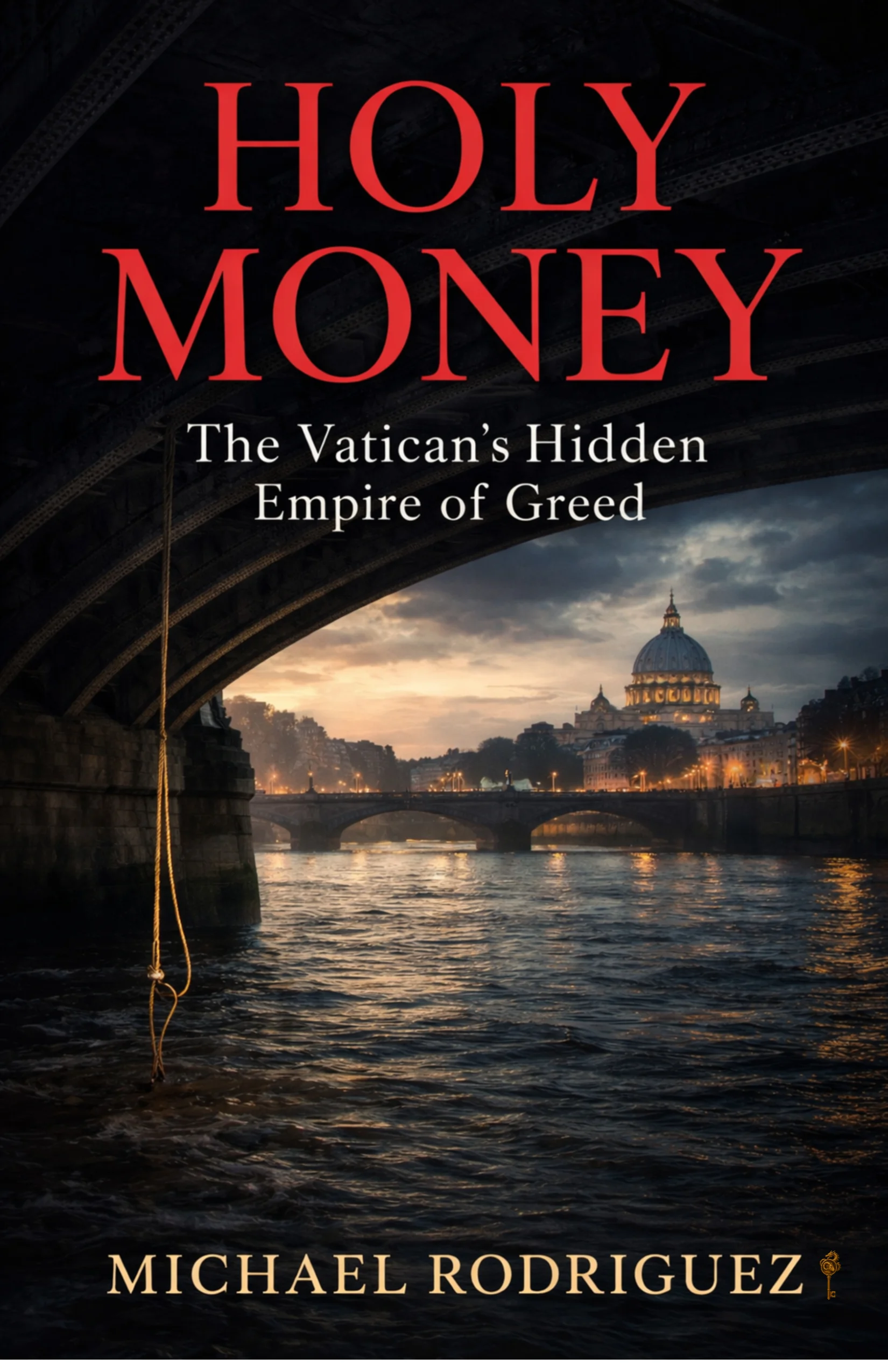
INTRODUCTION: Under the Bridge
The postal worker spotted the body at 7:30 AM.
It was Friday, June 18, 1982, and the Thames was running low that morning — low enough to reveal the orange scaffolding poles jutting from beneath Blackfriars Bridge in central London. Something was hanging from those poles. Not a bag. Not a piece of construction debris. A man. He swung gently in the river breeze, his feet dangling just above the waterline, his dark suit soaked through.
His name was Roberto Calvi. He was sixty-two years old, the chairman of Italy’s largest private bank, and — depending on whom you asked — either a suicide or a murder victim. Italian newspapers had given him a nickname years earlier: Il Banchiere di Dio. God’s Banker.
The London Metropolitan Police found $15,000 in his pockets. Three different currencies. They found bricks stuffed inside his suit — twelve pounds of them, distributed symmetrically, as if someone wanted the weight to be just right. They found a forged passport. And they found absolutely no explanation for how a man fleeing criminal charges in Italy had ended up dead under a bridge named after a medieval order of monks.
Blackfriars. You can’t make this up.
The initial inquest ruled suicide. Calvi’s family rejected this immediately. His wife, Clara, told reporters in Rome that Roberto had called her from London just hours before his death. He was terrified — not depressed. He’d said something was coming. He’d said he knew too much. She never heard from him again.
A second inquest in 1983 returned an open verdict — neither suicide nor murder confirmed. Two decades later, in 2002, the City of London Police reopened the case. Forensic experts tested the orange scaffolding rope. They analyzed the distribution of the bricks. They examined Calvi’s hands — no rust, no orange paint residue. If he’d climbed down the scaffolding himself, his palms would have shown it. They didn’t.
Five people were eventually charged with Calvi’s murder in Italy, including Mafia boss Giuseppe “Pippo” Calò and financier Flavio Carboni. All were acquitted in 2007 for lack of evidence. Clara Calvi died in 2016, still insisting her husband was killed. “They murdered him because he could have brought down the Vatican,” she told an Italian journalist in one of her final interviews.
Whether or not that’s true, what is true is this: the investigation that followed would take decades. And what it uncovered was far more disturbing than a single banker’s death. Because pulling the thread of Roberto Calvi’s life led investigators — journalists, prosecutors, and eventually the FBI — into the inner chambers of the most powerful religious institution on earth: the Vatican.
What they found there was not a church.
It was a financial empire.
An empire built over two centuries, in response to existential crises that the Church’s founders could never have imagined. An empire constructed by men who genuinely believed they were doing God’s work — and by men who used God’s name to do their own. An empire that, even today, operates with less transparency than most Fortune 500 companies, most sovereign wealth funds, and most private banks in the developed world.
Think about this for a moment. The Vatican — the spiritual home of 1.4 billion Catholics worldwide — operates the Western world’s most opaque financial system. According to a 2021 Forbes investigation, the Holy See controls more than 5,000 properties across the globe. Its bank — the Institute for the Works of Religion, or IOR — has handled billions of dollars in deposits from cardinals, religious orders, diplomats, and entities that, to this day, resist public scrutiny.
For most of its history, the IOR published no financial reports. Paid no taxes. Answered to no regulator. And every ten years — at least according to internal policy — it destroyed its records.
This is a book about how that happened. Not the theology. Not the faith. Not the stained glass and the incense and the prayers of the faithful. Those are someone else’s story.
This is the money story.
It stretches back more than two centuries — from Napoleon’s invasion of Rome in 1798, through a desperate bargain with the Rothschild banking dynasty, through the genius of an obscure Italian mining engineer named Bernardino Nogara, through the founding of the Vatican Bank during the darkest days of World War II, and into the catastrophic alliance between the Church, the Mafia, and a network of offshore shell companies that would eventually lead a man named Roberto Calvi to a bridge in London with bricks in his pockets.
Along the way, you’ll meet people you’ve probably never heard of. Archbishops who moved millions while quoting scripture. Financiers who laundered money for crime families and attended mass the next morning. A pope’s butler who blew the whistle. And a pope who did something no pontiff had done in six centuries — he quit.
You’ll also encounter a cast of secular characters who make any crime novel look restrained. Michele Sindona, the Sicilian tax lawyer who became the Vatican’s financial advisor and the Mafia’s favorite banker — before dying of cyanide-laced coffee in an Italian prison. Paul Marcinkus, the hulking American archbishop from Al Capone’s Chicago suburb who ran the Vatican Bank for two decades and was wanted for questioning by Italian authorities — but couldn’t be arrested because he lived behind sovereign walls. Licio Gelli, the grandmaster of the secret Masonic lodge P2, whose membership rolls included heads of Italian intelligence, cabinet ministers, and senior military officers. And Roberto Calvi himself — the man under the bridge, whose death connected all the threads.
The question at the heart of this book is simple: How did the world’s most sacred institution build a machine for washing the world’s dirtiest money?
The answer is complicated. And it starts, as many of history’s best financial stories do, with a catastrophe.
📚 Get Chapter 1 Free
Subscribe to receive the Introduction + Chapter 1 ("The Pope Who Lost Everything") as a free EPUB — and get notified about upcoming investigations.