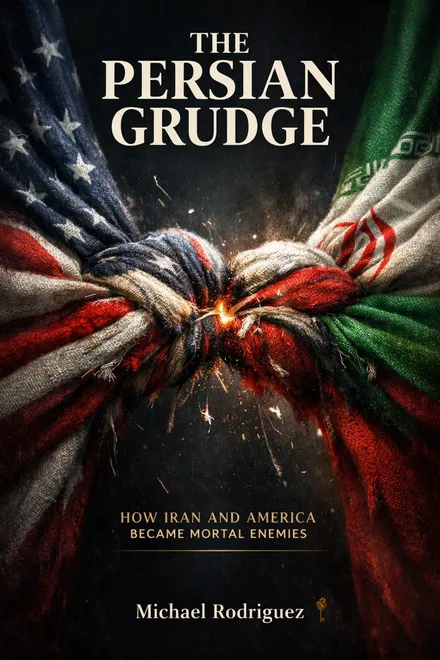
The Persian Grudge — Free Preview
Read the full Introduction below. From a Hellfire missile on a Baghdad highway to a champagne toast in the Shah’s palace — the full story of how Iran and America became mortal enemies. Subscribe below to get Chapter 1 free.
INTRODUCTION
Baghdad International Airport. January 3, 2020. 1:00 AM.
The road from the airport’s cargo terminal to the main highway is a flat, unlit strip of asphalt — six lanes wide, no streetlights, flanked by concrete blast walls left over from the American occupation. At this hour, the road is empty. Almost.
Two vehicles moved through the darkness. A white Hyundai Starex van. Behind it, a Toyota Avalon sedan. Inside the Avalon sat Major General Qasem Soleimani — commander of Iran’s Quds Force, the man who had spent twenty-two years orchestrating proxy wars from Beirut to Baghdad to Sanaa, the man the CIA once called “the single most powerful operative in the Middle East.” He had just landed on a Cham Wings flight from Damascus. He was not hiding. He carried an Iranian diplomatic passport. He had made this trip dozens of times.
Thirty-two thousand feet above him — invisible, inaudible — an MQ-9 Reaper drone circled in a slow, patient orbit. Its pilot sat in a climate-controlled trailer at Creech Air Force Base, sixty miles northwest of Las Vegas. Between the pilot and Soleimani: a satellite link, a chain of command running through CENTCOM in Tampa and the Pentagon’s E-Ring, and a presidential authorization signed by Donald Trump forty-eight hours earlier.
At 1:04 AM local time, the Reaper fired.
Four Hellfire missiles struck the convoy in rapid succession. The blast turned both vehicles into blackened shells. Soleimani’s body was identified by the ring on his severed hand — a thick silver band with a red carnelian stone, the kind Shia men wear as a mark of faith. Abu Mahdi al-Muhandis, the Iraqi militia leader riding in the van, was killed alongside him. Nine others died. As the New York Times reported within hours, body parts were scattered across a hundred-meter radius of scorched highway.
Tehran’s response was immediate. And theatrical.
Supreme Leader Ayatollah Ali Khamenei wept publicly — the first time state television had broadcast his tears in thirty years. Three days of national mourning were declared. An estimated five million Iranians flooded the streets of Tehran, Isfahan, Mashhad, and Soleimani’s hometown of Kerman for funeral processions that stretched for miles. As the BBC’s chief Middle East correspondent reported, the crowds were “larger than any gathering since Ayatollah Khomeini’s funeral in 1989.” On January 8, Iran launched a barrage of twenty-two ballistic missiles at Al-Asad Air Base in western Iraq — the largest direct Iranian military strike against American forces in history.
The world braced for a full-scale war. Cable news ran split-screen countdown graphics. The Pentagon moved B-52 bombers to Diego Garcia. Oil prices spiked eleven percent overnight. European foreign ministers scrambled to open back channels with Tehran while simultaneously ordering their citizens out of Iraq.
It didn’t come. Not exactly. The Iranian missile barrage injured over a hundred American soldiers — traumatic brain injuries, the Pentagon later admitted, after initially claiming zero casualties — but killed none. Whether that was intentional restraint or poor aim depends on who you ask. But the question that hung over every foreign ministry briefing room and cable news studio that week was the same one that had been hanging there, unanswered, for forty-one years: How did we get here?
Think about it. Really think about it.
In 1977 — just forty-three years before that Reaper drone turned Soleimani’s convoy into wreckage — President Jimmy Carter stood in the Niavaran Palace in Tehran and raised a crystal champagne flute to his host, Shah Mohammad Reza Pahlavi. “Iran, because of the great leadership of the Shah, is an island of stability in one of the more troubled areas of the world,” Carter declared, in what would become one of the most spectacularly wrong predictions in the history of American foreign policy. The Shah beamed. The two leaders clinked glasses. American and Iranian flags hung side by side behind them.
Iran was not merely an American ally. It was the American ally.
The Shah bought $20 billion worth of American weapons between 1972 and 1977 — more than any other country on earth during that period. Forty-five thousand American military advisors, defense contractors, and their families lived in Iran. The CIA and SAVAK — Iran’s feared secret police — shared intelligence, shared enemies, shared methods. According to declassified NSA documents published by George Washington University’s National Security Archive, Washington considered the Shah its most reliable partner in the entire Middle East, more dependable than Israel, more predictable than Saudi Arabia.
And then, in the span of thirteen months, the whole thing collapsed.
By February 1979, the Shah was gone — a dying man shuffling between exile in Egypt, Morocco, the Bahamas, and Mexico, begging for a hospital bed. An elderly cleric named Ruhollah Khomeini — a man most Americans had never heard of — sat in the Shah’s palace and declared an Islamic Republic. By November, sixty-six American diplomats were blindfolded, paraded before cameras, and held hostage for 444 days. The American flag was burning in the streets where Carter had given his toast.
From champagne to captivity in twenty-three months.
This is not a story about good guys and bad guys — though there is no shortage of villains on every side. This is a story about how the closest of alliances became the bitterest of hatreds. And the uncomfortable truth, the one that most American accounts skip past and most Iranian accounts distort, is that neither side stumbled into this feud by accident.
Every single step was a choice.
You’ve probably heard the shorthand version of this history. Americans tend to start the clock in 1979 — the hostage crisis, Khomeini’s wild-eyed face on magazine covers, the humiliation of Desert One (the botched rescue mission that killed eight American servicemen in a sandstorm). Iranians start the clock in 1953, when the CIA and British intelligence toppled Mohammad Mossadegh, a democratically elected prime minister whose only crime was nationalizing his country’s oil. Both sides are right. Both sides are leaving out half the story.
The full account spans a hundred and twenty years. It involves oil barons and ayatollahs, spymasters and hostage negotiators, a Shah who threw a $100 million party in the desert and a cleric who recorded revolutionary sermons on smuggled cassette tapes. It includes an American president who sold weapons to Iran in secret, another who promised a deal and then tore it up, and a third who ordered the assassination of a foreign general on a public highway.
The cast of characters is enormous. But the pattern — once you see it — is almost mechanical in its repetition.
Here’s the pattern: An outside power (first Britain, then America) intervenes in Iran to secure its interests. The intervention works — for a while. Then it generates a backlash that is worse, more dangerous, and more ideologically committed than whatever problem the intervention was meant to solve. The intervener responds to the backlash with more intervention. The cycle accelerates. Rinse, repeat, escalate.
The British wanted cheap oil in 1901. They got it. They also got the 1953 nationalization crisis. The Americans wanted a compliant anti-Communist ally in 1953. They installed one. They also got the 1979 Islamic Revolution. Washington wanted to contain the Revolution by backing Saddam Hussein in the Iran-Iraq War. That worked until Saddam invaded Kuwait. And on and on and on — each “solution” manufacturing the next crisis, each crisis demanding a more aggressive solution, until a seventy-year-old Iranian general was incinerated on a Baghdad highway at one in the morning and both countries stood on the edge of a war that neither claimed to want.
I find this pattern — its sheer predictability — both fascinating and, frankly, depressing.
So who was Qasem Soleimani? Not the cartoon villain of American cable news, and not the saintly martyr of Iranian state propaganda. The real man was more interesting than either caricature.
Born in 1957 in the village of Qanat-e Malek, in the mountainous Kerman province of southeastern Iran — a region so remote that it didn’t get paved roads until the 1960s and where winter temperatures drop below minus ten Celsius. His father was a farmer who owed money to the Shah’s government for land reform debts — debts that, as Iranian journalist Arash Azizi documented in his 2020 biography Shadow Commander, amounted to roughly $900, an impossible sum for a family that earned its living growing wheat and pistachios. Soleimani dropped out of school at thirteen to work construction, pouring foundations and hauling cinder blocks in Kerman city. He was functionally self-educated (a detail his hagiographers love and his critics ignore). When the Revolution came in 1979, he was twenty-one — young, poor, idealistic, and furious at the old order that had kept his family in debt.
He joined the Revolutionary Guards. The Iran-Iraq War made him.
By twenty-three, he was commanding a division. By thirty, he was running operations across the entire southeastern front. His soldiers — many of them teenage volunteers from villages like his own — worshipped him. Not because he was charismatic in any conventional sense. According to Dexter Filkins’ extraordinary 2013 profile in The New Yorker, Soleimani was quiet, almost shy in person. He spoke softly. He cried easily — at funerals, at poetry recitations, during prayers. He also, as one former CIA officer told Filkins, “ichly understood the utility of extreme violence.”
By 1998, when he took command of the Quds Force — the external operations arm of the Revolutionary Guards — Soleimani had become something unprecedented: a military commander who operated like an intelligence chief and a diplomat simultaneously. He ran Hezbollah in Lebanon. He coordinated Shia militias in Iraq (the same militias that killed hundreds of American soldiers with Iranian-supplied explosively formed penetrators between 2004 and 2011). He propped up Bashar al-Assad in Syria. He armed the Houthis in Yemen. General David Petraeus, who commanded American forces in Iraq and later ran the CIA, once received a text message from Soleimani that read, as Petraeus recounted to journalist Michael Gordon: “General Petraeus, you should know that I, Qasem Soleimani, control the policy for Iran with respect to Iraq, Lebanon, Gaza, and Afghanistan.”
The man was not bluffing.
And the man Washington killed that night in Baghdad was not some rogue actor. Soleimani was the living embodiment of a strategic doctrine that Iran had been perfecting since 1982 — the doctrine of asymmetric warfare through proxy forces, of fighting America everywhere and nowhere at once, of making every American intervention in the Middle East more expensive, more bloody, and more politically untenable than the last.
Kill the man, and you’ve eliminated a brilliant tactician. You’ve also confirmed — for every Iranian who was wavering, for every Iraqi who was on the fence, for every Hezbollah fighter and Houthi commander — that America will assassinate a senior government official on foreign soil using a robot in the sky. The recruitment posters, as they say, write themselves.
This book answers a single question: not “Who is right?” — because assigning moral clarity to a hundred and twenty years of mutual manipulation, betrayal, and violence is a fool’s errand — but “How did we get here?” How did two countries with no territorial dispute, no ethnic conflict, no religious war, and (for most of their shared history) no real reason to be enemies end up locked in a rivalry so toxic that one of them assassinated the other’s most important general on a third country’s soil?
The answer is not ideology. Not religion. Not culture clash. It is a chain of specific, identifiable, documentable decisions made by specific, identifiable, nameable human beings — most of whom believed they were acting rationally at the time.
That chain is what you hold in your hands.
Part 1: The Golden Trap (1901–1953) begins with a bankrupt Australian adventurer named William Knox D’Arcy who paid a Persian shah the modern equivalent of $480,000 for the right to drill for oil across an area the size of France. It ends with a CIA officer named Kermit Roosevelt — grandson of President Theodore Roosevelt — handing cash-stuffed envelopes to Iranian army officers in a Tehran basement, orchestrating the overthrow of the only democratic government Iran has ever known. The interval between these two events is fifty-two years. The resentment they generated has lasted seventy more and counting.
Part 2: The Peacock and the Ayatollah (1953–1979) follows two men whose lives were mirror images of each other. Shah Mohammad Reza Pahlavi — the insecure, Western-educated monarch who tried to modernize Iran at gunpoint — and Ruhollah Khomeini, the exiled cleric who spent fifteen years recording revolutionary sermons on cassette tapes that were smuggled across borders in suitcases. One had the army, the secret police, and the full backing of the United States. The other had nothing but an idea. The one with nothing won.
Part 3: Revolution and Rupture (1979–1988) takes you inside the American Embassy in Tehran on November 4, 1979, when a group of university students — average age: twenty-two — climbed the walls and took sixty-six American diplomats hostage, igniting a crisis that would destroy a presidency, reshape American foreign policy, and ensure that the words “Iran” and “enemy” became synonymous in the American mind for the next half century. Then comes the Iran-Iraq War — eight years of carnage in which the United States armed both sides (yes, both), Saddam Hussein used chemical weapons with American satellite intelligence, and Iran sent waves of teenage boys to clear minefields with their bodies.
Part 4: The Unfinished War (1989–2025) traces the shadow conflict from the end of the Cold War through the nuclear crisis, the drone strikes, and the proxy wars that continue as you read this sentence. It includes the 2015 nuclear deal — the most significant diplomatic achievement between Iran and America since 1979 — and its destruction three years later by a president who called it “the worst deal ever negotiated.” It ends where we began: with a Hellfire missile, a severed hand, and a grudge that shows no sign of ending.
If this were fiction, no editor would accept it. Too many plot twists. Too many betrayals. Too many moments where the characters do exactly the wrong thing for exactly the wrong reason at exactly the wrong time.
But it’s not fiction. Every scene in this book happened. Every quote is sourced. Every decision had consequences — consequences we are still living with, still paying for, still dying for.
Turn the page.
📖 Want to read Chapter 1? Get it free.
Chapter 1: The Golden Trap — How a bankrupt Australian adventurer paid a Persian shah $480,000 for the right to drill for oil across an area the size of France — and set in motion a century of conflict.
Enter your email below — receive Chapter 1 as EPUB instantly.
Already read Chapter 1? Get the full book:
Buy Full Book on Amazon