The Rigged Game — Free Preview
Read the Introduction and first chapter absolutely free. Discover the $2 trillion secret that the world’s richest don’t want you to know.
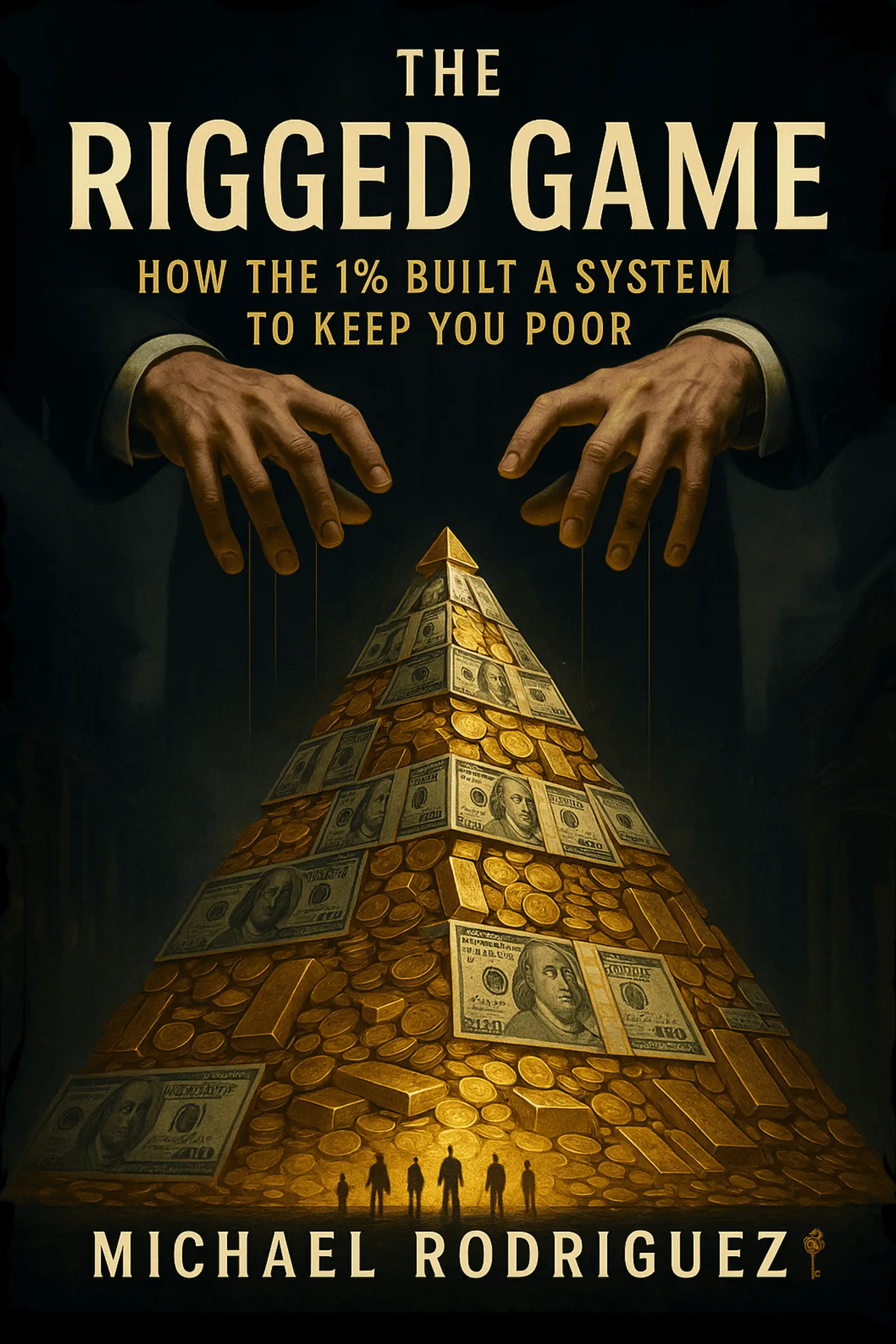
INTRODUCTION: THE $2 TRILLION SECRET
Picture this: You wake up tomorrow morning to discover that while you slept, ten men—just ten human beings—had somehow acquired more wealth than 3.8 billion of their fellow humans combined. Half of the entire planet’s population. Every construction worker in Bangladesh, every teacher in Brazil, every farmer in Nigeria, every nurse in the Philippines, every shop owner in Vietnam—all of them together possess less than these ten individuals.
You’d probably think this was some dystopian nightmare, the plot of a science fiction novel gone horribly wrong. But here’s the catch: you don’t need to wake up tomorrow to see this reality. It’s happening right now, today, while you’re reading these words.
Welcome to the most perfectly rigged game in human history.
I spent the last eighteen months following money trails through leaked documents, court records, and offshore databases that most people will never see. I interviewed former investment bankers who built the modern financial system, ex-government officials who watched it take over their countries, and reformed money launderers who helped hide trillions from public view. What I found will fundamentally change how you see the world around you.
The ten men I mentioned? They’re not cartoon villains twirling their mustaches in secret lairs. They’re celebrated business leaders: Elon Musk, the rocket man; Jeff Bezos, who transformed book-selling into internet domination; Mark Zuckerberg, who built the world’s largest surveillance machine while convincing us it was about “connecting friends.” Their combined wealth approaches $2 trillion—more than the GDP of most countries.
But here’s what the Forbes lists and breathless media profiles won’t tell you: this isn’t a story about exceptional entrepreneurship or revolutionary innovation. This is a story about a system so expertly designed to concentrate wealth that it makes the pharaohs of ancient Egypt look like amateurs.
Every dollar in their accounts represents a choice: that dollar flowing upward instead of funding better schools, repairing crumbling infrastructure, or providing healthcare to those who need it. We’re not just talking about rich people getting richer—we’re witnessing the largest transfer of wealth in human history, a systematic draining of resources from the many to the few that would make medieval kings weep with envy.
The Game They Don’t Want You to Understand
The system I’m about to reveal operates on a simple principle that they pray you’ll never figure out: capitalism isn’t broken—it’s working exactly as designed. Every crisis, every market crash, every “too big to fail” bailout isn’t a bug in the system—it’s a feature. The house always wins because the house wrote the rules.
Think about the last financial crisis for a moment. Regular people lost their homes, their jobs, their retirement savings. Meanwhile, the architects of that crisis not only avoided prison—they received taxpayer-funded bailouts and walked away with even larger fortunes. Goldman Sachs alone received $10 billion in direct bailout money, then turned around and paid out $16.2 billion in bonuses to their executives. The same year.
This isn’t incompetence. This is precision.
But the story of how we got here—how ten people came to control more wealth than half of humanity—doesn’t start with modern financial engineering or Silicon Valley disruption. It starts much earlier, in the castles of medieval Europe, the trading houses of Amsterdam, and the early factories of industrial England. The techniques have been refined over centuries, passed down through generations of wealth accumulators who understood something that most people never realize: money doesn’t just buy things—it buys the power to change the rules.
The Pyramid’s Architecture
Imagine capitalism as a vast pyramid. At the very top, those ten individuals control $2 trillion. Just below them, another 2,990 billionaires control an additional $13 trillion. Together, this group of 3,000 people—about the population of a large high school—holds more wealth than the bottom 60% of humanity combined.
But what most people don’t understand is how the pyramid was built. Every stone in that structure, every mechanism that keeps wealth flowing upward, was placed there deliberately by people who understood exactly what they were doing. They studied the mistakes of previous empires, learned from the failed attempts at wealth concentration throughout history, and built something far more sophisticated and enduring.
The Romans had their conquests and tribute. The medieval lords had their serfs and feudal obligations. The industrial barons had their factories and wage slaves. But the modern financial elite have something far more powerful: they’ve convinced us we’re playing the same game they are.
The Great Deception
Here’s the most brilliant part of the modern system: it’s convinced billions of people that they’re capitalists too. You own some stocks in your 401k? You’re a capitalist! You have a small business? You’re an entrepreneur! You bought some Bitcoin? You’re disrupting the financial system!
This is like telling someone with a piggy bank that they’re competing with JPMorgan Chase.
The reality is that there are two completely different games being played. There’s the game that regular people think they’re playing—work hard, save money, maybe start a business, build wealth slowly over decades. And then there’s the game that the actual power players are engaged in—using other people’s money to buy assets, leveraging government policy to increase those asset values, and extracting wealth from economic systems they control.
One group is playing checkers. The other is playing three-dimensional chess, and they wrote the rules for both games.
What You’re About to Learn
In the pages that follow, I’ll show you exactly how this system was constructed. Not with vague theories or political rhetoric, but with specific names, dates, documents, and dollar amounts. You’ll learn:
- How a small group of Dutch merchants in 1602 created the first modern corporation and used it to control half the world’s economy
- Why Adam Smith’s “invisible hand” was never invisible to those who learned to manipulate it
- How John D. Rockefeller built the first modern monopoly, was broken up by the government, then ended up wealthier and more powerful than before
- Why the 2008 financial crisis was just a dress rehearsal for what’s coming next
- How modern “disruption” is actually the oldest wealth concentration game in history, just played with new technology
But more importantly, you’ll understand why this matters for your life right now. Every time you pay rent to a landlord who owns hundreds of properties, every time you pay interest on a loan to a bank that created that money from nothing, every time you work for wages that buy less each year while asset prices soar beyond your reach—you’re experiencing the effects of decisions made centuries ago by people who understood this system far better than your economics textbooks will ever tell you.
The Documents They Don’t Want You to See
This investigation is built on evidence that powerful people spend enormous amounts of money trying to keep hidden. Court records from antitrust cases that reveal how modern monopolies actually operate. Leaked internal documents from major banks showing how they manipulate markets. Tax filings from billionaires’ charitable foundations that show how they avoid taxes while claiming to save the world. Meeting minutes from elite gatherings where global economic policy is actually decided.
Most people never see these documents. They’re buried in court archives, hidden behind paywalls, or written in deliberately obscure legal and financial language. But when you piece them together, they tell a clear story: the game has been rigged from the beginning, and it’s getting more rigged every year.
The Moment of Truth
We’re approaching what historians will likely call the greatest wealth concentration crisis in human history. Global debt now exceeds $350 trillion—more than four times the entire world’s economic output. Financial derivatives markets total over $4 quadrillion, a number so large it’s almost meaningless. Meanwhile, an entire generation is discovering that the traditional paths to financial security—education, homeownership, steady employment—no longer provide access to the middle class.
This isn’t an accident. This is the endgame of a system that has been building toward this moment for over four centuries.
But here’s what gives me hope, and what should give you hope too: every rigged game can be unrigged, but only if enough people understand how the rigging works. The people who built this system are brilliant, but they’re not gods. They’ve made mistakes, left evidence, created contradictions that can’t be sustained indefinitely.
The most important thing you need to understand as you read this book is that none of this is inevitable. The extreme inequality we see today, the concentration of power in the hands of so few people, the feeling that the economy works for everyone except you—none of this is the natural result of free markets or technological progress or human nature.
It’s the result of specific choices made by specific people who accumulated enough power to make those choices stick. And if it was built by human decisions, it can be changed by human decisions.
But first, you need to understand exactly what you’re up against.
CHAPTER 1: THE WEALTH PYRAMID
Ten Men vs. Half of Humanity
On your screen right now, if you were watching this unfold in real time, you’d see the most extraordinary wealth transfer in human history happening at digital speed. Every second, approximately $2,847 flows upward through the global financial system, concentrating in accounts controlled by fewer and fewer individuals. By the time you finish reading this sentence, another $14,000 has moved from the broader economy into the hands of the ultra-wealthy.
This isn’t hyperbole. This is mathematics.
The numbers are so staggering that our brains struggle to process them. Elon Musk’s net worth fluctuates by more in a single day than most Americans will earn in their entire lifetimes. Jeff Bezos could lose 99% of his wealth and still have more money than 99.9% of humans will ever see. Mark Zuckerberg’s daily capital gains often exceed the annual GDP of small nations.
But focusing on these individuals misses the bigger picture. They’re not the architects of this system—they’re its most successful products. To understand how we arrived at this moment of unprecedented concentration, we need to look at the architecture itself: the pyramid of power that took centuries to construct and is now extracting wealth at a scale that would have been impossible in any previous era of human history.
The Mathematics of Extraction
Let me show you exactly how this wealth pyramid operates, using data that most economic analyses conveniently ignore.
At the very apex sit approximately 10 individuals who control roughly $2 trillion in assets. That’s more wealth than the bottom 3.8 billion humans combined—every single person in the bottom 50% of global wealth distribution.
The next tier consists of about 2,990 additional billionaires who together control approximately $13 trillion. This brings our total to 3,000 people controlling $15 trillion in assets.
Now here’s where it gets interesting: the next tier down contains roughly 50 million individuals (the top 1% globally) who control an additional $40 trillion. Notice what’s happening here—as we move down the pyramid, the number of people increases exponentially, but their per-person wealth drops dramatically.
The bottom 50% of humanity—3.8 billion people—collectively owns less than $2 trillion. That means the average person in the bottom half of global wealth distribution owns approximately $500 worth of assets. Total. Not per year—total net worth.
But even these numbers don’t capture the full picture, because they only account for visible, reported wealth. They don’t include the vast shadow economy of offshore accounts, hidden assets, and complex financial structures designed specifically to avoid detection.
The Velocity of Concentration
What makes our current moment unprecedented isn’t just the scale of inequality—it’s the speed at which it’s accelerating. In 1980, the richest 1% in the United States controlled roughly 10% of total wealth. Today, they control over 35%. In just four decades, they’ve more than tripled their share of the pie.
But the global picture is even more dramatic. Since 2008—the year of the greatest financial crisis since the Great Depression—global billionaire wealth has increased by over 300%. During this same period, median household wealth in most developed countries has stagnated or declined when adjusted for inflation.
This isn’t a coincidence. The 2008 crisis marked a turning point where the mechanisms of wealth extraction shifted into overdrive. Central banks around the world implemented “quantitative easing” policies that essentially printed money and handed it directly to financial institutions. Asset prices soared, benefiting those who owned assets, while wages remained flat for those who depended on employment.
The Federal Reserve alone injected over $4 trillion into financial markets between 2008 and 2015. Where did this money go? It didn’t go to struggling homeowners facing foreclosure or workers who’d lost their jobs. It went to banks, which used it to inflate asset prices—stocks, real estate, bonds—that were primarily owned by the wealthy.
Want to read the full book?
This is just the beginning. The next 20 chapters reveal how the system was built — from medieval feudalism to Wall Street's modern wealth extraction machine — with names, dates, and dollar amounts.
Subscribe to get exclusive updates on new investigations and special offers.