Shadows of Power — Free Preview
Read the Introduction and first two chapters absolutely free. Discover how a college dropout from Brooklyn infiltrated the highest circles of power.
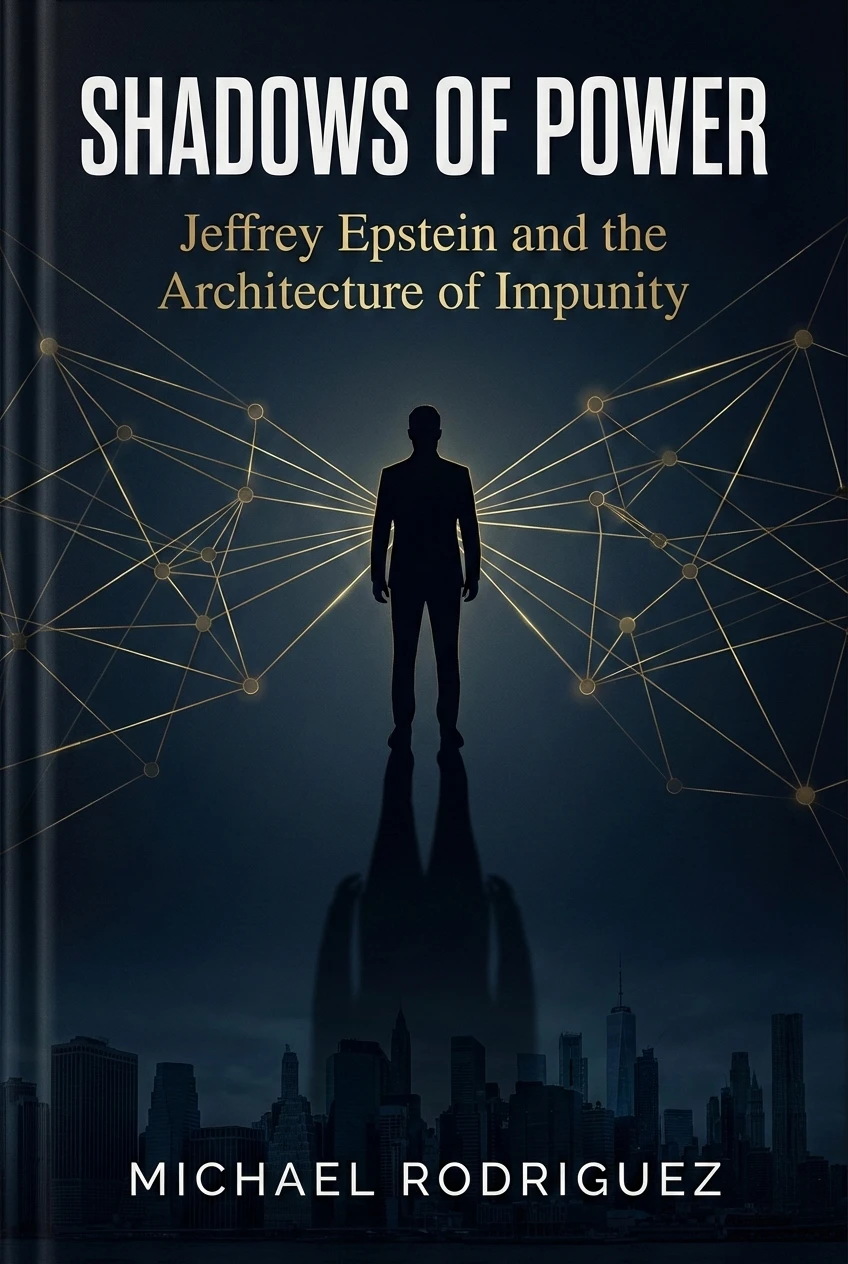
INTRODUCTION: The Silence of Cell 19
“The only thing necessary for the triumph of evil is for good men to do nothing.” But what happens when the ‘good men’ are actually on the guest list?
Imagine a room. It is small, smelling faintly of industrial disinfectant and stale despair. It is August 2019. The cameras—those unblinking eyes of justice—are conveniently malfunctioning. The guards, overworked and underpaid, are conveniently asleep. And inside this concrete box sits a man who knows enough to topple governments, shatter monarchies, and ruin the legacies of icons.
Jeffrey Epstein didn’t just die in that cell; a universe of secrets died with him. Or so they hoped.
But before we talk about the end—the noose, the conspiracy theories, the memes that would break the internet—we have to understand the beginning. Because monsters aren’t born in a vacuum. They are manufactured. They are assembled, piece by piece, by a society that values wealth over morality and access over accountability.
This isn’t just a story about a predator. If you think this is only about a pervert with a private plane, you are missing the point. This is a story about us. It’s about a system so fundamentally broken that a man could traffic children in plain sight for decades, while presidents, princes, and scientists sipped champagne in his living room, laughing at his jokes.
How did a college dropout from Brooklyn, a man with no degree and a fake Austrian passport, manage to wrap the world’s elite around his finger? Was he a spy? A genius? Or just the greatest conman since Bernie Madoff?
To find the answer, we have to go back. Before the island. Before the “Lolita Express.” Before the world knew his name. We have to go back to 1980, to a classroom in Manhattan, where a math teacher just walked in wearing a fur coat and a gold chain.
Buckle up. It’s going to be a bumpy, dirty, and infuriating ride.
CHAPTER 1: The Talented Mr. Nobody
New York City in the late 1970s was a feral place. The Bronx was burning, the subways were graffiti-bombed dungeons, and Wall Street was just beginning to snort its way toward the greed-is-good era of the 80s.
Into this chaos stepped Jeffrey Edward Epstein. Born in 1953 in Coney Island to a gardener and a school aide, his beginnings were aggressively ordinary. He was a middle-class Jewish kid, a piano player, a math nerd. There was no trust fund, no family crest. By all accounts, he should have become an accountant in Queens, raised two kids, and retired to Florida.
But Jeffrey had a superpower. It wasn’t math, though he was good at it. It was chameleonic social climbing. He had the uncanny ability to look at a person, figure out exactly what they wanted to see, and become that reflection.
The Dalton Anomaly
In 1974, Epstein landed a job at the Dalton School. For those unacquainted with the upper crust of Manhattan, Dalton is not just a school. It is an institution where the Masters of the Universe send their offspring to be molded into the next generation of rulers. Tuition costs more than most Americans earn in a year.
Here’s the first red flag, waving frantically in the wind: Epstein didn’t have a college degree. He had dropped out of Cooper Union and NYU. Yet, he was hired to teach calculus and physics to the children of the elite. How? Charm. Pure, unadulterated, weaponized charm.
At Dalton, Epstein was… weird. “Mr. Epstein” didn’t dress like a teacher. He dressed like a disco pimp who took a wrong turn at Studio 54. He wore open-collared shirts exposing gold chains, tight pants, and, famously, a full-length fur coat. In a faculty lounge of tweed jackets and elbow patches, Epstein looked like he was auditioning for Saturday Night Fever.
But it wasn’t just the clothes. It was the behavior. Former students recall a teacher who was less interested in quadratic equations and more interested in blurring lines. He was “handsy.” He was arrogant. He treated the classroom like his personal kingdom.
Yet, he wasn’t fired. Not immediately. Why? Because Epstein was already playing 4D chess while everyone else was playing checkers. He realized that the students weren’t the target audience. The parents were.
He tutored the children of Wall Street titans. He made sure to be seen, to be charming, to be “that brilliant young man who is just too smart for academia.” It worked. One of the fathers he impressed was Ace Greenberg, the legendary CEO of Bear Stearns.
Ace Greenberg was a Wall Street icon, a man who famously said he hired people who were “PSD” — Poor, Smart, and possess a Deep desire to get rich. In Epstein, he saw the ultimate PSD candidate.
In 1976, Epstein was quietly let go from Dalton (the rumors of inappropriate conduct with students were already swirling, a grim foreshadowing of the decades to come). But he didn’t land on the street. He landed on the trading floor of Bear Stearns. The elevator to the penthouse had just opened its doors.
CHAPTER 2: The Wolf of Nothing Street
Wall Street in the 1980s was the Wild West with better suits. It was an era of deregulation, corporate raiders, and junk bonds. If you had the nerve, you could make millions before lunch.
Epstein thrived here. He was a limited partner at Bear Stearns within four years—a meteoric rise that is almost unheard of for someone without a pedigree. He worked in the options division, a complex, high-risk world that suited his mathematical brain.
But here is where the “myth” begins to separate from reality. Epstein would later tell people he was a “financial bounty hunter,” a “currency trader,” a “fixer.” The truth is murkier. Colleagues from that time remember him as abrasive, arrogant, and prone to taking shortcuts.
The Exit Strategy
In 1981, his rocket ship exploded. He was pushed out of Bear Stearns. The official reason? “Policy violations.” Rumors swirled about him front-running trades or breaking SEC rules. In true Epstein fashion, the details are sealed in the vault of “things rich people don’t talk about.”
For most people, getting fired from a top investment bank for ethics violations is a career death sentence. You go work at a car dealership. You don’t fail up. But Epstein wasn’t most people. He understood a fundamental truth about the American elite: Competence is optional; perception is everything.
If you act rich, people assume you are rich. If you act like you know a secret, people assume you have a secret.
Epstein began to drift into the gray zones of finance. He marketed himself not as a broker, but as a “consultant.” It’s a beautiful word, isn’t it? It means everything and nothing. He claimed to recover stolen money for governments and banks. He claimed to be an intelligence asset. He claimed whatever the person across the table needed him to be.
Want to read the full book?
The story is just getting started. 13 more explosive chapters reveal how Epstein built his empire of impunity — and who protected him.
Subscribe to get exclusive updates on new investigations and special offers.