How the IMF Manipulates Countries
The Invisible Hand of the Market
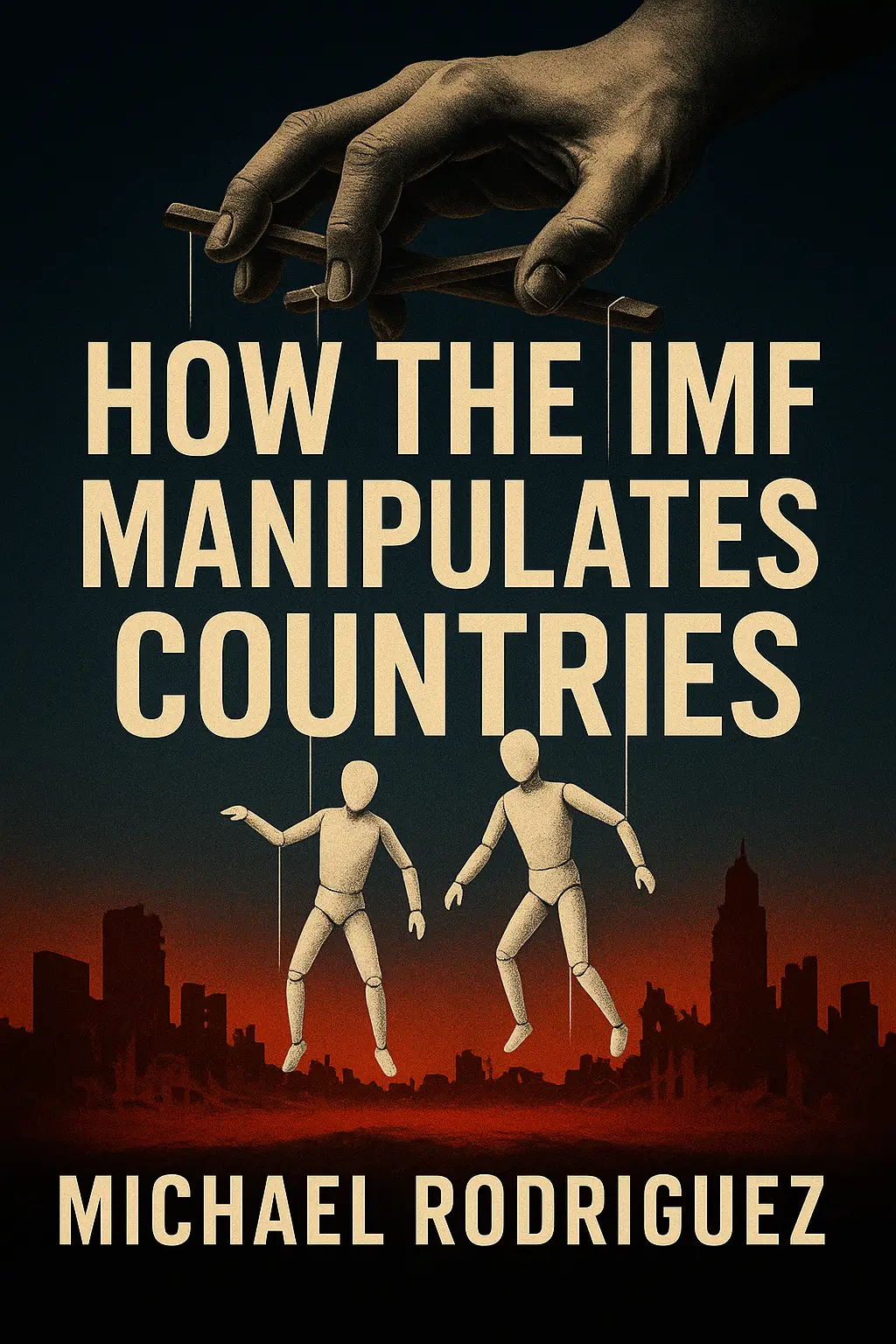
By Michael Rodriguez
First edition: May 2025 Published by Resource Economics Press New York • London • Singapore
ISBN: 9798231531981 (Hardcover) ISBN: 9798231388486 (eBook)
About the Book
In July 1944, delegates from 44 Allied nations met for three weeks at the Mount Washington Hotel in Bretton Woods, New Hampshire, and produced the architecture of the postwar international monetary system. Two institutions came out of that meeting: the International Bank for Reconstruction and Development, which would become the World Bank, and the International Monetary Fund. The voting shares in both were weighted by economic size — which is to say, by 1944 economic size — and the United States walked out of Bretton Woods with the largest single quota. Eighty years later, the US still holds the only single-country voting share above the 15% threshold required to block major IMF decisions.
“How the IMF Manipulates Countries” is a forensic account of what that voting structure has meant in practice — through the East Asian financial crisis of 1997-98, Russia’s 1998 default and the $4.8 billion IMF loan whose tracing became a US Bank of New York money-laundering investigation, the Argentina default of December 2001 ($82 billion in sovereign debt), the three Greek bailout programs of 2010-2015 (€289 billion total), and the parallel rise of China Development Bank and Export-Import Bank of China lending that now rivals IMF flows in scale.
The book draws on IMF Independent Evaluation Office reports, the official transcripts of IMF Executive Board meetings (declassified after twenty years), US Treasury working papers on the Russian 1998 program, the Greek bailout Memoranda of Understanding (published in full by the European Commission), AidData’s Geospatial Global Chinese Development Finance Dataset (3.0), and Joseph Stiglitz’s first-person account of the 1997 East Asian crisis from his post as World Bank Chief Economist.
What You’ll Discover
🏨 Bretton Woods, July 1944
The three weeks at the Mount Washington Hotel — Keynes versus White, the quota negotiation that gave the US 16.49% voting share, and the constitutional decision to require an 85% supermajority for major actions.
📜 The Washington Consensus
John Williamson’s 1989 paper, the ten policy recommendations he listed, and how the term escaped him and became — fairly or not — synonymous with IMF conditionality through the 1990s.
🌏 The East Asian Crisis of 1997-98
Thailand’s baht devaluation on July 2, 1997, the contagion through Indonesia and South Korea, and Joseph Stiglitz’s later argument that IMF capital-account liberalization advice in the preceding years had created the conditions for the crisis.
🇷🇺 Russia’s 1998 Default and the Bank of New York Investigation
The $4.8 billion IMF loan of July 1998, the August 17 ruble devaluation, and the subsequent US federal investigation into approximately $7 billion that moved through Bank of New York accounts traced to Russian sources.
🇦🇷 Argentina, December 2001
The $40 billion December 2000 IMF rescue, the convertibility regime that pegged the peso 1:1 to the dollar, the cacerolazos and the corralito, and the $82 billion default — at the time the largest sovereign default ever recorded.
🇬🇷 The Greek Bailouts, 2010-2015
The three Memoranda of Understanding (€110B, €130B, €86B), the Troika structure (IMF + ECB + European Commission), and the IMF’s own admission in 2013 that the first program’s growth assumptions had been “notably optimistic.”
🇨🇳 The Belt and Road Counter-Offer
China Development Bank and Export-Import Bank of China lending, AidData’s tracking of approximately $1 trillion in Chinese cross-border loans between 2008 and 2021, and the structural differences from IMF conditionality.
Key Revelations
- July 1-22, 1944 — Bretton Woods Conference, 730 delegates from 44 nations, producing the IMF Articles of Agreement.
- 16.49% — current United States IMF voting share, exceeding the 15% threshold required to block any decision needing 85% supermajority.
- 1989 — John Williamson’s “Latin American Adjustment: How Much Has Happened?” paper coining the term “Washington Consensus” and listing the ten policy recommendations.
- July 2, 1997 — Thailand abandons the baht’s peg to the US dollar, the proximate trigger of the East Asian financial crisis.
- August 17, 1998 — Russia devalues the ruble and defaults on its domestic GKO bonds, weeks after receiving a $4.8 billion IMF disbursement.
- December 2001 — Argentina defaults on approximately $82 billion in sovereign debt; the IMF Independent Evaluation Office’s 2004 review concludes the preceding program had been “extended beyond justifiable limits.”
- €289 billion — total of the three Greek bailout programs (May 2010, March 2012, August 2015) administered by the IMF-ECB-European Commission Troika.
- 2013 — IMF staff paper “Greece: Ex-Post Evaluation” admits the first program’s growth assumptions had been “notably optimistic” and that earlier debt restructuring would have produced better outcomes.
- 2014 — BRICS New Development Bank and Contingent Reserve Arrangement established (Fortaleza Summit, July 2014), with initial $50 billion subscribed capital and $100 billion currency-swap pool.
- ~$1 trillion — AidData estimate of Chinese cross-border lending 2008-2021 through China Development Bank, Export-Import Bank of China, and the BRI framework.
Fact-Check: Key Claims Verified
How the IMF Manipulates Countries is investigative nonfiction. Every central claim is drawn from IMF Independent Evaluation Office reports, IMF Executive Board minutes (declassified per the 20-year rule), the US Treasury Office of International Affairs working papers, AidData’s Global Chinese Development Finance Dataset, and the academic literature on sovereign debt and conditionality.
| Claim | Status | Verified Source |
|---|---|---|
| US voting share at the IMF is 16.49%, exceeding the 15% blocking threshold | ✅ Confirmed | IMF Quota and Voting Shares, current; IMF Articles of Agreement, Article XII Section 5 |
| Bretton Woods Conference held July 1-22, 1944, 730 delegates from 44 nations | ✅ Confirmed | US State Department records; Steil, "The Battle of Bretton Woods" (2013) |
| "Washington Consensus" coined by John Williamson in 1989 | ✅ Confirmed | Williamson, "Latin American Adjustment" (Institute for International Economics, 1990) |
| Thailand floated the baht on July 2, 1997, triggering the East Asian crisis | ✅ Confirmed | Bank of Thailand archives; IMF Recent Experiences with Surveillance (1998) |
| Russia defaulted August 17, 1998, weeks after the $4.8B IMF disbursement | ✅ Confirmed | IMF Independent Evaluation Office "Russia 1998" report (2003); GAO 2000 report |
| Argentina defaulted on ~$82 billion in sovereign debt in December 2001 | ✅ Confirmed | IMF IEO "Role of the IMF in Argentina" (2004); World Bank country reports |
| The three Greek bailout programs totaled €289 billion (2010, 2012, 2015) | ✅ Confirmed | European Stability Mechanism financial reports; IMF Greece program documents |
| BRICS New Development Bank established at the July 2014 Fortaleza Summit | ✅ Confirmed | BRICS Sixth Summit Declaration; NDB Articles of Agreement |
About the Author
Michael Rodriguez is an investigative nonfiction author who covers sovereign debt, multilateral institutions, and the political economy of international finance. For How the IMF Manipulates Countries, he worked from the IMF’s Independent Evaluation Office reports on Argentina (2004), Russia (2003), Greece (2016, 2017), and capital-account liberalization (2005); IMF Executive Board minutes declassified under the 20-year disclosure rule; the US Treasury Office of International Affairs Russia-program working papers; the published Memoranda of Understanding for all three Greek bailouts; AidData’s Geospatial Global Chinese Development Finance Dataset (Version 3.0); Joseph Stiglitz’s “Globalization and Its Discontents” (2002); and the BIS, OECD, and World Bank cross-border lending statistics.
His methodology combines forensic reading of IMF program documents, sovereign-default chronology reconstruction, and comparative tracking of Chinese versus Western official lending using AidData’s project-level disclosures. The book argues that the IMF is best understood not as an independent technocratic institution but as a creditor-coordination mechanism whose conditionality patterns can be read directly off its voting structure — and that the rise of Chinese state lending has, for the first time since 1944, created an external alternative for borrower nations.
Rodriguez is the author of several investigations in this series, available at michaelrodriguezbooks.com.
Get Your Copy Today
Share This Book
Uncover the Hidden Economics of Power
Stay Ahead of Global Financial Manipulation
Join thousands of readers who receive exclusive analysis on international finance, debt traps, and the hidden mechanisms controlling the global economy.