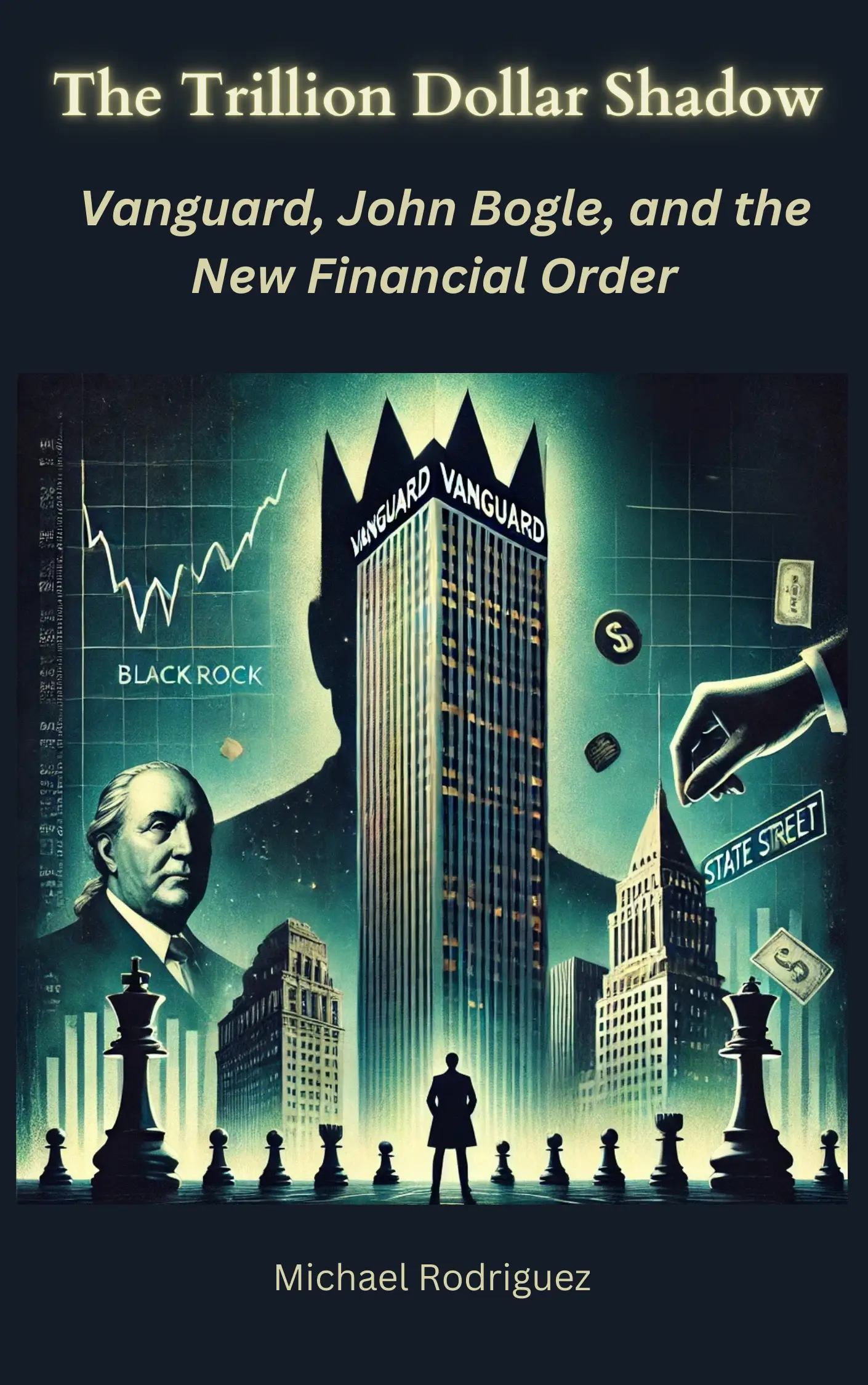
The Trillion Dollar Shadow
Vanguard, John Bogle, and the New Financial Order
By Michael Rodriguez
First edition: January 2025 Published by Resource Economics Press New York • London • Singapore
ISBN: 9798230169000 (Hardcover) ISBN: 9798227941503 (eBook)
About the Book
In 1951, a Princeton senior named John Clifton Bogle submitted a 130-page thesis titled “The Economic Role of the Investment Company.” It argued, essentially, that actively managed mutual funds could not consistently outperform the market after costs — and that a fund tracking a broad index, sold at the lowest possible expense ratio, would be a structurally superior product. The thesis received an A+. The investment industry ignored it for the next twenty-five years.
“The Trillion Dollar Shadow” is the story of what happened when the industry stopped ignoring it. Bogle founded Vanguard on September 24, 1974, after being fired from Wellington Management. Two years later, on August 31, 1976, he launched the First Index Investment Trust with $11.3 million in initial assets — a fraction of the $150 million the underwriters had targeted, and widely mocked at the time as “Bogle’s Folly.” By the time he died on January 16, 2019, that fund had become the Vanguard 500 Index Fund, Vanguard managed approximately $5.3 trillion across all products, and the index revolution Bogle had launched had become the dominant force in global asset allocation.
The book traces the architecture of that revolution: the mutual ownership structure that no competitor has been able to replicate, the 1976 launch and the slow accumulation of the 1980s, the explosion after the 2008 financial crisis demolished trust in active management, the rise of the iShares ETF business at BlackRock and SPDR at State Street as parallel index empires, and the “Big Three” problem that Bogle himself flagged in his final published op-ed — that index-fund concentration was on a trajectory to give a small handful of firms voting control over virtually every public corporation.
It draws on Bogle’s Princeton thesis (Mudd Manuscript Library, Princeton University), Vanguard’s annual reports from 1976 onward, the firm’s N-PX proxy voting disclosures, Bogle’s twelve published books, his Wall Street Journal op-eds, the Bebchuk-Hirst and Coates academic literature on the Big Three, and ISS, Glass Lewis, and Lazard institutional shareholder data on proxy patterns.
What You’ll Discover
📚 The 1951 Princeton Thesis
“The Economic Role of the Investment Company” — what Bogle actually argued at age 22, the data sources he used, and the twenty-five-year gap between the idea and its first commercial implementation.
🚪 The 1974 Firing from Wellington
The merger Bogle architected, the boardroom conflict that ended his presidency, and the September 24, 1974 founding of Vanguard as a back-office subsidiary that gradually became the operating entity.
🎯 August 31, 1976 — “Bogle’s Folly”
The First Index Investment Trust launch, the $11.3 million raised against a $150 million target, the Wall Street ridicule, and the slow institutional accumulation through the 1980s.
🏛️ The Mutual Ownership Structure
How Vanguard is owned by its funds and the funds are owned by their shareholders — and why no competitor has been able to replicate the structure under existing US securities law.
📈 The Post-2008 Acceleration
SPIVA scorecards documenting persistent active-fund underperformance, the great fee-compression wave of 2009-2019, and Vanguard’s AUM growth from roughly $1 trillion in 2008 to over $10 trillion in 2024.
🗳️ The Big Three and Proxy Voting
Bebchuk and Hirst’s 2019 “Specter of the Giant Three” calculations, Vanguard’s Investment Stewardship Reports, and the N-PX disclosure data showing how Vanguard actually votes on board elections, executive compensation, and shareholder proposals.
⚠️ Bogle’s Final Warning
The November 29, 2018 Wall Street Journal op-ed in which Bogle wrote that index-fund concentration had become “a major issue of corporate governance” — seven weeks before his death on January 16, 2019.
Key Revelations
- 1951 — Bogle’s 130-page senior thesis “The Economic Role of the Investment Company” submitted at Princeton; archived at Mudd Manuscript Library.
- September 24, 1974 — The Vanguard Group founded by Bogle after his dismissal from Wellington Management Company in January 1974.
- August 31, 1976 — First Index Investment Trust launches with $11.3 million; renamed Vanguard 500 Index Fund (VFINX) and later admiral-class VFIAX.
- December 2001 — Vanguard launches its first ETF, VIPERs (Vanguard Index Participation Equity Receipts), later restructured as standard ETF share classes of its index funds.
- ~$10.4 trillion — Vanguard’s approximate assets under management as of 2024, across more than 400 funds and 50 million investor accounts.
- 2019 — Bebchuk and Hirst’s “Specter of the Giant Three” paper in the Boston University Law Review, the most-cited academic work on Big Three concentration.
- ~22% of US public equity — combined Big Three (BlackRock + Vanguard + State Street) ownership estimate per Bebchuk-Hirst and later updates.
- November 29, 2018 — Bogle’s Wall Street Journal op-ed warning that index-fund concentration was on a trajectory to give a handful of firms voting control over virtually every US corporation.
- January 16, 2019 — John C. Bogle dies in Bryn Mawr, Pennsylvania, age 89.
- 2020 SEC rule changes — Investment Company Reporting Modernization expands N-PX disclosure requirements, finally enabling systematic study of how the Big Three actually vote.
Fact-Check: Key Claims Verified
The Trillion Dollar Shadow is investigative nonfiction. Every central claim is drawn from primary documents: Bogle’s archived Princeton thesis, Vanguard’s annual reports and prospectuses, SEC N-PX proxy-voting disclosures, Bogle’s published books and op-eds, and peer-reviewed academic literature on common ownership.
| Claim | Status | Verified Source |
|---|---|---|
| Bogle's 1951 Princeton senior thesis, "The Economic Role of the Investment Company" | ✅ Confirmed | Mudd Manuscript Library, Princeton University; Bogle, "Stay the Course" (2018) |
| Vanguard founded September 24, 1974 following Bogle's dismissal from Wellington | ✅ Confirmed | Vanguard corporate history; Bogle, "Common Sense on Mutual Funds" (1999) |
| First Index Investment Trust launched August 31, 1976 with $11.3 million | ✅ Confirmed | SEC prospectus filings; Bogle, "The Little Book of Common Sense Investing" |
| Vanguard is mutually owned by its funds, which are owned by shareholders | ✅ Confirmed | Vanguard SAI (Statement of Additional Information); SEC Form N-1A filings |
| Big Three combined ownership ~22% of S&P 500 equity | ✅ Confirmed | Bebchuk & Hirst, Boston University Law Review (2019); Lazard proxy reviews |
| Bogle's November 29, 2018 WSJ op-ed warning on index-fund concentration | ✅ Confirmed | Wall Street Journal archives; Bogle Center for Financial Literacy |
| Bogle died January 16, 2019, age 89, in Bryn Mawr, Pennsylvania | ✅ Confirmed | New York Times obituary; Philadelphia Inquirer; Vanguard press release |
| Vanguard AUM approximately $10.4 trillion in 2024 | ✅ Confirmed | Vanguard annual reports; ICI mutual fund factbook 2024 |
About the Author
Michael Rodriguez is an investigative nonfiction author who covers asset management, fund structure, and the political economy of capital allocation. For The Trillion Dollar Shadow, he worked from John Bogle’s archived 1951 Princeton senior thesis at the Mudd Manuscript Library, Vanguard’s complete annual report series from 1976 onward, the firm’s SEC Form N-PX proxy-voting disclosures, Bogle’s twelve published books (especially “Common Sense on Mutual Funds” and “Stay the Course”), his Wall Street Journal op-eds and Boglehead Forum interactions, the academic literature on common ownership (Bebchuk & Hirst 2019, Coates 2019, Azar-Schmalz-Tecu 2018), and the ICI Investment Company Factbook series.
His methodology combines archival reconstruction of Vanguard’s founding and early growth, forensic reading of mutual-fund prospectuses and N-1A disclosures to verify the operating mechanics of the at-cost ownership structure, and proxy-vote pattern analysis using ISS, Glass Lewis, and Lazard data on the Big Three’s actual voting record. The book argues that Bogle’s revolution succeeded — measurably, by every benchmark the industry uses — and that the unintended consequence is a concentration of voting power that Bogle himself recognized and named as a problem in the last weeks of his life.
Rodriguez is the author of several investigations in this series, available at michaelrodriguezbooks.com.