Weaponized Economy
The Hidden History of Trade Wars and Their Impact on Global Politics
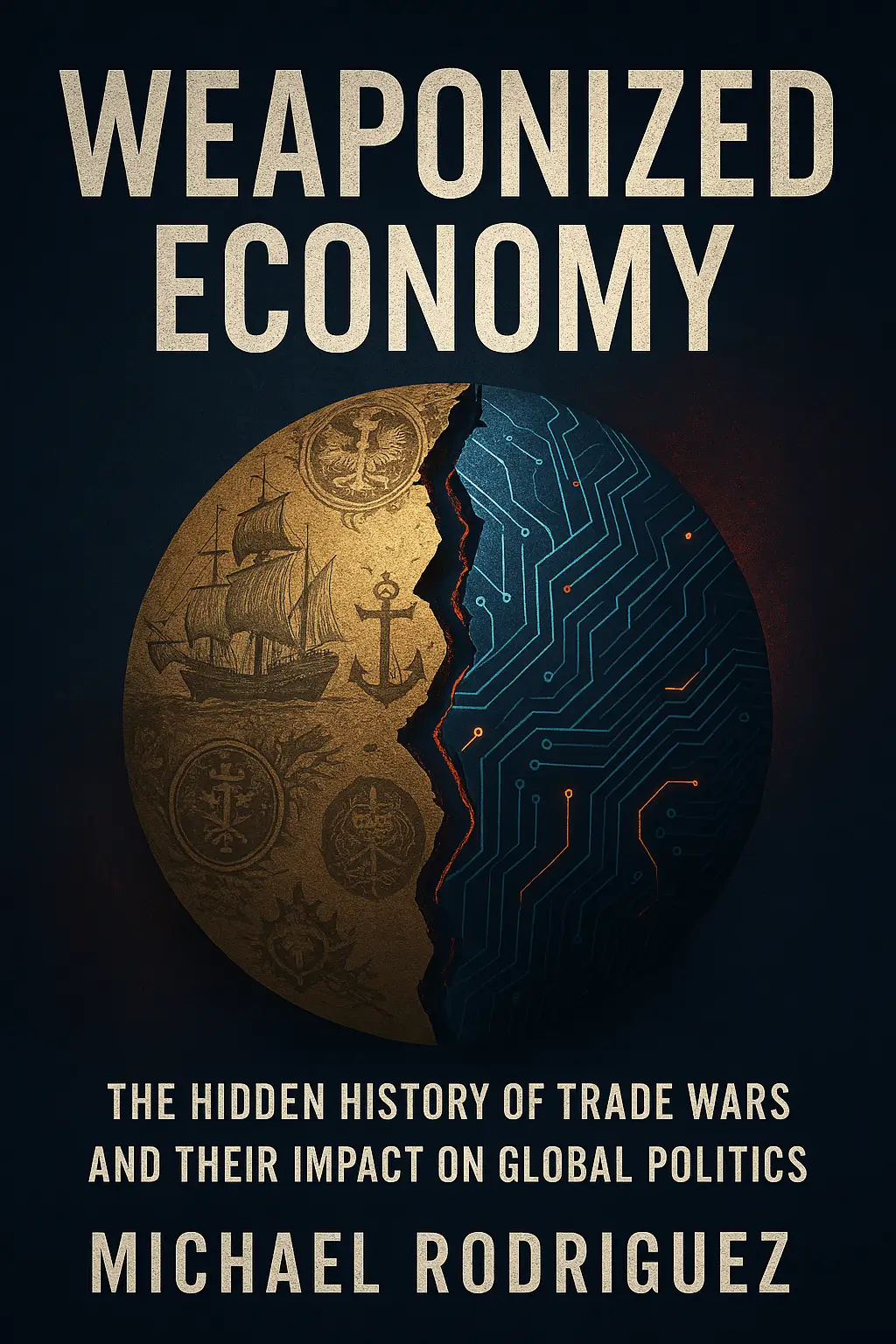
By Michael Rodriguez
First edition: January 2025 Published by Resource Economics Press New York • London • Singapore
ISBN: 9798230374428 (Hardcover) ISBN: 9798230126232 (eBook)
About the Book
On November 21, 1806, in a captured Prussian capital, Napoleon Bonaparte signed a decree ordering every state under French influence to close its ports to British vessels. It was the first attempt in modern history to wage a continent-wide economic war. The Continental System lasted eight years, was systematically evaded by smugglers and neutral shippers, and ultimately bankrupted Napoleon’s allies more than it bankrupted Britain. When Tsar Alexander I withdrew Russia from the system in 1810, the proximate cause of the 1812 Russian campaign was already in motion.
“Weaponized Economy” traces the two-hundred-year arc from the Berlin Decree to the SWIFT disconnection of seven Russian banks on March 12, 2022. The book argues that economic warfare is not a substitute for kinetic warfare — it is a parallel instrument that nations consistently overestimate as a tool of coercion and consistently underestimate as a generator of blowback. It examines the Opium Wars (1839-1842, 1856-1860) as the original case of trade weaponization through gunboat enforcement, the Smoot-Hawley Tariff Act of 1930 as a textbook study in retaliation cascades, the 1949-1994 CoCom export-control regime as a Cold War precedent for today’s semiconductor export controls, and the modern US-China Section 301 tariff series as the world’s largest peacetime economic conflict by dollar volume.
It draws on the US Treasury Office of Foreign Assets Control (OFAC) Sanctions Lists, US Trade Representative Section 301 investigation reports, the European External Action Service sanctions database, Federal Reserve and ECB analyses of the 2022 Russian reserve freeze, CoCom declassified records (released via the National Archives in 1996), and Adam Tooze’s contemporaneous analysis in “Shutdown” and “Crashed” of the post-2008 and post-2020 sanctions regimes.
What You’ll Discover
🇫🇷 Napoleon’s Continental Blockade
The Berlin Decree of November 21, 1806, the Milan Decree of December 17, 1807, the systematic smuggling through Heligoland, and how Russian non-compliance triggered the 1812 invasion that destroyed the Grande Armée.
☕ The Opium Wars and Gunboat Trade
The 1839 Lin Zexu confiscation of British opium stocks at Canton, the 1842 Treaty of Nanjing that ceded Hong Kong and imposed a $21 million indemnity, and the Second Opium War (1856-1860) that opened the Yangtze and legalized the opium trade.
📉 Smoot-Hawley and the Retaliation Cascade
The June 17, 1930 signing, the immediate Canadian retaliation, the British Imperial Preference shift in 1932, and the approximately 65% collapse in world trade between 1929 and 1934.
🚫 CoCom and the Cold War Tech Embargo
The Coordinating Committee for Multilateral Export Controls, founded November 22, 1949, operating quietly until its 1994 dissolution; the 1987 Toshiba-Kongsberg scandal involving submarine-propeller machining technology sold to the Soviet Union.
🇰🇵 The North Korea Sanctions Architecture
UN Security Council Resolution 1718 (October 14, 2006) and the subsequent 2270, 2321, 2371, and 2375 expansions; the limits of enforcement when China and Russia retain partial dissent.
⚛️ Iran, the JCPOA, and Maximum Pressure
The 2015 Joint Comprehensive Plan of Action, the US withdrawal of May 8, 2018, and the “maximum pressure” sanctions reimposition — including the secondary sanctions on European firms doing business with Iran.
🇺🇸🇨🇳 Section 301 and the 2018-Present Trade War
The March 2018 Section 301 finding on Chinese IP practices, the four tariff tranches reaching approximately $370 billion of Chinese imports, the Phase One agreement of January 15, 2020, and the Biden-era expansions targeting EVs, semiconductors, and batteries (May 2024).
Key Revelations
- November 21, 1806 — Napoleon’s Berlin Decree, the founding document of modern economic warfare; extended by the Milan Decree of December 17, 1807.
- August 29, 1842 — Treaty of Nanjing ends the First Opium War; Hong Kong ceded, $21 million indemnity, five “treaty ports” opened.
- June 17, 1930 — Hoover signs the Smoot-Hawley Tariff Act despite a petition from 1,028 economists opposing it; world trade contracts ~65% over the next four years.
- November 22, 1949 — CoCom (Coordinating Committee for Multilateral Export Controls) founded in Paris; operates in secrecy until dissolved March 31, 1994.
- October 14, 2006 — UN Security Council Resolution 1718 establishes the North Korea sanctions regime following the first DPRK nuclear test.
- July 14, 2015 — JCPOA signed in Vienna by Iran, the P5+1, and the EU; the US withdraws May 8, 2018.
- March 12, 2022 — Seven major Russian banks disconnected from SWIFT, including VTB, Bank Otkritie, Sovcombank, and Novikombank.
- ~$300 billion — Russian central bank foreign reserves frozen by G7 and EU jurisdictions following the February 2022 invasion.
- December 5, 2022 — G7 oil price cap takes effect at $60/barrel for Russian seaborne crude exports.
- March 22, 2018 — Trump signs Presidential Memorandum invoking Section 301 against China; tariffs eventually cover approximately $370 billion of imports.
Fact-Check: Key Claims Verified
Weaponized Economy is investigative nonfiction. Every central claim is drawn from primary historical sources (the actual texts of the Berlin Decree, Treaty of Nanjing, and Smoot-Hawley Act), contemporary government disclosures (OFAC Sanctions Lists, USTR Section 301 reports, EU sanctions database), and the academic literature on the economics of trade restrictions and sanctions effectiveness.
| Claim | Status | Verified Source |
|---|---|---|
| Berlin Decree signed November 21, 1806; Milan Decree December 17, 1807 | ✅ Confirmed | French National Archives; Bonaparte, "Correspondance de Napoléon Ier" Vol. 13 |
| Treaty of Nanjing: $21M indemnity, Hong Kong ceded, signed August 29, 1842 | ✅ Confirmed | UK National Archives FO 17 series; Fairbank, "Trade and Diplomacy on the China Coast" |
| Smoot-Hawley Tariff Act signed June 17, 1930; world trade fell ~65% by 1934 | ✅ Confirmed | US Statutes at Large Vol. 46; League of Nations trade statistics 1934 |
| CoCom founded November 22, 1949, dissolved March 31, 1994 | ✅ Confirmed | US National Archives RG 489; Mastanduno, "Economic Containment" (1992) |
| UNSC Resolution 1718 of October 14, 2006 establishes DPRK sanctions regime | ✅ Confirmed | UN Security Council records; S/RES/1718 (2006) full text |
| JCPOA signed July 14, 2015; US withdrawal announced May 8, 2018 | ✅ Confirmed | US State Department records; IAEA Vienna; UNSC Resolution 2231 |
| SWIFT disconnection of 7 Russian banks effective March 12, 2022 | ✅ Confirmed | EU Council Decision (CFSP) 2022/335; SWIFT press release |
| Approximately $300B in Russian central bank reserves frozen after February 2022 | ✅ Confirmed | Bank of Russia 2022 annual report; G7 finance ministers joint statements |
About the Author
Michael Rodriguez is an investigative nonfiction author who covers the economics of conflict, sanctions regimes, and the political economy of trade restrictions. For Weaponized Economy, he worked from primary historical texts — the Berlin and Milan Decrees in the French National Archives, the Treaty of Nanjing in UK Foreign Office files (FO 17 series), the original Smoot-Hawley Tariff Act in the US Statutes at Large — and contemporary disclosures including the US Treasury Office of Foreign Assets Control (OFAC) Sanctions Lists, the USTR Section 301 investigation reports for the 2018-2024 China actions, the EU Council Decisions establishing the 2022 Russia sanctions architecture, and the declassified CoCom records released by the US National Archives in 1996.
His methodology combines historical reconstruction of sanctions regimes through their founding legal instruments, comparative effectiveness measurement using the Hufbauer-Schott-Elliott “Economic Sanctions Reconsidered” framework, and supply-chain blowback analysis drawing on Federal Reserve and ECB studies of the 2022 reserve freeze. The book argues that nearly every economic-warfare episode produces the same pattern: the imposing power overestimates leverage, the target adapts faster than expected, and the unintended consequences fall more heavily on uninvolved third parties than on either belligerent.
Rodriguez is the author of several investigations in this series, available at michaelrodriguezbooks.com.