Architect of Power: Your Questions Answered
March 26, 2026 · By Michael Rodriguez
He fled Nazi Germany as a boy and returned as an American soldier to liberate concentration camps. He won the Nobel Peace Prize while secretly bombing Cambodia. He opened diplomatic relations with China in 48 hours and helped overthrow a democracy in Chile on a Tuesday afternoon. Henry Kissinger was the most consequential — and most contested — diplomat of the twentieth century: refugee and architect of empire, strategic genius and accused war criminal. These are the questions readers ask most about the man, the doctrine, and what Architect of Power reveals about the price of world order.
Q1: What is Architect of Power about?
The Full Arc of Kissinger's Power: Architect of Power: Henry Kissinger and the Price of World Order is a comprehensive investigation of the most influential diplomat in American history — from his flight from Nazi Germany as Heinz Alfred Kissinger in 1938, through his intellectual formation at Harvard under Fritz Kraemer, to his unprecedented dual role as National Security Advisor and Secretary of State under Nixon and Ford.
The book reconstructs the pivotal events that defined Kissinger's career: the secret flight to Beijing that opened China, the Paris Peace Accords that ended (and didn't end) the Vietnam War, the covert operations that toppled Salvador Allende in Chile, shuttle diplomacy in the Middle East after the Yom Kippur War, and the vast consulting empire — Kissinger Associates — that made him the most powerful private citizen in the world after leaving office.
Every chapter is sourced from declassified documents, Nixon White House tapes, congressional testimony, and the diplomatic record. As Architect of Power documents, the distance between what Kissinger said publicly and what the classified record reveals is the distance between statecraft and its human cost.
Q2: Is this a biography or a political analysis?
Both — and That's the Point: Most books on Kissinger choose a lane. The authorized biographies celebrate the strategic brilliance. The prosecutorial accounts catalog the victims. Architect of Power does something different: it traces Kissinger's personal journey — the refugee trauma, the Harvard years, the cultivation of powerful mentors — while analyzing the intellectual framework he built from those experiences: realpolitik, balance of power, strategic triangulation.
The book argues that you cannot understand Kissinger's policies without understanding the man who made them — and you cannot assess the man without confronting the full consequences of those policies. It holds the strategic brilliance and the moral wreckage in the same frame, because that is where the truth lives.
— From Architect of Power, Introduction
The result is neither hero worship nor character assassination. It's an investigation — of a mind, a doctrine, and the world that mind reshaped.
Q3: What was the secret flight to Beijing?
48 Hours That Changed the World: In July 1971, Henry Kissinger — then National Security Advisor — feigned illness during an official visit to Pakistan. While the press reported he was resting in the Himalayan hill station of Nathia Gali, he boarded a Pakistani International Airlines plane and flew secretly to Beijing to meet Premier Zhou Enlai.
Those 48 hours changed the geopolitical map of the Cold War. Kissinger and Zhou negotiated the framework for President Nixon's historic visit, which took place in February 1972. The "opening to China" exploited the Sino-Soviet split, giving the United States leverage against both communist powers simultaneously — a textbook example of triangular diplomacy.
The gamble was extraordinary. If the flight had leaked, it could have destabilized relations with Japan, Taiwan, and the Soviet Union simultaneously. Kissinger went anyway. As Architect of Power reconstructs through declassified cables and memcon records, the Beijing trip was Kissinger at his most brilliant — bold, secretive, and willing to upend decades of American foreign policy in a single covert maneuver.
Q4: Why did Kissinger win the Nobel Peace Prize — and why was it controversial?
The Prize That Broke the Committee: In 1973, Henry Kissinger and North Vietnamese negotiator Lê Đức Thọ were jointly awarded the Nobel Peace Prize for the Paris Peace Accords, which were supposed to end the Vietnam War. Two members of the Nobel Committee resigned in protest — the first and only time that has happened in the prize's history.
Lê Đức Thọ refused the award, stating that peace had not actually been achieved in Vietnam. He was right. The war continued for two more years until Saigon fell in April 1975. An estimated 1.3 million more people — soldiers and civilians on all sides — died between the signing of the accords and the war's actual end.
— From Architect of Power, Chapter 8
Meanwhile, the secret bombing of Cambodia — Operation Menu and its successors — had killed between 150,000 and 500,000 Cambodian civilians, destabilizing the country and creating the conditions for the Khmer Rouge's rise. As Architect of Power documents, the Nobel Prize controversy encapsulates the Kissinger paradox: diplomatic achievement built on human catastrophe.
Q5: What happened in Chile on September 11, 1973?
The Other 9/11: On September 11, 1973 — twenty-eight years before the attacks on New York — the Chilean military, led by General Augusto Pinochet, launched a coup against the democratically elected government of President Salvador Allende. Fighter jets bombed the presidential palace. Allende died during the assault. The coup inaugurated seventeen years of military dictatorship.
Kissinger's role is documented in declassified State Department cables, CIA operational files, and the Nixon White House tapes. When told that Allende had been elected, Nixon instructed the CIA to "make the economy scream." Kissinger oversaw a two-track strategy: overt economic pressure and covert support for military plotters. The Church Committee later confirmed CIA involvement in destabilizing the Allende government.
Under Pinochet, at least 3,200 people were executed or "disappeared," over 40,000 were imprisoned, and thousands were tortured — including at facilities run under Operation Condor, a multinational campaign of political repression that Kissinger's State Department was briefed on and did not oppose. As Architect of Power traces through the documentary record, Chile represents the starkest test case for realpolitik: strategic logic applied without moral constraint.
Q6: What is realpolitik and why does it matter?
The Doctrine That Shaped the World: Realpolitik — literally "the politics of reality" — is the intellectual framework Kissinger brought to American foreign policy. Its core premise: states pursue interests, not ideals. International order depends not on shared values but on a balance of power maintained through strategic calculation.
Kissinger didn't invent realpolitik — it traces back to Bismarck, Metternich, and the European balance-of-power tradition he studied at Harvard. But he operationalized it in American foreign policy with unprecedented scope: the China opening exploited the Sino-Soviet split through triangular diplomacy. Détente managed superpower competition through arms control treaties and back-channel negotiations. Shuttle diplomacy in the Middle East used American leverage to broker disengagement agreements after the 1973 war.
Where realpolitik produced catastrophe, the pattern was consistent: strategic calculation without moral constraint. Cambodia was bombed to protect a flank in Vietnam — 150,000 to 500,000 civilians died. Chile's democracy was sacrificed to prevent "another Cuba" — seventeen years of dictatorship followed. Bangladesh's independence struggle was ignored to preserve the Pakistan channel to China — an estimated 300,000 to 3 million Bengalis died. As Architect of Power argues, the doctrine works until you count the bodies.
Q7: How is this book different from other Kissinger books?
Neither Hagiography Nor Prosecution: The Kissinger shelf is long and divided. On one side: Niall Ferguson's authorized biography, which had full access to Kissinger's private papers but rendered its subject as a misunderstood idealist. On the other: Christopher Hitchens' The Trial of Henry Kissinger, a prosecutorial brief that treated every decision as a crime but didn't engage with the strategic logic behind them.
Architect of Power occupies neither camp. It traces the architecture of Kissinger's thinking — how he processed information, weighed tradeoffs, and constructed the frameworks that guided his decisions — using primary sources including declassified State Department cables, CIA operational files, Nixon White House tapes, and congressional testimony from the Church Committee and Pike Committee investigations.
Crucially, this book was written after Kissinger's death in November 2023 at age 100. That matters. Previous biographies were constrained — consciously or not — by the knowledge that their subject was still alive, still influential, still capable of shaping the narrative. Architect of Power is the first comprehensive assessment written free of that constraint, with access to the full declassified record and the perspective that finality provides.
---📖 Get the Full Story
Discover the complete investigation in Architect of Power: Henry Kissinger and the Price of World Order
📦 Buy on Amazon 📖 Read Free ChapterAvailable Now
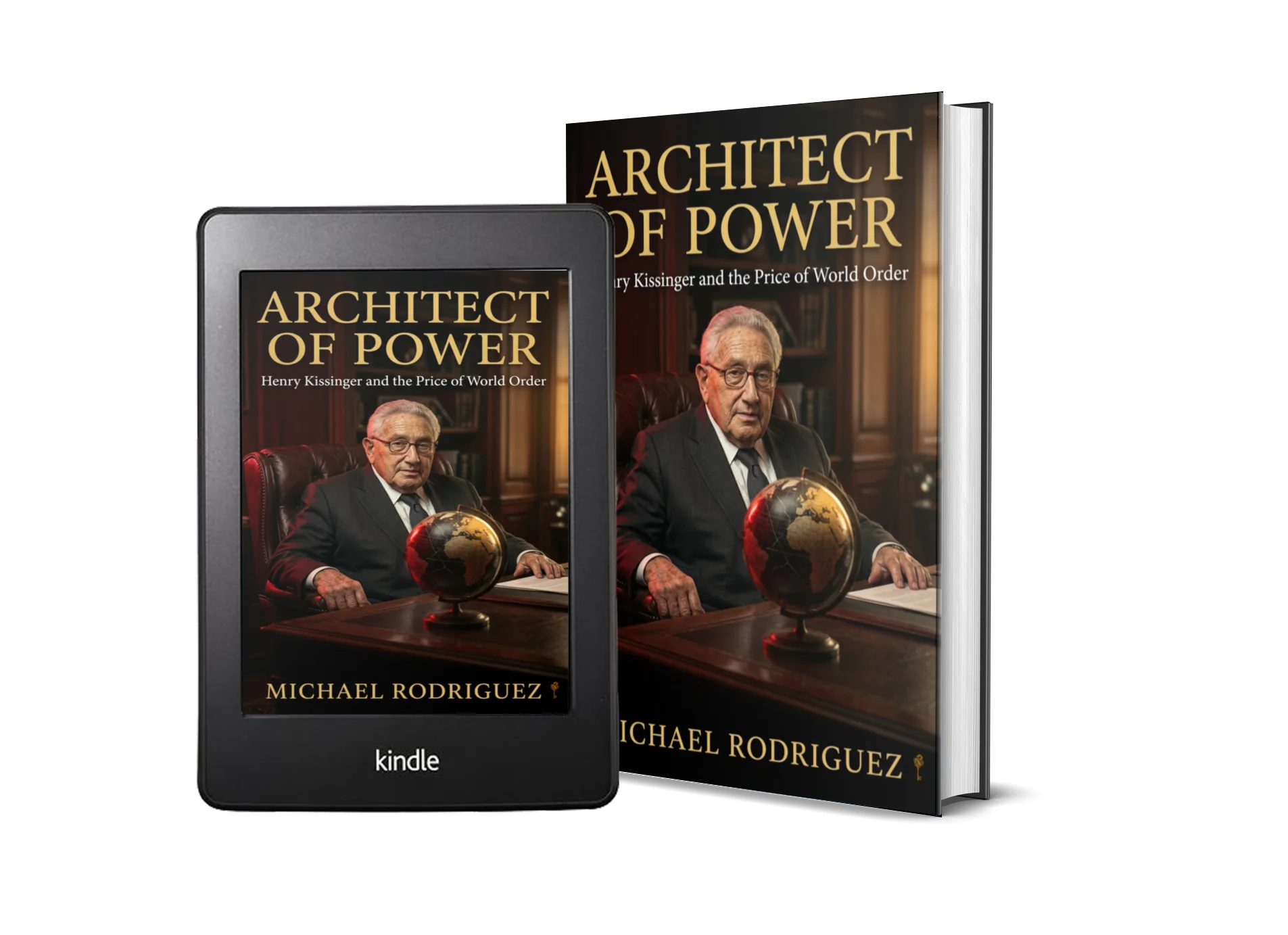
Libraries: OverDrive, Hoopla, BorrowBox
📘 ISBN: 9798233211027 (Hardcover) | 9798233027277 (eBook)
Published: March 2026 | Resource Economics Press
---About this Investigation: This FAQ draws from the research behind Architect of Power: Henry Kissinger and the Price of World Order, including analysis of declassified State Department cables, CIA operational files, Nixon White House tapes, Church Committee and Pike Committee testimony, Paris Peace Accords negotiation records, and primary sources spanning five decades of American foreign policy.
Share This Article
📚 Related Articles
📕 Related Books
Subscribe to Newsletter
Get updates on new books, exclusive content, and free chapters from Michael Rodriguez.