Kissinger's Realpolitik: The Architecture of Cold War Diplomacy
March 26, 2026 · By Michael Rodriguez
Henry Alfred Kissinger arrived in the United States in 1938 — a fifteen-year-old Jewish refugee from Fürth, Bavaria, carrying nothing but the conviction that civilization was fragile. By the time he left the White House in 1977, he had reshaped the global order. He opened China. He negotiated détente with the Soviet Union. He ended American involvement in Vietnam — after first expanding the war into Cambodia and Laos. He orchestrated the overthrow of a democratically elected government in Chile. He won the Nobel Peace Prize while authorizing the bombing of civilian populations across three continents. No single American diplomat in the twentieth century wielded more power, achieved more strategic breakthroughs, or left more bodies in his wake.
In researching Architect of Power, I spent years tracing Kissinger's decisions through declassified cables, White House tapes, congressional testimony, and the memoirs of those who served alongside him. What emerged is not the caricature of either camp — neither the visionary statesman his admirers celebrate nor the war criminal his critics condemn. The documented record reveals something more complicated and more instructive: a man who understood power better than almost anyone alive, and who wielded it with a clarity of purpose that was simultaneously brilliant and devastating.
1. The Refugee's Theory of Order
Heinz Alfred Kissinger was born in 1923 in Fürth, a Bavarian city where Jews had lived for centuries. By 1938, that coexistence was over. The Nuremberg Laws stripped his family of citizenship. His father, a schoolteacher, lost his position. The Kissingers fled to New York, arriving with the remnants of a middle-class life and the knowledge that everything — status, security, identity — could be erased overnight. Thirteen members of the Kissinger family who stayed behind were murdered in the Holocaust.
This was not an abstraction for Kissinger. It was biographical fact. The experience of total state collapse — of a civilized society descending into industrialized murder — gave him a horror of disorder that never left him. For Kissinger, the worst outcome was not injustice. The worst outcome was chaos. Injustice could be reformed. Chaos consumed everything, including the possibility of reform. This conviction would become the foundation of everything he built.
At Harvard, Kissinger transformed personal trauma into intellectual framework. His doctoral thesis examined the Congress of Vienna, focusing on Metternich and Castlereagh — the two statesmen who reconstructed European order after the Napoleonic Wars. What fascinated Kissinger was not their morality but their effectiveness. Metternich was a reactionary who suppressed democratic movements across Europe. Castlereagh represented a constitutional monarchy. They disagreed about almost everything — except the necessity of a stable balance of power. Together, they built a system that prevented a general European war for a century.
— From Architect of Power, Chapter 1
This intellectual framework — realpolitik in its purest form — meant that Kissinger would always prioritize stability over principle, structure over sentiment, the balance of power over the rights of individuals. His admirers called it strategic clarity. His critics called it moral bankruptcy. Both were describing the same thing.
2. The Secret Channel: Opening China
On July 9, 1971, Henry Kissinger pulled off one of the most audacious diplomatic maneuvers of the twentieth century. During a state visit to Pakistan, he announced that he had a stomachache and retreated to his quarters. While the press reported that the National Security Adviser was resting with an upset stomach, Kissinger boarded a Pakistani International Airlines Boeing 707 and flew secretly to Beijing. He was the first senior American official to set foot in the People's Republic of China since Mao Zedong's revolution in 1949.
What followed was seventeen hours of meetings with Premier Zhou Enlai — one of the most consequential diplomatic conversations in modern history. Kissinger and Zhou discussed Taiwan, Vietnam, the Soviet Union, and the fundamental architecture of a new relationship between two nations that had spent twenty-two years treating each other as existential enemies. The chemistry between the two men was immediate. Zhou, himself a master diplomat, recognized in Kissinger a strategic mind that operated on the same level as his own.
The geopolitical logic was elegant in its ruthlessness. The Sino-Soviet split of the 1960s had created an opportunity that no previous administration had been willing to exploit. China and the Soviet Union — ostensibly communist allies — were now rivals, with border skirmishes along the Ussuri River nearly escalating to nuclear war in 1969. Kissinger saw the triangle: by establishing relations with Beijing, the United States could play the two communist powers against each other. Each would have more reason to cooperate with Washington than to confront it. The weaker side of the triangle would always seek the friendship of the remaining corner.
— From Architect of Power, Chapter 4
When Nixon's visit to China was announced to the world on July 15, 1971, the shock was global. America's Cold War allies had not been consulted. Japan, which had built its entire postwar foreign policy around the American alliance, learned of the opening from television broadcasts. The strategic triumph was real. So was the pattern it established: Kissinger's most consequential decisions were made in secret, presented to the public as accomplished facts, and debated only after they were irreversible.
3. The Price of Order: Cambodia and Chile
The strategic brilliance of the China opening exists in the same record as Operation Menu. Beginning on March 18, 1969 — less than two months after Nixon's inauguration — the United States began a sustained bombing campaign against Cambodia. Over the next fourteen months, B-52 bombers flew 3,875 sorties, dropping 108,823 tons of ordnance on a neutral country. The campaign was kept secret from Congress, from the American public, and from the Cambodian people who were dying under the bombs. Pentagon records were falsified to show the strikes hitting targets in South Vietnam.
The stated justification was military necessity: North Vietnamese forces were using Cambodian territory as a staging ground and supply route. The strategic logic was defensible in narrow terms. The execution was catastrophic. Estimates of Cambodian civilian casualties from American bombing between 1969 and 1973 range from 150,000 to 500,000. The bombing destabilized Cambodia's government, destroyed the country's rural infrastructure, and drove peasants into the arms of the Khmer Rouge — the genocidal movement that would kill nearly two million Cambodians after taking power in 1975.
Kissinger's fingerprints are on every page of this record. The White House tapes capture him discussing targeting decisions. Declassified cables show his direct involvement in selecting strike zones. When the bombing became public through investigative journalism, Kissinger's response was not to defend the policy on its merits but to pursue the journalists and their sources. The wiretapping of reporters and government officials that followed became part of the pattern of abuse that culminated in Watergate.
— From Architect of Power, Chapter 6
The Chilean operation revealed the moral architecture of Kissinger's realpolitik at its starkest. A democratically elected government was overthrown not because it threatened American security, but because it challenged the ideological framework of the Cold War order Kissinger was building. The distinction between strategic necessity and ideological preference — a distinction Kissinger himself insisted upon in his academic writings — collapsed entirely when applied to Latin America. Order, it turned out, meant American order. And the price was paid by people who had no voice in the decision.
4. Shuttle Diplomacy and the Middle East
If Cambodia and Chile represented the darkest applications of Kissinger's strategic framework, his Middle East diplomacy demonstrated its highest achievement. The Yom Kippur War of October 1973 caught the world off guard. Egypt and Syria launched a coordinated surprise attack on Israel during the holiest day of the Jewish calendar. The initial Arab advances threatened Israel's existence. The Soviet Union began airlifting supplies to its Arab allies. The United States responded with its own airlift to Israel. For a brief, terrifying period, the two superpowers stood closer to direct military confrontation than at any point since the Cuban Missile Crisis.
Kissinger's management of the crisis was a masterclass in diplomatic choreography. He simultaneously reassured Israel of American support, signaled to Egypt that the United States was willing to broker a genuine settlement, and kept the Soviet Union from escalating to direct intervention. When the fighting ended, Kissinger launched what became known as shuttle diplomacy — flying between Jerusalem, Cairo, and Damascus in an exhausting series of negotiations that produced the first Sinai disengagement agreement in January 1974.
The numbers tell the story of the effort: twenty-four flights between capitals in thirty days. Kissinger would meet with Golda Meir in Jerusalem in the morning, fly to Aswan to meet with Anwar Sadat in the afternoon, and return to Jerusalem with a counter-proposal by evening. Each conversation required not just diplomatic skill but an intimate understanding of what each leader could accept domestically. Sadat needed to show Egypt had recovered its honor after the humiliation of 1967. Meir needed to show Israel's security had not been compromised. Both needed to believe the Americans were honest brokers — while knowing that Kissinger was simultaneously arming Israel and reassuring Arab states.
The framework Kissinger built during those weeks laid the groundwork for the Camp David Accords five years later. By establishing the United States as the indispensable mediator — the only power trusted enough by both sides to broker agreements — Kissinger effectively excluded the Soviet Union from Middle East diplomacy. It was strategic triangulation applied to a regional conflict, and it worked. The Egyptian-Israeli peace that emerged from this process has held for nearly five decades.
5. The Consulting Empire
When Kissinger left government in January 1977, he did not leave power. He simply changed its form. In 1982, he founded Kissinger Associates — a consulting firm that monetized the most valuable commodity in international affairs: access. The firm's client list read like a Fortune 500 roster: American Express, Coca-Cola, Fiat, Daewoo, and dozens of multinational corporations seeking to navigate the geopolitical landscape Kissinger had helped create.
The business model was straightforward and enormously profitable. Corporations paid substantial retainers — reportedly in the range of $200,000 to $500,000 annually — for Kissinger's analysis of political risk, his introductions to foreign leaders, and his ability to open doors that remained closed to conventional lobbyists. When a CEO needed a meeting with the Chinese Premier, Kissinger could make a phone call. When a corporation needed to understand how a Middle Eastern succession crisis might affect oil markets, Kissinger could provide analysis informed by relationships built over decades.
The consulting empire extended Kissinger's influence far beyond what any former official had previously achieved. He remained a fixture at the Bilderberg Group's annual meetings, a regular presence at the World Economic Forum in Davos, and a dinner guest of sitting presidents from both parties. Republican and Democratic administrations alike sought his counsel. He advised George H.W. Bush on German reunification, Bill Clinton on China, George W. Bush on the Iraq War, and — remarkably — was still offering strategic advice to world leaders past his hundredth birthday.
The architecture he built outlasted any single administration because it was designed to be structural, not personal. The triangular diplomacy with China and the Soviet Union evolved into the post-Cold War order. The Middle East framework he established remained the foundation of American regional strategy. The consulting firm institutionalized his access. At 100, Kissinger was not a relic. He was proof that the systems he built were durable — that the architecture of power, once constructed, could sustain itself long after the architect had left the drafting table.
6. What the Record Actually Shows
The documented evidence in Architect of Power resists the clean narratives that both Kissinger's defenders and his critics prefer. The record does not support the claim that he was merely a brilliant strategist who made difficult choices in impossible circumstances. Nor does it support the claim that he was simply a war criminal who should have faced prosecution. The truth encompasses both realities and refuses to resolve into either.
The China opening was a genuine strategic revolution that reshaped the global order. The Cambodia bombing killed hundreds of thousands of civilians and destabilized an entire nation. The Middle East shuttle diplomacy built a framework for peace that endured for decades. The Chile operation destroyed a democracy and installed a dictatorship that tortured tens of thousands. These are not contradictions in the record. They are the record. The same mind, the same strategic framework, the same theory of order produced all of these outcomes.
What the primary sources prove is that Kissinger's realpolitik was not a philosophy applied selectively. It was applied with absolute consistency. The balance of power was the supreme value. Anything that served that balance — including diplomatic breakthroughs, secret wars, and the overthrow of elected governments — was justified by the framework. Anything that threatened that balance — including democratic movements, congressional oversight, and press freedom — was an obstacle to be managed or overcome.
The world Kissinger built is still standing. The US-China relationship he initiated, for all its current tensions, remains the central axis of global politics. The Middle East architecture he designed still shapes American strategy in the region. The model of the national security adviser as a rival power center to the State Department — which Kissinger pioneered — is now permanent. Whether the price was worth it is the question Architect of Power asks readers to answer for themselves. The book provides the evidence. The judgment belongs to you.
---📖 Get the Full Investigation
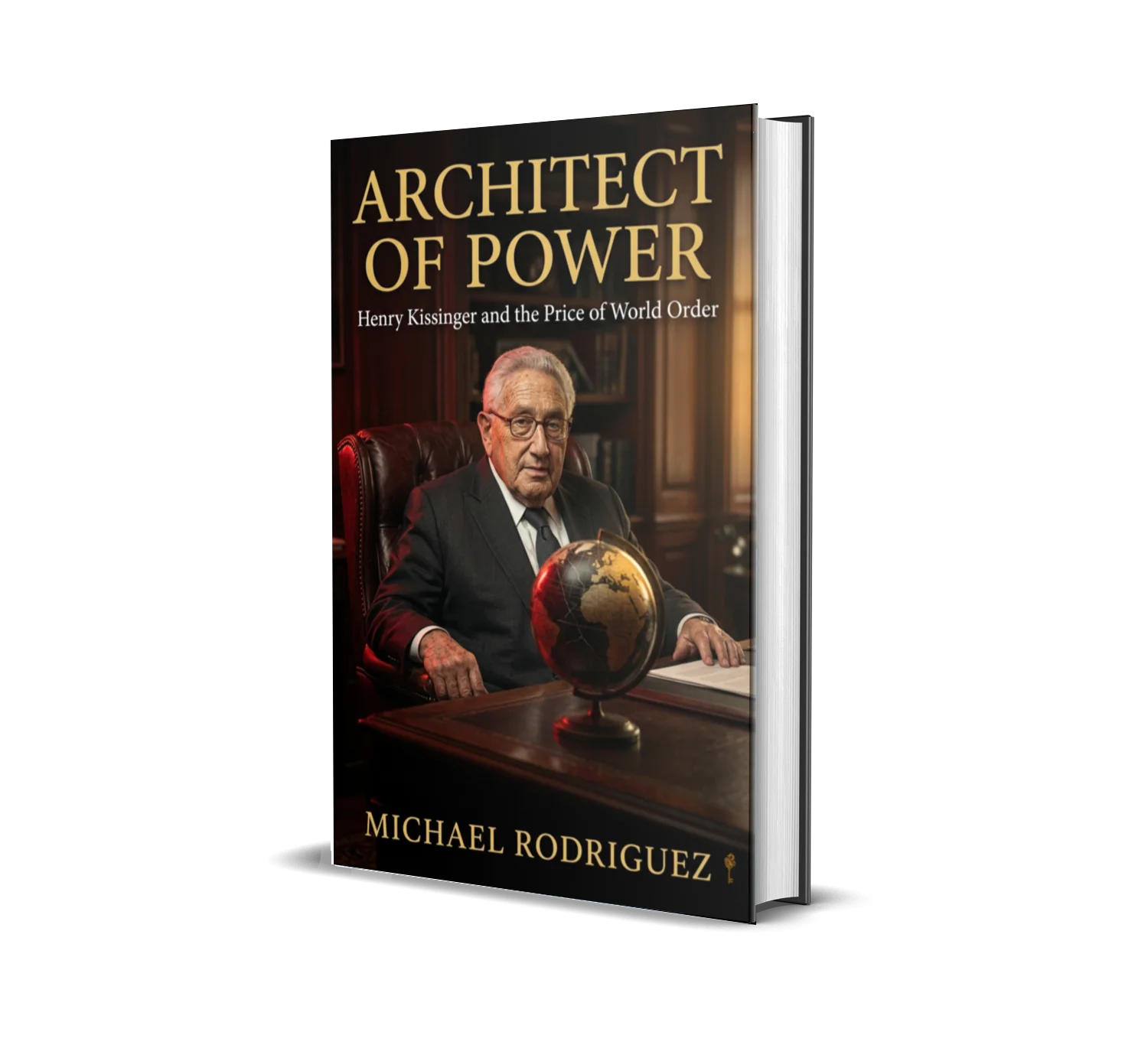
Discover the complete evidence in Architect of Power: Henry Kissinger and the Price of World Order
📦 Buy on Amazon 📖 Read Free ChapterAvailable Now
Libraries: OverDrive, Hoopla, BorrowBox
📘 ISBN: 9798233211027 (Hardcover) | 9798233027277 (eBook)
Published: March 2026 | Resource Economics Press
---About this Investigation: This article draws from the research behind Architect of Power: Henry Kissinger and the Price of World Order, including analysis of declassified National Security Council cables, White House tape transcripts, congressional testimony from the Church Committee and Pike Committee investigations, State Department historical documents, and FOIA-released records spanning the Nixon and Ford administrations.
Share This Article
📚 Related Articles
📕 Related Books
Subscribe to Newsletter
Get updates on new books, exclusive content, and free chapters from Michael Rodriguez.