The Dark Triad in Corporate America: Why Psychopaths Rise to the Top
April 8, 2026 · By Michael Rodriguez
David — not his real name — sat across from me in a private dining room at a midtown Manhattan restaurant, nursing a bourbon he hadn't touched in twenty minutes. He was sixty-one years old, a Fortune 100 executive with a corner office on the forty-second floor, a compensation package north of $14 million annually, and the kind of quiet authority that makes waiters materialize without being summoned. He had agreed to speak on background for Dark Advantage, and over the course of three hours he described a twelve-year climb from associate to C-suite that operated on a single principle he articulated with unnerving clarity: "I learned to see people as chess pieces." He did not mean this as metaphor. He meant it as methodology. Early in his career, David identified a colleague named Jennifer — talented, well-liked, positioned for a promotion he wanted. He spent four months studying her. He learned that her daughter was being treated for anxiety disorder. He learned that her husband traveled three weeks out of every four. He cataloged her stress triggers, her insecurities, her reliance on a small circle of trusted colleagues. Then he began. He manufactured moments of connection — asking about her daughter with precisely calibrated concern, offering to cover her projects when she seemed overwhelmed, positioning himself as her most reliable ally. Over eighteen months, he systematically absorbed her institutional knowledge, redirected her key client relationships to himself, and built a quiet case to senior leadership that her role had become redundant. When the restructuring came, he recommended her position for elimination. She never saw it coming. He described the entire sequence with the detached precision of a chess player analyzing a game he had won years ago. No guilt. No satisfaction. Just a clean recounting of moves and countermoves that had delivered the desired result.
David is not an aberration. He is a data point in an increasingly documented pattern. Research in personality psychology and organizational behavior has established, with growing empirical certainty, that the corporate hierarchy does not merely tolerate dark personality traits — it actively selects for them. The traits that make someone a destructive romantic partner, a toxic friend, or a dangerous neighbor are, in the precise context of corporate competition, advantages. Dark Advantage investigates why this happens, how it works at the level of specific mechanisms, and what ethical professionals can do to survive a system designed to reward predators.
The Promotion Machine That Rewards Predators
Corporate promotion systems are built on a foundational assumption that almost no organization examines critically: that the behaviors which make someone visible as a leader are the same behaviors that make someone effective as a leader. This assumption is wrong. And the gap between visibility and effectiveness is precisely where Dark Triad personalities build their careers.
Consider what promotion committees actually measure. They measure self-promotion — the ability to articulate your accomplishments in terms that register with decision-makers who may interact with you for thirty minutes per quarter. They measure confidence signaling — the projection of certainty that reads as competence, regardless of whether the certainty is warranted. They measure political maneuvering — the cultivation of relationships with the specific individuals whose endorsements carry weight at the specific moments when advancement decisions are made. And they measure dominance in group settings — the willingness to speak first, speak loudly, and hold the floor in meetings where attention is the scarcest resource.
These are precisely the skills that Dark Triad personalities deploy naturally. Narcissists project confidence with a conviction that genuine experts — who understand the limits of their knowledge — cannot replicate. Machiavellians build political networks with a strategic patience that colleagues focused on actual work do not have time for. Psychopaths remain unperturbed under pressure in ways that read as "executive temperament" rather than what they actually are: the absence of emotional response to situations that should provoke emotional response.
The data is striking. Psychopaths represent approximately 1% of the general population — roughly one in a hundred people you pass on the street. But research by psychologist Robert Hare and organizational researcher Paul Babiak, who screened over two hundred corporate professionals using the PCL-R (Psychopathy Checklist-Revised), found that the rate among senior business leaders was approximately 4%. A 2016 study published in the Journal of Criminal Justice by forensic psychologist Nathan Brooks pushed the estimate higher: his sample of 261 corporate professionals in senior management positions suggested rates between 8% and 12%. One in a hundred on the sidewalk. Potentially one in eight in the boardroom. The corporate ladder is not a meritocracy. It is a selection mechanism — and what it selects for overlaps significantly with clinical personality pathology.
Rodriguez calls this "the loudness advantage" in Dark Advantage. In a study published in the Journal of Personality and Social Psychology, researchers found that individuals who spoke more frequently and with greater confidence in group settings were consistently rated as more competent by observers — even when independent analysis showed their contributions were no more insightful than those of quieter participants. Being loud beats being right. Being certain beats being correct. And dark personalities are louder and more certain than almost everyone in the room, because they are unburdened by the self-doubt that accompanies genuine expertise.
Machiavellianism: The Puppet Master's Playbook
Of the three Dark Triad traits, Machiavellianism is the most strategically sophisticated — and the most difficult to detect until the damage is already done. Named after Niccolò Machiavelli, whose sixteenth-century treatise The Prince argued that effective leadership requires the willingness to deceive, the trait describes a personality orientation defined by strategic, long-term manipulation of other people as instruments for personal advancement.
Where narcissists operate through the brute force of self-aggrandizement and psychopaths through the cold mechanics of indifference, Machiavellians operate through architecture. They map organizational power structures the way a chess grandmaster maps a board — identifying which pieces have value, which have positional importance, and which can be sacrificed. They cultivate relationships not on the basis of genuine connection but on the basis of strategic utility: who controls information, who influences decisions, who can be leveraged, who can be discarded.
Research by psychologists Richard Christie and Florence Geis, who developed the Mach-IV scale in the 1970s, established that high-Machiavellian individuals excel in environments characterized by ambiguity, face-to-face interaction, and latitude for improvisation — conditions that describe virtually every corporate hierarchy above the middle-management level. In experimental settings, high-Machs consistently outperformed low-Machs in negotiation games, coalition-building exercises, and resource-allocation tasks. They won not because they were smarter — IQ showed no significant correlation with Machiavellianism scores — but because they were willing to deploy tactics that other participants considered off-limits: deception, strategic betrayal, and the exploitation of trust.
— From Dark Advantage
The corporate Machiavellian operates on a longer time horizon than most colleagues can sustain. David's eighteen-month campaign against Jennifer was not impulsive. It was a calculated sequence of moves in which every act of apparent kindness was an investment in future exploitation. He asked about her daughter not because he cared but because emotional vulnerability is leverage. He covered her projects not because he was generous but because institutional knowledge is a resource that can be appropriated once the original holder has been removed. This is the Machiavellian method: build trust as a prelude to extraction, and ensure that by the time the target realizes what happened, the evidence trail points to their own inadequacy rather than your manipulation.
The organizational cost is immense. A 2019 study published in Personality and Individual Differences found that teams led by high-Machiavellian managers showed significantly lower trust, higher turnover, and reduced knowledge-sharing. The Machiavellian leader extracts value from the team, channels it upward as personal credit, and leaves behind a depleted organization that senior leadership blames on "execution problems" rather than predatory management. The puppet master escapes while the puppets absorb the consequences.
Narcissism: The Mirror King in the Corner Office
Narcissistic personality traits create one of the most insidious dynamics in corporate life: the leader who interviews spectacularly and destroys from within. Grandiose narcissism — characterized by inflated self-importance, a sense of entitlement, and a deep need for admiration — produces a presentation style that maps almost perfectly onto what most hiring committees and boards of directors unconsciously seek when they evaluate leadership candidates.
Narcissists tell compelling stories. They project vision. They radiate the kind of absolute certainty that makes anxious organizations feel safe. A meta-analysis published in The Leadership Quarterly in 2017 confirmed what organizational psychologists had long suspected: narcissism is positively correlated with leadership emergence but negatively correlated with leadership effectiveness. Narcissists are more likely to be chosen as leaders. They are also more likely to drive organizations into the ground once they arrive. The initial impression — charismatic, decisive, transformational — deteriorates into a reality of credit-stealing, blame-deflecting, and the systematic punishment of anyone who threatens the narcissist's self-image.
Travis Kalanick at Uber is the case study that Dark Advantage examines in forensic detail. Kalanick built Uber into a company valued at $70 billion through a culture of deliberate, systematic rule-breaking that treated regulatory frameworks not as constraints to be respected but as obstacles to be circumvented. The Greyball software — a proprietary system Uber developed to identify government regulators attempting to use the app for sting operations — served them a fake version of the interface showing phantom cars that could never be hailed. Uber deployed Greyball across more than seventy countries and multiple US cities, including Portland, Philadelphia, and Austin. When the New York Times broke the story in March 2017, Uber did not deny the program. The narcissistic architecture of the company's culture treated the exposure as a public relations problem rather than an ethical one.
Kalanick's Uber evaded regulators across seventy countries. It generated workplace harassment complaints at rates that triggered a 215-page internal investigation led by former US Attorney General Eric Holder. The company lost its license to operate in London — a market serving 3.5 million riders. Susan Fowler's explosive blog post in February 2017 documented a culture of sexual harassment so pervasive and institutionally protected that HR departments actively shielded repeat offenders. The board forced Kalanick to resign in June 2017. But here is the figure that Dark Advantage forces readers to confront: Kalanick retained his equity stake. When Uber went public in May 2019, his shares were worth approximately $3.6 billion. The three-billion-dollar goodbye. The architect of one of the most toxic and lawless corporate cultures in Silicon Valley history was rewarded more lavishly than almost any ethical CEO in American business. The system punished the behavior. The system enriched the person. This distinction is not incidental — it is the engine that ensures the next Kalanick is already building the next Uber somewhere right now.
Psychopathy: The Ice Machine
Psychopathy — defined clinically by shallow affect, callous indifference to the suffering of others, pathological lying, and a parasitic orientation toward relationships — is the trait that most people associate with criminal violence. And that association is not wrong. The PCL-R, developed by Robert Hare as the gold standard for psychopathy assessment, was originally designed for criminal forensic populations. But Hare himself has spent the past two decades arguing that the same trait profile operates in corporate environments with equal devastation and far less accountability.
The competitive advantage of psychopathy is coldly logical: in situations that require decisions involving human cost, psychopaths make faster decisions because they experience no emotional friction. Layoff a thousand employees to meet quarterly targets? A psychopath sleeps soundly. Close a factory in a town where it's the only employer? A psychopath sees an optimization problem. Approve a product knowing it carries safety risks? A psychopath calculates liability costs versus revenue. These are not failures of intelligence. They are absences of empathy — and in corporate environments that reward decisiveness and punish hesitation, the absence of empathy looks indistinguishable from courage.
Elizabeth Holmes at Theranos is the definitive case. Holmes dropped out of Stanford at nineteen and founded a company on a promise she could not deliver: a device called the Edison that would run hundreds of diagnostic blood tests from a single finger prick. The technology never worked. Internal testing showed error rates that made results meaningless. Theranos lab director Ian Gibbons, who tried to raise concerns about the technology's limitations, was marginalized and eventually died by suicide in 2013. Former employees who attempted to blow the whistle were threatened with legal action by David Boies's law firm. The machinery of intimidation was as sophisticated as the technology was fraudulent.
But Holmes continued to raise money. She recruited Henry Kissinger, James Mattis, George Shultz, and William Perry to her board of directors — a roster of geopolitical heavyweights who provided legitimacy without providing oversight, because none of them had the technical expertise to evaluate the claims they were endorsing. She secured a retail partnership with Walgreens that deployed Theranos devices in pharmacy locations where real patients received real results from a machine that produced data no more reliable than a random number generator. At its peak, Theranos was valued at $9 billion, and Holmes personally at $4.5 billion. The due diligence failures that enabled this fraud were not incidental. They were structural. Investors trusted the narrative because the narrator showed no signs of doubt — because a psychopath does not doubt. Holmes maintained eye contact, spoke in a manufactured baritone, and projected a conviction so absolute that questioning her felt like questioning the future itself. In November 2022, she was sentenced to over eleven years in federal prison. But the system that allowed her to operate for over a decade — the system that valued confidence over evidence, narrative over data, charisma over competence — remains fully intact.
When the Triad Converges: The Perfect Storm
Each Dark Triad trait is dangerous in isolation. Machiavellianism builds the strategy. Narcissism provides the performance. Psychopathy removes the constraints. But when all three converge in a single individual operating within a system that rewards each trait independently, the result is not merely additive — it is multiplicative. Sam Bankman-Fried is the convergence case study.
SBF built FTX into the third-largest cryptocurrency exchange in the world with a peak valuation of $32 billion. He positioned himself as the philosopher-king of crypto — the billionaire who slept on a beanbag in the office, wore cargo shorts to Senate hearings, played video games during investor calls, and pledged to donate virtually his entire fortune to effective altruism causes. The persona was constructed with Machiavellian precision, performed with narcissistic grandiosity, and maintained with psychopathic indifference to the humans being harmed beneath the surface.
Behind the beanbag and the cargo shorts, FTX was commingling billions in customer deposits with its sister trading firm Alameda Research. Bankman-Fried made approximately $40 million in political donations — distributed strategically across both parties — while simultaneously directing the misappropriation of over $8 billion in customer funds. The political donations were not charity. They were camouflage. Every dollar spent on Washington access purchased a layer of institutional trust that made scrutiny less likely. Senators who had accepted his donations praised his transparency. Media outlets that had profiled him as the ethical face of crypto amplified a narrative built on fabrication. The mathematics of manipulation in action: spend $40 million on perceived virtue to provide cover for the extraction of $8 billion in other people's money.
When FTX collapsed in November 2022, the bankruptcy filing revealed accounting systems so chaotic that John Ray III — the restructuring expert who had previously unwound Enron — described them as the worst he had encountered in forty years of practice. There was no independent board of directors. There was no chief financial officer for much of the company's existence. The organizational structure was designed not to provide oversight but to prevent it. This was not incompetence. It was architecture — Machiavellian architecture built to ensure that the only person who understood the full picture was the person perpetrating the fraud.
— From Dark Advantage
Bankman-Fried was convicted on seven federal counts in November 2023 and sentenced to twenty-five years in prison in March 2024. The conviction came too late for the customers whose funds had been commingled, the employees who had been deceived, and the charitable organizations that had been used as moral shields for financial predation. The lesson Dark Advantage draws from SBF is not that the system eventually catches these individuals — it is that the system is structurally incapable of catching them before the damage is done, precisely because the same traits that enable the fraud are the traits the system is designed to reward.
The Antidote: Building Power Without Losing Your Soul
The final section of Dark Advantage rejects the false binary that dominates most discussions of workplace power: that you must either become a predator or accept being prey. The antidote is not to out-manipulate the manipulators. It is to build systems of professional self-defense that exploit the structural weaknesses dark personalities cannot eliminate — weaknesses that are hardwired into the same traits that give them their advantage.
The Documentation Protocol targets the Machiavellian's dependence on ambiguity. Dark personalities thrive when agreements are verbal, accountability is informal, and history can be rewritten. The protocol teaches a systematic approach to creating contemporaneous evidence trails — emails that confirm verbal commitments, meeting summaries distributed within twenty-four hours, and progress updates that establish a timestamp record of who contributed what. These are not bureaucratic exercises. They are defensive weapons. A Machiavellian cannot rewrite a history that has been documented in real time and distributed to multiple witnesses.
The Visibility Strategy targets the narcissist's primary weapon: credit appropriation. Narcissistic leaders systematically absorb the accomplishments of their subordinates, presenting team results as personal achievements to senior leadership. The visibility strategy provides specific tactics for ensuring that your contributions are independently documented before they can be claimed — strategic communication with stakeholders outside your immediate chain of command, written updates that create attribution records, and the cultivation of peer witnesses who can corroborate your contributions if they are misrepresented.
The Alliance Framework targets the psychopath's most exploitable vulnerability: isolation dependence. Dark personalities are remarkably effective against individuals. A single person challenging a narcissistic CEO will be dismissed, marginalized, or terminated. But coalitions fundamentally alter the power dynamics. Five people presenting a unified, documented case to a board of directors create a situation that even the most skilled manipulator cannot spin. The alliance framework provides a step-by-step process for identifying potential allies, building trust incrementally, and coordinating action at moments of maximum institutional leverage — board meetings, quarterly reviews, compliance audits.
The Boundary System targets the most common entry point dark personalities exploit: the desire to be helpful. Ethical professionals are conditioned to say yes — to take on extra work, to share information freely, to trust colleagues who present themselves as allies. The boundary system teaches readers to distinguish between genuine collaboration and strategic exploitation, to establish professional limits that protect their time, information, and institutional position, and to recognize the early warning signs of manipulation before the trap closes.
The core principle is this: you do not need to become ruthless. You need to become immune to ruthlessness. That requires understanding exactly how dark personalities operate — their patterns, their tells, their predictable responses to resistance — and building systems that neutralize their tactics without compromising your own integrity. You can't change the game. But you can learn to play it without becoming a monster. The full framework, with case studies, implementation templates, and specific scenarios drawn from real corporate environments, is available in Dark Advantage.
📖 Get the Full Story
Discover the complete investigation in Dark Advantage: Why Narcissists, Manipulators, and Psychopaths Win at Power
📦 Buy on Amazon 📖 Read Free Chapter📚 Available Now
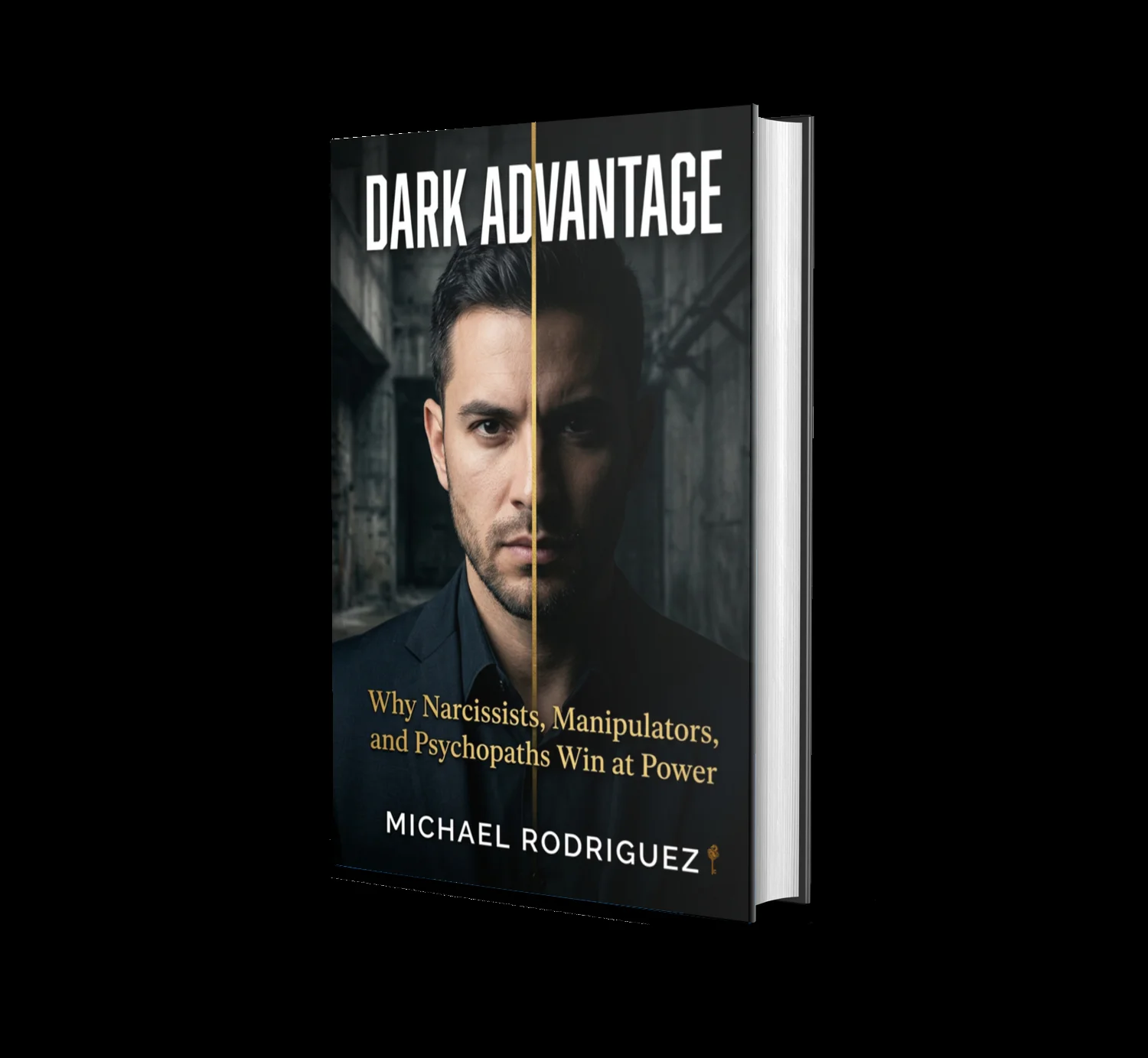
Dark Advantage: Why Narcissists, Manipulators, and Psychopaths Win at Power
Drawing on cutting-edge psychology research and real-world case studies, Dark Advantage reveals why dark personalities dominate modern organizations — and gives ethical professionals the tools to fight back.
ISBN: 9798233580215 (eBook) · 9798232445867 (Hardcover)
Publisher: Resource Economics Press
Also available at libraries via OverDrive, Hoopla, BorrowBox
About this Investigation: This article draws from the research behind Dark Advantage: Why Narcissists, Manipulators, and Psychopaths Win at Power, including analysis of peer-reviewed psychology studies, corporate case studies documented in court filings and SEC investigations, investigative journalism from The New York Times, Bloomberg, and The Wall Street Journal, and firsthand interviews with corporate executives.
Share This Article
📚 Related Articles
📕 Related Books
Subscribe to Newsletter
Get updates on new books, exclusive content, and free chapters from Michael Rodriguez.