Dark Triad Psychology: Your Questions Answered
April 8, 2026 · By Michael Rodriguez
Stanford Graduate School of Business, class of 2009. Two students sit three rows apart. Both are brilliant. Both graduate near the top of their cohort. One builds her career on competence, transparency, and collaboration — the kind of leader every management textbook celebrates. The other builds his on strategic self-promotion, calculated alliances, and the quiet elimination of internal rivals. Fifteen years later, the ethical leader is a respected VP at a mid-size firm. The manipulator is CEO of a Fortune 500 company, earning forty-seven times her salary. This is not an anomaly. This is the system working exactly as designed. Research published in the Journal of Applied Psychology confirms what most professionals suspect but cannot articulate: individuals exhibiting Dark Triad personality traits — narcissism, Machiavellianism, and psychopathy — are promoted faster, paid more, and reach the C-suite at rates four to six times the general population baseline. Dark Advantage investigates why this happens, how these personalities operate, and what ethical people can do about it. These are the questions readers ask most.
Q1: What is Dark Advantage about?
A Defense Manual, Not a Manipulation Guide: Dark Advantage: Why Narcissists, Manipulators, and Psychopaths Win at Power is an investigation into why dark personalities dominate modern organizations — and a practical framework for ethical professionals who refuse to play dirty but need to stop losing. The book draws on cutting-edge research in personality psychology, organizational behavior, and behavioral economics to explain the mechanics behind an uncomfortable reality: the traits that make someone dangerous in personal relationships often make them spectacularly successful in corporate hierarchies.
Rodriguez examines real case studies in forensic detail. Travis Kalanick built Uber into a $70 billion company through a culture of deliberate rule-breaking — then walked away with $3.6 billion after being forced to resign. Elizabeth Holmes convinced Henry Kissinger, James Mattis, and George Shultz to sit on the Theranos board while her blood-testing technology produced results no more reliable than a coin flip. Sam Bankman-Fried positioned himself as the philosopher-king of cryptocurrency, donating millions to effective altruism causes while secretly misappropriating billions in customer funds. Each case follows the same arc: charm, exploit, extract, repeat.
But Dark Advantage is not a catalog of villains. The final section — The Antidote — provides specific, research-backed countermeasures for recognizing dark personalities before they cause damage, documenting their behavior in ways that hold up under scrutiny, and building organizational structures that reward competence over charisma. The book is designed to be read by anyone who has ever watched a less qualified, more politically savvy colleague get the promotion they deserved.
Every claim is sourced from peer-reviewed journals, court filings, SEC enforcement actions, and on-the-record testimony. Rodriguez cites specific studies, sample sizes, and effect sizes — not pop-psychology generalizations. This is the book that takes the academic research out of the journals and puts it in the hands of the people who need it most.
Q2: What is the Dark Triad and why does it matter at work?
Three Traits, One Devastating Combination: The Dark Triad is a cluster of three personality traits identified by psychologists Delroy Paulhus and Kevin Williams in 2002. Machiavellianism is the capacity for strategic, long-term manipulation — reading people as instruments and deploying them accordingly. Narcissism is grandiose self-importance combined with an insatiable need for admiration and a willingness to exploit others to maintain the self-image. Psychopathy is the absence of empathy and remorse — the ability to inflict harm on others without experiencing emotional consequences. Most people have trace amounts of all three. Dark Triad individuals have them in concentrations that fundamentally alter how they interact with the world.
The workplace implications are staggering. A landmark study by Board and Fritzon, published in the British Journal of Psychology, found that senior business executives displayed personality disorder traits at rates comparable to criminal psychiatric patients — just different ones. The criminals scored high on traits associated with impulsive violence. The executives scored high on traits associated with charm, grandiosity, manipulation, and lack of empathy. Same underlying psychology. Different expression. Different outcomes.
— From Dark Advantage, Introduction
Research by psychologist Paul Babiak, who screened over two hundred corporate professionals, found that approximately one in twenty-five business leaders met the clinical threshold for psychopathy — roughly four times the rate in the general population. These individuals had risen faster, received higher performance ratings from superiors, and were consistently described by peers as "charismatic" and "visionary." Their subordinates, however, told a different story: bullying, credit-stealing, gaslighting, and strategic sabotage. As Dark Advantage documents, the corporate ladder is not a meritocracy — it is an environment that selects for specific psychological traits that happen to overlap significantly with clinical personality disorders.
Q3: Why do narcissists and psychopaths get promoted faster?
The Loudness Advantage: Corporate promotion systems are not designed to identify the best performers. They are designed to identify the people who appear to be the best performers — and this distinction is where dark personalities gain their decisive edge. Narcissists project confidence that reads as competence. Psychopaths remain calm under pressure in ways that read as leadership. Machiavellians build political networks that generate endorsements from the right people at the right time. Together, these traits create a composite profile that matches what most promotion committees are unconsciously looking for.
The research is unambiguous. A meta-analysis published in The Leadership Quarterly found that narcissism positively predicts leadership emergence — meaning narcissists are more likely to be perceived as leaders in group settings, particularly during initial interactions. First impressions carry disproportionate weight in corporate environments where executives evaluate employees they may interact with only a few times per year. The narcissist who dominates a quarterly review meeting will outshine the quiet performer who delivered 30% more revenue but presented the numbers without theatrical flair.
Dark personalities also weaponize information asymmetry. They claim credit for team successes in private conversations with senior leadership. They selectively share information to make rivals appear less competent. They volunteer for high-visibility projects while delegating the difficult, unglamorous work to subordinates. As Dark Advantage details, these are not occasional tactics — they are systematic behavioral patterns that compound over years and create career trajectories that honest professionals cannot replicate through merit alone.
The most insidious mechanism is what Rodriguez calls the "confidence cascade." When a narcissistic leader expresses certainty, subordinates and peers defer — not because the narcissist is right, but because certainty itself is socially rewarded. Dissent becomes socially costly. The narcissist's version of reality becomes the organizational consensus, not through evidence, but through sheer force of self-assurance. This is how companies end up making catastrophic strategic decisions while every smart person in the room stays silent.
Q4: How did Travis Kalanick walk away with $3 billion?
The Uber Playbook — Rule-Breaking as Business Strategy: Travis Kalanick did not build Uber by following the rules. He built it by systematically breaking them and calculating — correctly — that the penalties would never exceed the profits. When drivers recorded dashcam footage of Kalanick berating an Uber driver in 2017, the public saw a CEO losing his temper. What Dark Advantage examines is the infrastructure beneath that moment: a corporate culture engineered to treat regulation as an obstacle, competitors as enemies, and employees as expendable resources.
The Greyball software is the signature example. Uber developed a proprietary tool that identified government regulators attempting to use the app to conduct sting operations — and served them a fake version of the interface with phantom cars. The company deployed Greyball in Portland, Philadelphia, Austin, and multiple international cities. When the New York Times broke the story in 2017, Uber did not deny the program's existence. It defended it. The logic was pure Machiavellianism: if the law stands between you and growth, circumvent the law until the growth makes you too big to punish.
Kalanick's Uber faced over a dozen federal investigations, lost its license to operate in London (serving 3.5 million riders), and generated workplace harassment complaints at a rate that prompted a 215-page internal investigation led by former Attorney General Eric Holder. The Holder Report recommended sweeping reforms. The board forced Kalanick to resign in June 2017. But here is the number that Dark Advantage forces readers to confront: Kalanick retained his equity stake. When Uber went public in 2019 at a $75 billion valuation, his shares were worth approximately $3.6 billion. The architect of one of the most toxic corporate cultures in Silicon Valley history was rewarded more lavishly than almost any ethical CEO in American business.
This is the paradox at the heart of the book. The system punished the behavior. The system rewarded the person. Until organizations learn to separate these two outcomes, dark personalities will continue to treat corporate governance as a cost of doing business — and a very profitable one.
Q5: What happened at Theranos and FTX?
Strategic Grandiosity and Altruism as a Mask: Elizabeth Holmes and Sam Bankman-Fried operated in different industries, different decades, and different regulatory environments. But Dark Advantage identifies the same psychological architecture underlying both frauds: a carefully constructed public persona that made skepticism feel morally inappropriate.
Holmes dropped out of Stanford at nineteen, founded Theranos, and told investors she had developed technology that could run hundreds of diagnostic tests from a single drop of blood. She had not. The Edison device produced unreliable results — in some cases, telling cancer patients they were healthy and healthy patients they had cancer. But Holmes had recruited Henry Kissinger, George Shultz, James Mattis, and William Perry to her board of directors. She had secured a partnership with Walgreens to deploy Theranos devices in retail pharmacies. She had raised over $700 million at a peak valuation of $9 billion. The technology did not work. The narrative worked perfectly.
Bankman-Fried executed a variation on the same theme. Where Holmes used revolutionary technology as her shield, SBF used moral virtue. He positioned himself as the altruist of crypto — the billionaire who slept on a beanbag, wore cargo shorts to Senate hearings, and pledged to donate the vast majority of his wealth to effective altruism causes. The persona was so convincing that members of Congress, major media outlets, and some of the most sophisticated institutional investors in the world accepted it at face value. Behind the mask, FTX was commingling customer funds with its sister trading firm Alameda Research, making billions in undisclosed loans to insiders, and maintaining accounting systems so chaotic that bankruptcy investigators described them as unprecedented in their experience.
Rodriguez identifies what he calls "the mathematics of manipulation" — the precise ratio of public virtue signaling to private extraction that allows Dark Triad individuals to operate at scale. Holmes spent an estimated $1 on marketing and narrative control for every $4 she raised. SBF spent approximately $40 million on political donations and effective altruism pledges while misappropriating over $8 billion. The investment in perceived virtue generates returns that dwarf any conventional marketing expenditure. As Dark Advantage documents, the most dangerous manipulators do not hide their ambition — they wrap it in a cause that makes questioning them feel like attacking the cause itself.
Q6: Can ethical people compete against dark personalities?
The Antidote — Understanding Ruthlessness Without Embracing It: Yes — but not by trying to out-manipulate the manipulators. The final section of Dark Advantage provides three specific frameworks that leverage the structural weaknesses dark personalities cannot eliminate, precisely because those weaknesses are built into the same traits that give them their advantage.
The first is the Documentation Protocol. Dark personalities thrive in environments where verbal agreements, informal conversations, and ambiguous accountability structures allow them to rewrite history. The documentation protocol teaches readers how to create contemporaneous evidence trails — emails, memos, meeting summaries — that make historical revisionism impossible. Rodriguez draws on techniques used by compliance officers and forensic accountants, adapted for everyday professionals who suspect they are working with a manipulator but cannot yet prove it.
The second is the Visibility Strategy. One of the primary weapons in the narcissist's arsenal is credit appropriation — taking public ownership of subordinates' work. The visibility strategy provides specific tactics for ensuring that your contributions are independently documented before they can be claimed by someone else. This includes strategic communication with stakeholders outside your immediate chain of command, written progress updates that create a timestamp record, and alliance-building with peers who can corroborate your contributions.
The third is the Alliance Framework. Dark personalities are surprisingly vulnerable to coalitions. A single individual challenging a narcissistic leader will be isolated and destroyed. Five individuals presenting a unified, documented case to senior leadership or a board of directors create a situation that even the most skilled manipulator cannot spin. Rodriguez provides a step-by-step process for identifying potential allies, building trust without exposing yourself to retaliation, and coordinating action at the moment of maximum institutional leverage.
The core principle is straightforward: you do not need to become ruthless. You need to become immune to ruthlessness. That requires understanding exactly how dark personalities operate — their tells, their patterns, their predictable responses to resistance — and building systems that neutralize those tactics without compromising your own integrity.
Q7: Is Dark Advantage based on real psychology research?
Peer-Reviewed Science, Not Pop Psychology: Every substantive claim in Dark Advantage is sourced from one of three categories: peer-reviewed academic research, documented corporate case studies drawn from legal proceedings, or investigative journalism published by established outlets. Rodriguez does not ask readers to take his word for anything.
The academic foundation includes studies published in the Journal of Applied Psychology, The Leadership Quarterly, Personality and Individual Differences, the British Journal of Psychology, and the Journal of Business Ethics. Key researchers cited include Paul Babiak and Robert Hare (corporate psychopathy), Delroy Paulhus and Kevin Williams (the original Dark Triad framework), and Adrian Furnham (dark traits in organizational settings). Rodriguez provides sample sizes, effect sizes, and replication status for major findings — distinguishing robust, replicated results from preliminary single-study findings.
The corporate case studies are drawn from court filings, SEC enforcement actions, bankruptcy proceedings, and internal investigation reports that entered the public record through litigation. The Uber section cites the Holder Report, driver lawsuit depositions, and Department of Justice filings related to the Greyball program. The Theranos section draws on trial transcripts from United States v. Elizabeth Holmes. The FTX analysis uses the John Ray III bankruptcy report and SDNY criminal indictment documents. These are not secondhand accounts — they are primary source materials produced under oath or judicial supervision.
The investigative journalism sources include reporting from the Wall Street Journal, New York Times, Financial Times, and Bloomberg, cited with specific dates, authors, and headlines so readers can verify every reference. Rodriguez structured the sourcing this way deliberately: a book about manipulation and deception must hold itself to the highest evidentiary standard, or it becomes part of the problem it claims to address.
📖 Get the Full Story
Discover the complete investigation in Dark Advantage: Why Narcissists, Manipulators, and Psychopaths Win at Power
📦 Buy on Amazon 📖 Read Free Chapter📚 Available Now
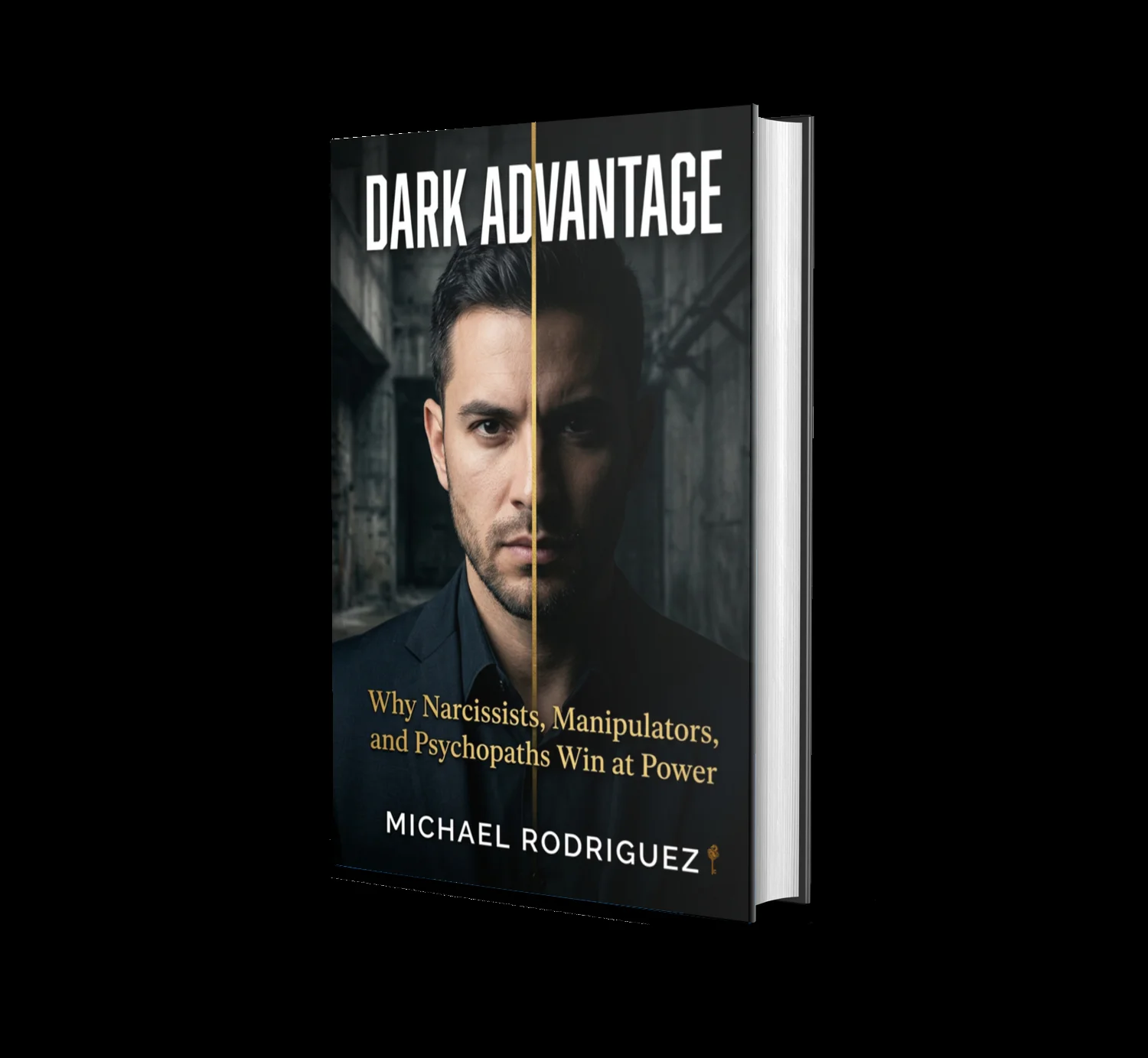
Dark Advantage: Why Narcissists, Manipulators, and Psychopaths Win at Power
Drawing on cutting-edge psychology research and real-world case studies, Dark Advantage reveals why dark personalities dominate modern organizations — and gives ethical professionals the tools to fight back.
ISBN: 9798233580215 (eBook) · 9798232445867 (Hardcover)
Publisher: Resource Economics Press
Also available at libraries via OverDrive, Hoopla, BorrowBox
About this Investigation: This FAQ draws from the research behind Dark Advantage: Why Narcissists, Manipulators, and Psychopaths Win at Power, including analysis of peer-reviewed studies in personality psychology and organizational behavior, corporate case studies drawn from court filings and SEC enforcement actions, investigative journalism from the Wall Street Journal, New York Times, and Financial Times, and cross-referencing with primary source materials produced under oath or judicial supervision.
Share This Article
📚 Related Articles
📕 Related Books
Subscribe to Newsletter
Get updates on new books, exclusive content, and free chapters from Michael Rodriguez.