The Shadow Cabinet: Your Questions Answered
March 14, 2026 · By Michael Rodriguez
They told you it was a conspiracy theory. Then the documents got declassified. MK-Ultra. COINTELPRO. Operation Mockingbird. Operation Gladio. These weren't paranoid fantasies — they were government programs, confirmed by congressional investigations and verified through tens of thousands of declassified pages. These are the questions readers ask most about the organizations that meet behind closed doors, the operations that were never supposed to see daylight, and what The Shadow Cabinet reveals about the architecture of hidden power.
Q1: What is The Shadow Cabinet about?
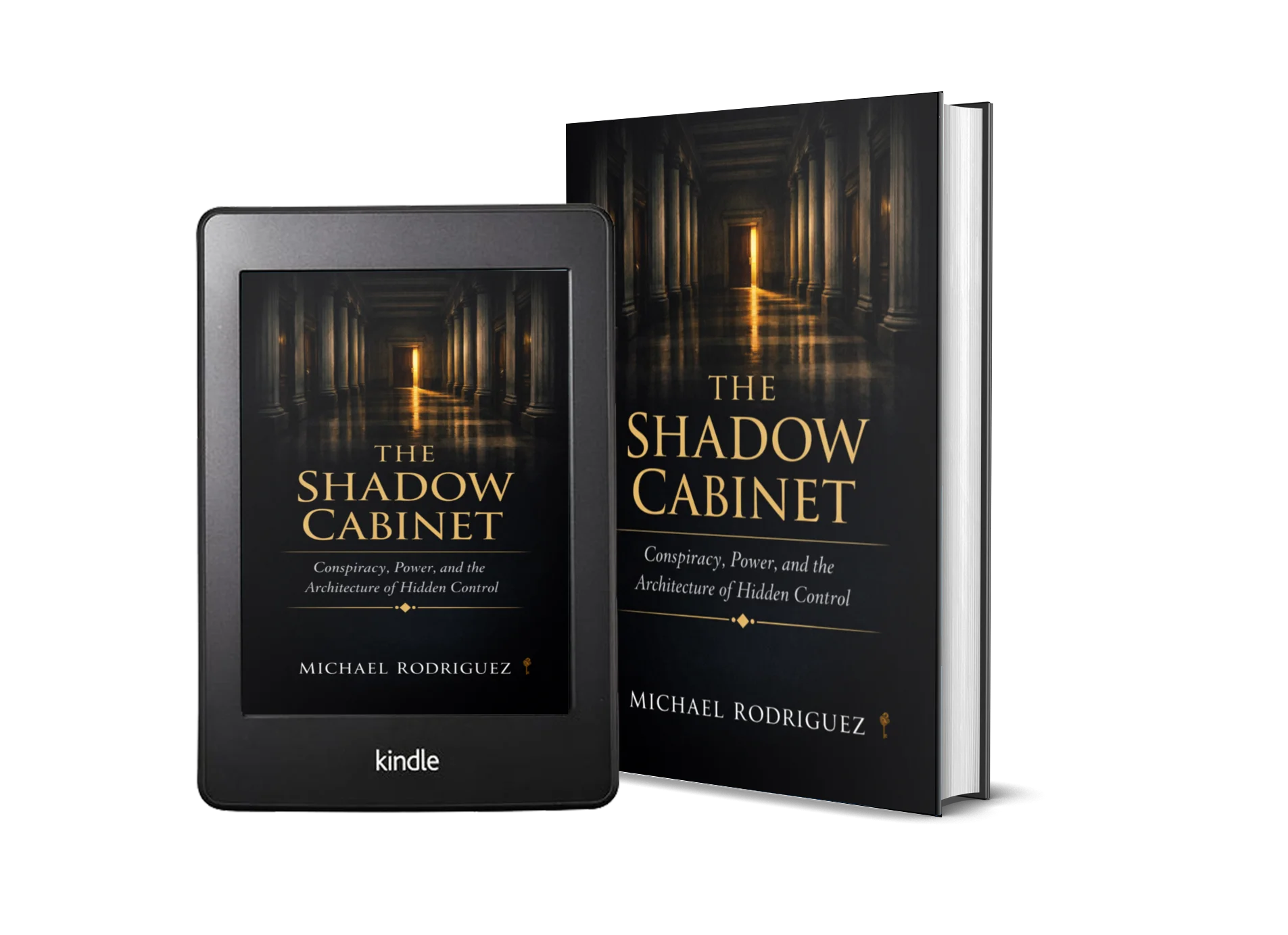
The Investigation Nobody Wanted Published: The Shadow Cabinet: Conspiracy, Power, and the Architecture of Hidden Control is the first comprehensive single-volume investigation into the world's most secretive organizations and verified covert government operations. The book examines the Bilderberg Group, the Council on Foreign Relations, the Trilateral Commission, and the World Economic Forum — tracing their founding, funding, membership, and documented influence on government policy.
It also reconstructs the full record of declassified programs: MK-Ultra (CIA mind control experiments on unwitting citizens), COINTELPRO (FBI domestic surveillance and disruption of civil rights organizations), Operation Mockingbird (intelligence infiltration of media), and Operation Gladio (NATO's secret paramilitary networks across Western Europe).
Every claim in the book is sourced from congressional testimony, declassified documents, FOIA releases, and on-the-record statements by the people involved. As The Shadow Cabinet documents, the gap between what we know and what we were told should make every citizen uncomfortable.
Q2: Is this a conspiracy theory book?
The Framework That Separates Fact from Fiction: No — and that distinction is the entire point. A conspiracy theory makes claims without verifiable evidence. The Shadow Cabinet applies a proprietary five-question Conspiracy Evaluation Framework to every major claim:
1. Is there primary source documentation?
2. Are specific individuals named with dates and locations?
3. Has the claim been independently corroborated by multiple sources?
4. Has a government body officially acknowledged it?
5. Is there a falsifiable mechanism (not just "they control everything")?
— From The Shadow Cabinet, Introduction
Claims that pass all five tests — like MK-Ultra, COINTELPRO, and Gladio — are treated as documented fact. Claims that fail — like John Coleman's "Committee 300" — are clearly identified as unverified. The book doesn't tell readers what to believe. It gives them the tools to judge for themselves.
Q3: What is the Bilderberg Group, and does it really control world policy?
Seventy Years of Secret Meetings: The Bilderberg Group is a real organization that has met annually since 1954. It was founded by Prince Bernhard of the Netherlands, Polish political adviser Józef Retinger, and American businessmen including David Rockefeller. Approximately 130 attendees — heads of state, CEOs, intelligence officials, central bankers — gather each year at a luxury hotel under intense security.
The group publishes its attendee list but not its agenda, discussions, or conclusions. Denis Healey, a longtime steering committee member, told the Guardian in 2001: "To say we were striving for a one-world government is exaggerated, but not wholly unfair."
Does Bilderberg "control" policy? The documented evidence shows that attendees include the people who make policy — but there is no verified evidence that binding decisions emerge from Bilderberg meetings. The influence is real; the mechanism is coordination and relationship-building, not a secret command structure. As The Shadow Cabinet argues, the reality is both less dramatic and more disturbing than the conspiracy theories suggest.
Q4: What was MK-Ultra, and how do we know it was real?
The Documents That Survived Destruction: MK-Ultra was a CIA program that ran from 1953 to 1973. It involved experiments on unwitting American citizens, including administering LSD without consent, psychic driving techniques, sensory deprivation, and electroshock therapy. The program operated through 149 sub-projects at 80 institutions, including universities and hospitals.
We know it was real because CIA Director Stansfield Turner testified before the U.S. Senate in 1977, confirming the program's existence. The agency had destroyed 90% of its files in 1973 on orders from Director Richard Helms, but 20,000 pages survived — discovered in a financial records building that the destruction order had missed.
— From The Shadow Cabinet, Chapter 4
The Church Committee's investigation produced fourteen volumes of testimony and evidence. Surviving victims and their families received a $750,000 settlement in 1988 — a tacit government admission of wrongdoing.
Q5: What was Operation Gladio?
NATO's Secret Armies: Operation Gladio was a network of secret NATO-backed paramilitary organizations maintained across Western Europe from the early 1950s through at least the 1990s. Originally designed as "stay-behind" forces to resist a potential Soviet invasion, some Gladio cells evolved into instruments of domestic political manipulation.
Italian Prime Minister Giulio Andreotti confirmed Gladio's existence before the Italian Senate in 1990. The European Parliament passed a resolution (November 22, 1990) condemning these secret armies and demanding investigations in all NATO member states.
The most devastating connection involves the 1980 Bologna train station bombing, which killed 85 people. The initial investigation blamed left-wing terrorists, but subsequent prosecutions revealed that right-wing extremists with documented connections to Italian military intelligence carried out the attack — operating under the protection of a Gladio-linked network. As The Shadow Cabinet traces in detail, Gladio passes all five questions of the Conspiracy Evaluation Framework with extensive documentation.
Q6: How does the Conspiracy Evaluation Framework work in practice?
The Committee 300 Test Case: Take John Coleman's 1992 book Committee 300, which claimed that 300 elites governed the world through a single coordinating body. Applying the five-question framework:
Primary documentation? Coleman provided no declassified documents, no FOIA releases, no congressional testimony.
Named individuals with verifiable actions? He named real organizations but attributed unfalsifiable omnipotence to them.
Independent corroboration? No independent investigators have confirmed his specific structural claims.
Government acknowledgment? No government has acknowledged a "Committee 300."
Falsifiable mechanism? "They control everything" is untestable by design.
Score: 0 out of 5. Compare that to MK-Ultra, which passes all five tests with extensive documentation. The framework doesn't tell readers what to believe — it shows them how to evaluate claims systematically. As The Shadow Cabinet demonstrates, some conspiracies are documented fact. Others aren't. Knowing the difference is the reader's job — and this book provides the tools.
Q7: Why should I read this book instead of just searching online?
Signal vs. Noise: Three reasons. First, the internet drowns conspiracy topics in noise — mixing verified documents with unsubstantiated speculation, influencer hot takes, and algorithm-driven rabbit holes. The Shadow Cabinet separates signal from noise using consistent evidentiary standards applied across every chapter.
Second, the book covers ground that no single online source does. It's the first comprehensive single-volume survey connecting elite coordination networks (Bilderberg, CFR, Trilateral Commission) with verified covert operations (MK-Ultra, COINTELPRO, Gladio, Mockingbird) and modern influence architecture (WEF, revolving-door appointments, algorithmic information control).
Third, the Conspiracy Evaluation Framework is a tool you keep after the book ends. Once you learn to apply those five questions, you can assess any conspiracy claim — past, present, or future — without depending on anyone else's conclusions. That's not a book. That's an intellectual toolkit.
---📖 Get the Full Investigation
Discover the complete evidence in The Shadow Cabinet: Conspiracy, Power, and the Architecture of Hidden Control
📦 Buy on Amazon 📖 Read Free ChapterAvailable Now
Libraries: OverDrive, Hoopla, BorrowBox
📘 ISBN: 9798233145827 (Hardcover) | 9798232915087 (eBook)
Published: March 2026 | Rodriguez Press
---About this Investigation: This FAQ draws from the research behind The Shadow Cabinet: Conspiracy, Power, and the Architecture of Hidden Control, including analysis of declassified CIA and FBI documents, Church Committee testimony, European Parliament resolutions, FOIA releases, and cross-referencing with primary sources spanning seven decades of documented covert operations and elite coordination networks.
Share This Article
📚 Related Articles
📕 Related Books
Subscribe to Newsletter
Get updates on new books, exclusive content, and free chapters from Michael Rodriguez.