Iran vs America: Your Questions Answered
April 3, 2026 · By Michael Rodriguez
Baghdad International Airport. January 3, 2020. 1:00 AM. Four Hellfire missiles turned a two-vehicle convoy into blackened shells. Qasem Soleimani — the most powerful military commander in the Middle East — was identified by the ring on his severed hand. Five million Iranians flooded the streets for his funeral. Twenty-two ballistic missiles slammed into an American air base in Iraq. The world braced for war. But the question hanging over every foreign ministry briefing room was the same one that had been hanging there, unanswered, for forty-one years: How did we get here? These are the questions readers ask most about the conflict that The Persian Grudge traces from its origins to the present day.
Q1: What is The Persian Grudge about?
120 Years of Mutual Destruction: The Persian Grudge: How Iran and America Became Mortal Enemies traces the complete arc of the Iran-US conflict — from a bankrupt Australian adventurer named William Knox D'Arcy who paid a Persian shah the modern equivalent of $480,000 for oil rights across an area the size of France in 1901, to the explosive Iran-Israel confrontation of 2024.
The book covers fourteen chapters across four parts: the oil curse and the 1953 coup, the Shah's reign and the Islamic Revolution, the hostage crisis and the Iran-Iraq War, and the shadow wars from 1989 through the nuclear standoff and the Soleimani assassination. Every claim is sourced from declassified CIA and NSA documents, congressional testimony, and firsthand accounts.
What makes the narrative compelling — and unsettling — is the pattern Michael Rodriguez identifies: an outside power intervenes in Iran to secure its interests. The intervention works for a while. Then it generates a backlash worse than the original problem. The intervener responds with more intervention. Rinse, repeat, escalate. As The Persian Grudge documents, this cycle has been running for over a century.
Q2: Why did the CIA overthrow Iran's government in 1953?
Operation Ajax — The Coup That Started Everything: In 1951, Prime Minister Mohammad Mossadegh nationalized the Anglo-Iranian Oil Company (later BP), ending British control over Iranian petroleum revenues. Britain responded with an oil embargo and lobbied Washington for regime change. The Eisenhower administration — persuaded by Cold War fears that Iran might fall to Soviet influence — authorized the CIA to act.
Kermit Roosevelt, grandson of President Theodore Roosevelt, entered Tehran with cash-stuffed envelopes and a plan. The operation cost approximately $1 million — roughly $11 million in today's dollars. Roosevelt organized paid street protests, bribed military officers and newspaper editors, and coordinated a military coup that removed Mossadegh and installed Shah Mohammad Reza Pahlavi as an absolute ruler.
— From The Persian Grudge, Introduction
The CIA's own internal history, declassified in 2013 after a sixty-year classification, confirmed the operation's scope. Iranians never forgot. The coup remains the founding grievance of the Islamic Republic — referenced in political speeches, taught in schools, and cited as proof that America cannot be trusted. As The Persian Grudge documents, that $1 million operation generated seventy years of blowback costing trillions.
Q3: What caused the 1979 hostage crisis?
444 Days That Reshaped American Foreign Policy: After twenty-six years of authoritarian rule — propped up by $20 billion in American weapons purchases and 45,000 American military advisors living in Iran — the Shah's regime collapsed in February 1979. The Islamic Revolution, led by Ayatollah Ruhollah Khomeini, replaced America's closest Middle Eastern ally with a theocracy fundamentally hostile to Washington.
On November 4, 1979, a group of university students — average age twenty-two — climbed the walls of the American Embassy in Tehran and took sixty-six diplomats hostage. The crisis lasted 444 days, destroyed Jimmy Carter's presidency, and ensured that the words "Iran" and "enemy" became synonymous in the American political vocabulary for the next half century.
The failed rescue attempt — Operation Eagle Claw — ended with eight dead American servicemen in a desert sandstorm, their burned helicopters broadcast on Iranian television. The hostages were released minutes after Ronald Reagan's inauguration on January 20, 1981 — a final humiliation that cemented the rupture between the two nations.
Q4: Did America really arm both sides in the Iran-Iraq War?
The Devil's Double Game: Yes — and the documented evidence is damning. When Saddam Hussein invaded Iran in September 1980, launching an eight-year war that killed over a million people, the Reagan administration pursued a policy of strategic cynicism that defies any conventional understanding of alliance politics.
Publicly, Washington "tilted" toward Iraq. The United States provided Saddam with satellite intelligence — including imagery of Iranian troop positions that Saddam's forces used to target attacks with chemical weapons. Declassified CIA documents, published by the National Security Archive, confirm that Washington knew Iraq was using mustard gas and nerve agents and continued providing intelligence support regardless.
— From The Persian Grudge, Chapter 9
Simultaneously — and secretly — the Reagan administration sold weapons to Iran through intermediaries. The Iran-Contra scandal, when it broke in 1986, revealed that the proceeds from these arms sales were funneled to Nicaraguan Contra rebels, in direct violation of a congressional ban. As The Persian Grudge traces, Washington armed both sides of a war that bled both countries — and then used the chaos to fund an illegal covert operation in Central America.
Q5: Who was Qasem Soleimani, and why did the US kill him?
The Shadow Commander: Soleimani was born in 1957 in a remote village in Kerman province where winter temperatures drop below minus ten Celsius. His father owed money to the Shah's government for land reform debts — roughly $900, an impossible sum for a farming family. He dropped out of school at thirteen to work construction. The Revolution gave him purpose. The Iran-Iraq War made him a commander.
By 1998, when he took command of the Quds Force — the external operations arm of the Revolutionary Guards — Soleimani had become something unprecedented: a military commander who operated like an intelligence chief and diplomat simultaneously. He ran Hezbollah in Lebanon, coordinated Shia militias in Iraq, propped up Assad in Syria, and armed the Houthis in Yemen. As General David Petraeus recounted, Soleimani once texted him: "You should know that I, Qasem Soleimani, control the policy for Iran with respect to Iraq, Lebanon, Gaza, and Afghanistan."
Trump authorized the drone strike on January 3, 2020. Soleimani was identified by a thick silver ring with a red carnelian stone on his severed hand. Iran's response — twenty-two ballistic missiles at Al-Asad Air Base — was the largest direct Iranian military strike against American forces in history.
Q6: What happened to the Iran nuclear deal?
The Deal That Almost Ended the Grudge: The 2015 Joint Comprehensive Plan of Action (JCPOA) was the most significant diplomatic achievement between Iran and America since 1979. Iran agreed to limit uranium enrichment to 3.67%, reduce its centrifuge count, and submit to international inspections. In return, crippling economic sanctions were lifted.
In May 2018, President Trump withdrew the United States from the deal, calling it "the worst deal ever negotiated," and reimposed sanctions. Iran's response was predictable and escalatory: enrichment climbed from 3.67% to 20%, then to 60%, and by 2023 reached 84% — just short of the 90% threshold for weapons-grade material. The International Atomic Energy Agency confirmed Iran had accumulated enough enriched uranium for multiple nuclear warheads if further processed.
As The Persian Grudge documents, the JCPOA's collapse followed the same pattern that has defined the entire relationship: a diplomatic opening sabotaged by domestic politics, mistrust, and the gravitational pull of seventy years of accumulated grievance.
Q7: Why should I read this book instead of searching online?
The Full Arc, Not the Headlines: Three reasons. First, most coverage of Iran focuses on whatever is happening right now — a nuclear negotiation, a protest movement, a military strike. The Persian Grudge connects these events into a single, coherent 120-year narrative, showing how the 1901 oil concession connects to the 2024 escalation through an unbroken chain of cause and effect.
Second, the book draws on declassified documents, congressional testimony, and primary sources that aren't easily accessible through casual internet research. Rodriguez cites the National Security Archive at George Washington University, surviving CIA internal histories, and on-the-record statements from officials on both sides — material that provides depth impossible to get from news articles or social media threads.
Third, the book presents both perspectives without taking sides. American accounts tend to start the clock in 1979 with the hostage crisis. Iranian accounts start in 1953 with the coup. Both are leaving out half the story. The Persian Grudge starts at the beginning and follows the evidence wherever it leads — which is what makes it uncomfortable for both sides and essential for anyone who wants to understand the rivalry that could still ignite a major war.
📖 Get the Full Story
Discover the complete investigation in The Persian Grudge: How Iran and America Became Mortal Enemies
📦 Buy on Amazon 📖 Read Free Chapter📚 Available Now
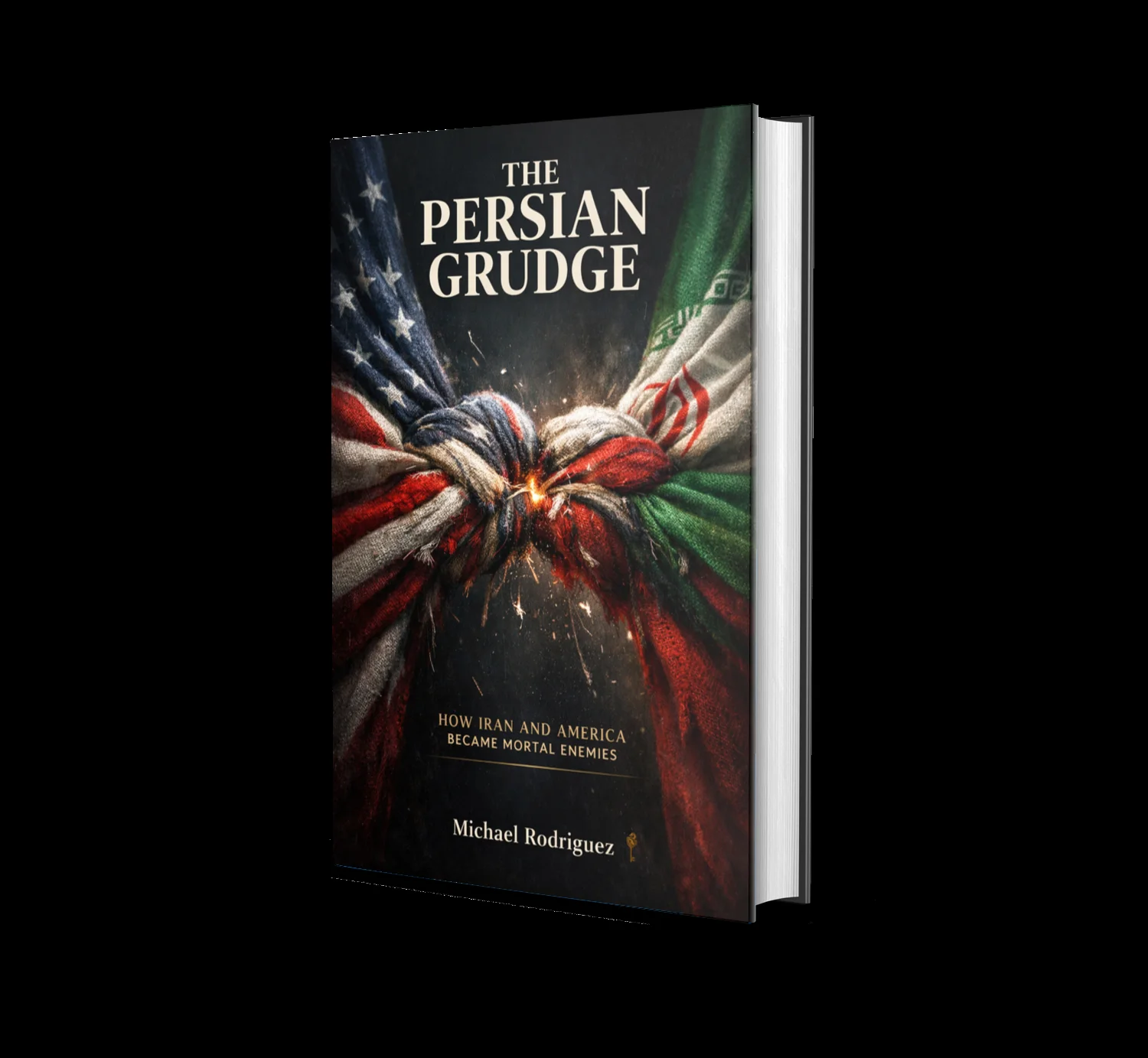
The Persian Grudge: How Iran and America Became Mortal Enemies
From the 1901 oil concession to the 2024 escalation — the definitive account of how two nations with no territorial dispute became locked in the most dangerous rivalry in modern geopolitics.
ISBN: 9798233056147 (eBook) · 9798224949861 (Hardcover)
Publisher: Resource Economics Press
Also available at libraries via OverDrive, Hoopla, BorrowBox
About this Investigation: This FAQ draws from the research behind The Persian Grudge: How Iran and America Became Mortal Enemies, including analysis of declassified CIA and NSA documents, National Security Archive publications, congressional testimony, firsthand accounts, and cross-referencing with primary sources spanning 120 years of documented conflict between Iran and the United States.
Share This Article
📚 Related Articles
📕 Related Books
Subscribe to Newsletter
Get updates on new books, exclusive content, and free chapters from Michael Rodriguez.