How the Maktoum Family Built Dubai: 190 Years of Dynastic Power
May 22, 2026 · By Michael Rodriguez
In August 1833, eight hundred Bedouin walked one hundred thirty kilometers up the Arabian coast and founded a fishing village at the mouth of a saltwater creek. They had no army, no navy, no foreign alliances, and no oil — oil would not be discovered for another one hundred thirty-three years. They had a leader named Maktoum bin Butti bin Suhail and a bet: that the new ruler of Abu Dhabi, who had just killed his own brother in a family dispute, would be too distracted by his own succession crisis to come after them. The bet paid off. One hundred ninety-two years later, the village they founded generates AED 541 billion in annual gross domestic product, contains the world's tallest building, hosts the third-largest international airline by revenue, and is ruled — without interruption — by the direct male-line descendants of the man who led the original walk. This is the story of how a small Bedouin family converted that 1833 gamble into one of the most operationally aggressive dynastic enterprises of the modern era. It is also the story of what they had to seal away to make the conversion work. The Arabic word maktoum means hidden. Maktoum is the documented record of the unsealing.
The Secession: 1833 and the Eight Hundred
The Bani Yas was a tribal confederation of approximately twenty subsections of Bedouin tribes, scattered across what is now the southern coast of the United Arab Emirates and parts of inland Saudi Arabia. The confederation traced its lineage to Yas bin Amer of the Najdi tribal line. Its core summer water source was the Liwa Oasis — a forty-mile arc of small palm-tree settlements in present-day Al Dhafra. Its two dominant branches were the Al Bu Falah — the ancestors of the Al Nahyan rulers of Abu Dhabi — and the Al Bu Falasah, the ancestors of the Al Maktoum rulers of Dubai.
For seventy-two years, from 1761 until 1833, the Al Bu Falasah remained loyal to Abu Dhabi. They paid tribute. They sent fighters. They watered their camels at the same wells. They watched as the Al Bu Falah grew Abu Dhabi from a fishing village of four hundred people into a coastal town of perhaps two thousand. Then, in the summer of 1833, Sheikh Tahnun bin Shakhbut — the ruler of Abu Dhabi — was killed in what the British India Office dispatches describe as a "family dispute." The senior branch had publicly demonstrated its inability to police its own succession. For the Al Bu Falasah, this was the signal.
Maktoum bin Butti called a majlis of the Bu Falasah leadership in late summer 1833 and asked one question: Are we staying? The answer was no. Eight hundred members of the branch — men, women, children, camels, sheep, goats, a portable carpet workshop, a small mosque tent — walked one hundred thirty kilometers north over a period of several weeks and settled at Shindagha, a sandy peninsula at the mouth of Dubai Creek. Maktoum bin Butti and his co-leader Obeid bin Said bin Rashid ruled jointly until Obeid's death in 1836. From 1836 to 1852, Maktoum bin Butti ruled alone.
Every ruler of Dubai from 1833 to 2026 — Saeed, Hasher, Maktoum II, Saeed II, Rashid, Maktoum III, Mohammed — has been a direct male-line descendant of that original Maktoum bin Butti. Seven uncontested successions across one hundred ninety-two years. By dynastic standards, the record is unusual. Most royal lines manage one major succession crisis per century. The Maktoums have managed seven without a coup, without an external arbitration, without losing the city once. As Maktoum documents, this is not luck. It is a deliberately constructed system of inter-emirate marriage, ministerial allocation, and family discipline.
The 1894 Tariff: How Dubai Stole the Persian Merchants
In 1894, a Maktoum bin Hasher — the great-grandson of the original Maktoum bin Butti — did something no other ruler on the Trucial Coast had done. He abolished tariffs on the port of Dubai. Not reduced them. Abolished them entirely on most categories of trade goods. The decision was, in its immediate context, opportunistic: across the Persian Gulf, in the port of Bandar Lingeh, the Persian government had begun tightening tariffs on Sunni Arab merchant families. Maktoum bin Hasher had grown up watching pearl boats come and go from Dubai Creek. He understood the math. Lower friction, more boats. More boats, more merchants. More merchants, more rent.
The Lingeh merchants moved. Within a decade, the population of Dubai had doubled. By 1900, it stood at approximately 10,000. By 1908, around 15,000. By 1920, Dubai had displaced Sharjah and Ras al-Khaimah as the dominant trading port on the lower Trucial Coast. As Maktoum argues, the 1894 decision was Dubai's first major strategic move that did not depend on military force or tribal allegiance. It was a regulatory move. And it established a principle that would be applied — with variations — to every subsequent Maktoum decision: make it easier to come here. Make it harder to leave. Take a cut of everything that moves.
— From Maktoum, Chapter 22
The same logic, in exactly the same form, would be applied in 1959 when Sheikh Rashid borrowed against future port revenues to dredge Dubai Creek. It would be applied in 1985 when Sheikh Mohammed launched Emirates Airline as a brand layer on top of wet-leased Pakistani aircraft. It would be applied in 2019 when the UAE issued the first golden visas. It would be applied in 2022 when Dubai's Virtual Assets Regulatory Authority became the first government in the world to issue formal crypto-asset exchange licenses to Binance, Crypto.com, Bybit, and OKX. The pattern is consistent across one hundred thirty-two years. The 1894 tariff abolition is the prototype.
The Pearling Collapse and the Aviation Pivot
In 1893, a Japanese man named Mikimoto Kōkichi successfully cultured the world's first hemispherical pearl inside a captive oyster at a marine farm on Ago Bay. By 1919, fully round cultured pearls were appearing in international jewelry markets. By the late 1920s, cultured pearls could be produced for roughly a tenth of the cost of natural pearls. The Gulf's natural-pearl industry — which had, at its peak in the 1920s, employed roughly 12,000 men across approximately 335 dhows from Dubai alone — was on a collision course with extinction.
Then the 1929 Wall Street crash. Then the Great Depression. Then a collapse in global luxury-goods demand that, between 1929 and 1933, reduced the wholesale price of a high-grade Gulf pearl from £25 per chow to under £5. Dubai's pearling fleet beached itself between 1935 and 1938. The population, which had risen above 20,000 in the late 1920s, dropped. The Maktoum treasury, which had depended on pearl-export duties and the rents of the merchant class that lived off pearling, evaporated.
The decision that saved Dubai was, in retrospect, almost trivial. In 1937, the British carrier Imperial Airways approached Sheikh Saeed bin Maktoum — the father of Sheikh Rashid, the grandfather of Sheikh Mohammed — with a proposal to use Dubai's protected lagoon as a refueling stop for Short Empire flying boats on the London-to-Karachi route. The contract paid Sheikh Saeed approximately 440 rupees a month plus landing fees. In 1937 terms, this was a small line item. In retrospect, it was the seed of every subsequent Maktoum decision.
Sheikh Rashid bin Saeed was twenty-five years old in 1937. He spent the next several summers at the Imperial Airways camp on the southern bank of the Creek, asking British engineers about wing loadings, fuel chains, and the future of long-range aviation. Twenty-one years later, when he became ruler of Dubai in 1958, the airport was already in his head. As Maktoum documents, the pattern would be repeated across his entire reign. Whenever the current revenue source approached its peak, Rashid had already begun building the infrastructure for the next one.
Fateh-1, June 1966: The Twenty-Year Clock
The well that changed everything was almost not drilled. In 1963, a consortium of Dubai Marine Areas Ltd. — owned jointly by British Petroleum, the Compagnie Française des Pétroles, and Continental Oil — had been holding offshore exploration concessions in Dubai's territorial waters for eleven years and had drilled six dry wells. The board in London was discussing winding down. The local managing director, Edward Henderson, recommended one more well. Sheikh Rashid, who had cultivated a warm working relationship with Henderson over a decade, quietly supported the recommendation.
The well — named Fateh-1, from the Arabic word for opening or conquest — hit oil in early 1966. By June 1966, the consortium had confirmed commercial viability. Production began in 1969 at approximately 100,000 barrels per day. By Saudi standards this was modest. Saudi Aramco was producing roughly 3 million barrels per day. Abu Dhabi, which had struck oil in 1958, was at 600,000 barrels per day by 1969. Dubai's reserves — between 1 and 2 billion recoverable barrels in total — would peak in 1991 at approximately 410,000 barrels per day before beginning a long decline.
Sheikh Rashid received the confirmation cable from Henderson in his majlis in Shindagha. He read the cable twice. He folded it. He put it in his breast pocket. He turned to the messenger and said, in Arabic: "Now we have to work very hard for twenty years." Then he asked for tea.
This is, in retrospect, the operating doctrine of the entire Maktoum economic strategy. Oil was not an endpoint. Oil was a window. Every dirham of revenue had to be converted, immediately, into infrastructure that would generate non-oil income after the window closed.
The infrastructure went up fast. Port Rashid, the first deepwater port, opened in 1972. Jebel Ali Port — at the time, the largest man-made harbor in the world — opened in 1979. Dubai International Airport tripled in size between 1969 and 1985. The Dubai World Trade Centre, a 39-story tower built in empty desert sixteen kilometers from the existing city, opened in 1979. Each of these projects was, by global standards, built at five times current demand. Each of them was full within a decade.
By 2024, the strategy had worked. Dubai's GDP reached AED 541 billion ($147 billion) — a 5.8 percent single-year growth rate, the strongest on record. Oil contributed less than 1 percent of GDP. As Maktoum documents, this is one of the most successful sovereign-level economic diversifications in modern history.
The Five-Month Airline
In March 1985, Sheikh Mohammed bin Rashid Al Maktoum asked Sir Maurice Flanagan, the British managing director of the Dubai ground-handling company dnata, how long it would take to start a national airline. Flanagan, who was 65 years old with a career in British commercial aviation, gave the industry-standard answer: 18 to 24 months. Mohammed said: You have five months. And ten million dollars.
The team Flanagan assembled wet-leased a Boeing 737-300 and an Airbus A300B4 from Pakistan International Airlines — meaning PIA supplied the planes, the pilots, the cabin crew, and the maintenance, while Emirates supplied the brand, marketing, and route network. Two destinations: Karachi and Mumbai. Sixty employees. Sheikh Ahmed bin Saeed Al Maktoum, Mohammed's uncle, became chairman. He still holds that role in 2026, four decades later.
The first Emirates flight, EK600, departed Dubai International Airport at 11:45 a.m. on Friday, October 25, 1985. There were 156 passengers on board. The flight operated on schedule. Forty years later, Emirates operates 256 aircraft including 117 Airbus A380 superjumbos (roughly half of all A380s ever built), serves 150 destinations across six continents, employs over 100,000 staff, and generated approximately $33 billion in fiscal-year 2024 revenue with $5.2 billion in net profit. By any meaningful measure, Emirates is one of the largest and most profitable airlines in the world.
The principle that made the five-month launch possible was the same principle that built Dubai itself: outsource the infrastructure, own the brand. The hard parts of the airline — the aircraft, the maintenance, the operational crew base — were rented from PIA. The valuable parts — the route network, the customer experience, the brand positioning — were built by Mohammed's team. Forty years later, Dubai applies the same principle to AI companies and crypto exchanges. The infrastructure is foreign. The brand is Maktoum. The cut, on everything that moves through the system, accrues to Dubai.
The Tallest Building and the Bailout
The Burj Khalifa opened on January 4, 2010. Eight hundred and twenty-eight meters tall. Designed by Skidmore, Owings & Merrill, built by Samsung C&T, financed by Emaar Properties and the Dubai government. It is, sixteen years later, still the tallest building in the world — and likely to remain so until at least 2030, when the Jeddah Tower in Saudi Arabia is projected to be completed.
What is rarely emphasized in the official Dubai narrative is that the Burj Khalifa was originally called Burj Dubai. The renaming happened three weeks before the opening ceremony. Sheikh Mohammed announced that the tower would, henceforth, be known as the Burj Khalifa — in honor of Sheikh Khalifa bin Zayed Al Nahyan, then president of the UAE and ruler of Abu Dhabi, who had extended a $10 billion bailout to Dubai during the November 2009 Dubai World debt crisis.
The debt crisis was severe. On November 25, 2009, the Dubai government Department of Finance announced that Dubai World — the holding company controlling DP World, Nakheel, Istithmar, and several other major Dubai sovereign-corporate entities — was requesting a six-month standstill on approximately $59 billion in debt obligations. The Dubai stock exchange fell 7.2 percent the following day. Abu Dhabi extended the $10 billion line through the UAE Central Bank in December 2009. The Dubai World debt was restructured over the following three years. The 2024 GDP record, achieved fifteen years later, was made possible by the 2009 bailout that almost didn't happen.
The renaming of the tower was, in symbolic terms, an enormous concession. The tower had been, for the entire six years of its construction, branded as Burj Dubai — the symbol of Dubai's ambition. Renaming it Burj Khalifa was a public acknowledgment that Dubai owed Abu Dhabi, in a way that could be seen from every angle of the city skyline. As Maktoum argues, every Instagram reel of the world's tallest building functions as a permanent thank-you note.
The Cost Ledger: The Migrant Workers and the Daughters
The Burj Khalifa was built by approximately 12,000 workers, the majority from Pakistan, Bangladesh, India, and the Philippines. The migrant labor force across Dubai's entire 2003–2010 construction boom reached approximately 700,000 at peak. The Dubai Ministry of Labour officially reported about 1,000 worker deaths per year during this period across all construction sites — roughly 6,000 total during the Burj Khalifa era. Most were heatstroke, heart failure, and falls. Most were under-investigated. The workers operated under the kafala sponsorship system, in which the employer held the worker's residence visa. Recruitment fees of $2,000 to $5,000 paid to brokers in home countries took 18 to 24 months to pay back on wages of $150 to $300 per month. Passport confiscation was widespread until the 2015 reforms began to address it. As Human Rights Watch and the International Labour Organization documented across investigations from 2006 to 2018, the labor conditions that produced the world's tallest tower would not have been legal in most Western jurisdictions.
The Maktoum family's own daughters appear on the same ledger. Sheikha Shamsa, born 1981, was abducted from a Cambridge, England street in August 2000 by men working for her family. The UK Foreign Office quietly de-prioritized the Cambridgeshire police investigation. She has not appeared in public since. Sheikha Latifa, born 1985, attempted to escape Dubai in 2002 and again on March 4, 2018. The second attempt ended with a yacht interception in international waters off Goa and a return to Dubai in a black hood. Princess Haya bint Hussein, daughter of King Hussein of Jordan and Sheikh Mohammed's second official wife, fled to London in April 2019 with her two children. The UK High Court Family Division — presided over by Sir Andrew McFarlane, the most senior family-law judge in England — issued three consequential rulings: on March 5, 2020, finding that Sheikh Mohammed had orchestrated the abductions of Shamsa and Latifa; on October 6, 2021, finding that Sheikh Mohammed had authorized Pegasus spyware hacks on Haya's phones and her solicitors' phones; and on December 21, 2021, awarding Haya £554 million in divorce settlement — the largest in British legal history.
These are not separate stories from the construction story. They are the same story. As Maktoum argues throughout: the same hand that built the tallest building sent commandos for his own daughter. The same family that founded an airline in five months also confiscated passports from the migrant workers who flew on its planes. The same dynasty that signed a federation in 1971 with its boyhood friend used Israeli-manufactured spyware on its ex-wife's solicitors in 2021. The book is not asking the reader to like the Maktoums. It is not asking the reader to dislike them. It is asking the reader to look at them.
The Seven Principles of the Maktoum Playbook
One hundred ninety-two years of Maktoum strategy can be distilled, with reasonable fidelity, into seven principles that the book traces across all four parts.
- Move when the political center fractures. The 1833 secession was timed precisely to coincide with internal weakness in Abu Dhabi.
- Make it easier to come here than to leave. Take a cut of everything that moves. The 1894 tariff abolition is the prototype.
- Find the next industry before the current one dies. Build the infrastructure before the revenue arrives. Aviation was prepared during the pearling collapse. Diversification was prepared before the oil peak.
- Build capacity at five times current demand. The capacity creates the demand. Jebel Ali Port, Emirates Airline, the Burj Khalifa, the AI regulatory sandbox — every megaproject is over-scaled on day one and at capacity within a decade.
- Marry into your rival's family. Put the children in the right ministries. Sheikh Mohammed's mother was an Al Nahyan. His ministerial appointments were calibrated to the inter-emirate balance.
- Never let one constituency become indispensable. Multiple commercial districts. Multiple free zones. Multiple regulatory regimes. No single industry, no single neighborhood, no single foreign investor base becomes politically essential.
- Outsource the infrastructure. Own the brand. Wet-leased aircraft from Pakistan in 1985. Korean general contractors on the Burj. American chips and Chinese open-source models in the AI economy of 2026. Dubai is, structurally, an orchestration layer on top of foreign-supplied infrastructure.
The principles are extractable, in varying degrees. Some — the twenty-year clock, the capacity-ahead-of-demand strategy, the brand-on-top-of-infrastructure model — apply to founders, organizations, and even other countries. Others — the absolute political authority, the family endogamy, the labor-arbitrage system, the willingness to send commandos for dissenting daughters — are not, in any defensible sense, transferable. As Maktoum argues in its closing chapter: you can copy some of this. The rest is the cost ledger. The cost ledger is in this book, accounted for in full.
The Question
The book closes with one question for the reader to answer for themselves: if you had been born into a small ruling family of a desert emirate, with the same constraints and the same starting position the Maktoums had, would you do what they did?
Would you secede from Abu Dhabi in 1833? Would you abolish tariffs in 1894? Would you bet on aviation in 1937? Would you dredge a creek in 1959? Would you build a port for ships that did not yet exist in 1976? Would you launch an airline in five months in 1985? Would you build the world's tallest tower on the backs of migrant workers who could not legally refuse? And — this is the harder part of the question — would you, when one of your daughters tried to leave on a yacht, send commandos for her?
The Maktoum dynasty exists because, at every point in its 192-year history, somebody answered yes to the entire package. The infrastructure, the brand, the airline, the tower, the migrant labor, the absent princesses. The package is not, in the family's own self-understanding, separable. You take all of it or you take none of it. The seal is open. The question is yours.
📖 Get the Full Investigation
📚 Available Now
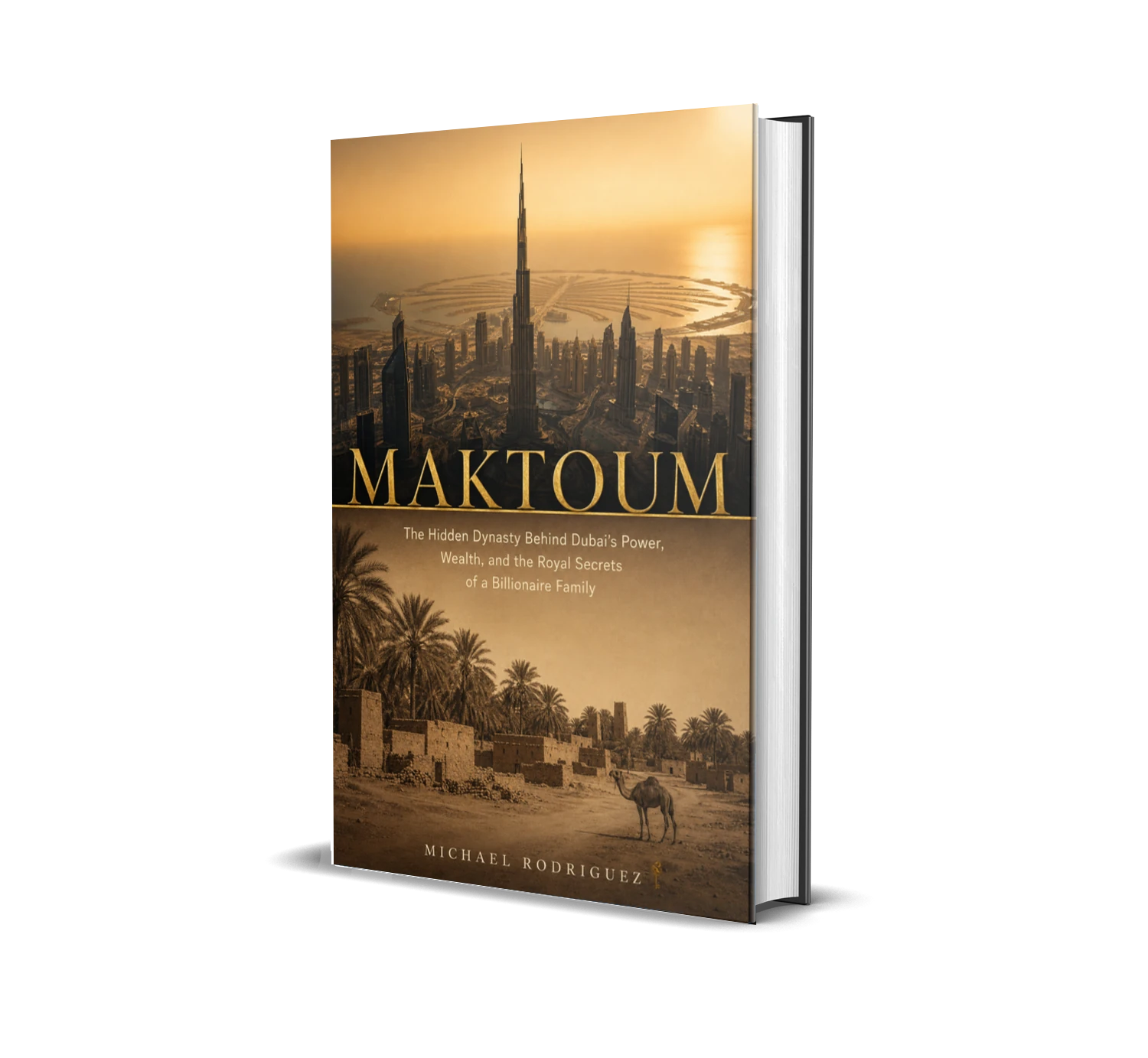
Maktoum: The Hidden Dynasty Behind Dubai's Power, Wealth, and the Royal Secrets of a Billionaire Family
190 years. Seven rulers. One playbook. One cost ledger. From the 1833 Bedouin secession to the £554M divorce — the documented record of how a small family built Dubai, and what they sealed to make it work.
ISBN: 9798235188716 (eBook) · 9798235685314 (Hardcover)
Publisher: Resource Economics Press
📚 Related Articles
- Maktoum Dynasty FAQ — Your Questions Answered
- Vatican Bank: Two Centuries of Financial Crime
- Kissinger and the Cost of Realpolitik