Maktoum Dynasty: Your Questions Answered
May 22, 2026 · By Michael Rodriguez
On the night of March 4, 2018, a thirty-two-year-old woman was hiding in the engine room of a sixty-meter American-flagged yacht called the Nostromo, eighty kilometers off the coast of Goa. She had a satellite phone, a fake Irish passport, and a former French naval intelligence officer hiding two decks above her. She was the daughter of the ruler of Dubai. The yacht's navigation system had been compromised for days. By 10 p.m., she heard the flashbang grenade explode on the upper deck. By midnight, she was in a black hood, on a Zodiac, on her way to a waiting helicopter. The men in the uniforms were not Indian. They were Emirati commandos who, officially, were not there. Her name was Sheikha Latifa bint Mohammed Al Maktoum. Her family name — maktoum — is a classical Arabic word that means hidden, sealed, withheld from view. The investigation into the 192-year dynasty that produced both the world's tallest tower and the commandos who came for her is the subject of Maktoum: The Hidden Dynasty Behind Dubai's Power, Wealth, and the Royal Secrets of a Billionaire Family. These are the questions readers ask most.
Q1: What does the word maktoum actually mean?
A Family Surname That Also Means "Sealed": In classical Arabic, maktoum (مكتوم) is the passive participle of the verb root k-t-m, which describes the act of concealing, withholding, sealing shut. When an Arabic-speaking imam asks God to forgive sins both visible and maktoum, he is asking forgiveness for the ones nobody saw. When a thirteenth-century pearl merchant labeled a chest maktoum, he meant: keep this closed. The contents are not for daylight. It is also the surname of the family that, in 1833, founded Dubai. The man whose name became the dynastic title — Sheikh Maktoum bin Butti bin Suhail — was a Bedouin leader of the Al Bu Falasah branch of the Bani Yas confederation, born in the late eighteenth century, who led 800 of his kinsmen out of Abu Dhabi during an internal power crisis and founded a settlement at the mouth of a saltwater creek. His descendants have not lost the city in 192 years.
The semantic doubling is, in the book, treated as more than a coincidence. The Maktoum dynasty is, in its public-facing operation, one of the most visible brands in the world — Emirates Airline, the Burj Khalifa, the Palm Jumeirah, Dubai International Financial Centre, the Expo 2020 grounds, the DP World logistics network across 82 marine terminals in 40 countries. None of this is hidden. But the family's internal decisions — succession, marriages, the treatment of dissenting daughters, the management of inter-emirate political relationships, the structure of Dubai Holding's $300 billion private ledger — remain, by design, maktoum. The book argues that this is not contradiction. It is operating model. As Maktoum documents, the dynasty's longevity depends precisely on the asymmetry between what it shows and what it seals.
Q2: Who founded Dubai, and how did the city begin?
The 1833 Secession That Almost Did Not Happen: Dubai was founded in August 1833 when approximately 800 members of the Al Bu Falasah branch of the Bani Yas confederation — led jointly by Sheikh Maktoum bin Butti bin Suhail and Obeid bin Said bin Rashid — walked 130 kilometers north from Abu Dhabi to the mouth of Dubai Creek. The trigger was an internal power crisis in Abu Dhabi: Sheikh Tahnun bin Shakhbut, the ruler of the Al Bu Falah branch, had been killed in a family dispute earlier that summer. The Al Bu Falasah, junior cousins of the Al Bu Falah, had spent decades watching the senior branch consolidate wealth, water rights, and political authority. The 1833 crisis was the moment to leave.
The migration was, in tribal Arab terms, an enormous gamble. The new ruler of Abu Dhabi could have sent a war party. The existing residents of the Creek — a few hundred fishermen and pearl divers at Shindagha — could have resisted. The British residency, watching from a distance, could have demanded that Maktoum and Obeid be returned to Abu Dhabi for justice. None of these things happened. Maktoum and Obeid had timed the move precisely. They had bet on Abu Dhabi's internal distraction, on the Shindagha residents' small numbers, and on the British commitment to maritime peace under the 1820 General Maritime Treaty.
— From Maktoum, Chapter 1
The bet paid off. Obeid bin Said died in 1836; Maktoum bin Butti became sole ruler and governed Dubai until his death in 1852. He was succeeded by his son Saeed. Saeed by Hasher. Hasher by another Maktoum. Every ruler of Dubai from 1833 to today has been a direct descendant of Maktoum bin Butti — seven uncontested successions across 192 years, a dynastic record that is unusual even by Arab royal standards. Most royal lines manage one major succession crisis per century. The Maktoums have managed seven without losing the city. As Maktoum documents, this is not luck. It is a deliberately constructed system of inter-tribal marriage, ministerial allocation, and family discipline that the book traces in detail across all four parts.
Q3: Who is Sheikh Mohammed bin Rashid Al Maktoum?
The Poet Who Ran a Country: Sheikh Mohammed bin Rashid Al Maktoum was born July 15, 1949 — the third of four surviving sons of Sheikh Rashid bin Saeed Al Maktoum, the man who built modern Dubai. His mother, Sheikha Latifa bint Hamdan Al Nahyan, was a member of the Abu Dhabi ruling family — a marriage arrangement that, by design, biologically cemented the inter-emirate union before the United Arab Emirates existed as a political entity. Mohammed completed military training at the Mons Officer Cadet School in Aldershot, England, in the late 1960s. On December 9, 1971 — just days after the British formally withdrew from the Gulf — he was sworn in as the first Minister of Defence of the United Arab Emirates, at age 22. He was, that morning, the youngest defence minister in the world.
He has been at the operational center of Dubai's government in some capacity ever since. He launched Emirates Airline in 1985 with $10 million and a five-month deadline. He became Crown Prince of Dubai in 1995 while his older brother Maktoum bin Rashid held the throne. He oversaw the construction of the Palm Jumeirah (begun 2001), the Burj Khalifa (opened 2010), and the foundation of Dubai World as a holding company in 2006. When his older brother died in January 2006, Mohammed succeeded him as ruler of Dubai, UAE Vice President, and UAE Prime Minister — the three roles he still holds in 2026, at age 76.
His personal brand is unusual in modern royalty. He writes Arabic poetry (his 2009 collection 40 Poems from the Desert has been translated into English). He flies falcons. He participates personally in international equestrian competitions. He has, by various counts, 25 acknowledged children from at least six wives. His estimated net worth, depending on the source, ranges from $14 billion to $18 billion. He owns 99.67 percent of Dubai Holding, which controls Jumeirah Group, Emirates NBD bank, Borse Dubai, and roughly $360 billion in assets through ICD. He is also, per UK High Court rulings dated March 5, 2020 and October 6, 2021, the man who orchestrated the abductions of his own daughters and authorized the use of Pegasus spyware on his ex-wife's solicitors. As Maktoum argues, both of these facts coexist. The book is the unsealing of how.
Q4: What happened to Princess Latifa, and is she safe?
The 2018 Yacht and the BBC Bathroom Videos: Sheikha Latifa bint Mohammed Al Maktoum was born on December 5, 1985 — the second of Sheikh Mohammed's children to be given the name Latifa, after her older sister had died as an infant. Her first escape attempt came in 2002, at age 16, when she was intercepted at the Oman border and returned to Dubai. According to her own video testimony recorded before the 2018 attempt, she was subsequently imprisoned in a Dubai villa for three years and subjected to physical abuse and forced medication.
The second attempt was on March 4, 2018. Latifa, her Finnish friend and capoeira instructor Tiina Jauhiainen, and former French naval intelligence officer Hervé Jaubert planned to sail from Oman through international waters to Sri Lanka, then fly to the United States on a fake Irish passport and claim political asylum. They departed on the sixty-meter American-flagged yacht Nostromo. The yacht's electronics had been compromised. Eighty kilometers off the coast of Goa, the vessel was boarded by a joint Indian Coast Guard and Emirati special forces unit. Latifa was removed in a black hood, transported to a UAE helicopter, and returned to Dubai. Jauhiainen and Jaubert were detained for two weeks and then deported.
The case did not become public knowledge until December 2018, when the BBC released a 40-minute video Latifa had recorded before the escape describing her motivations and naming names. In February 2021, the BBC's Panorama program aired additional hidden videos Latifa had recorded from a small Dubai bathroom — the only place in the villa where she could obtain privacy. The videos were smuggled out through a network arranged by Jauhiainen. As Maktoum documents, the United Nations Human Rights Office subsequently demanded that the UAE produce proof Latifa was alive and well. Photographs were released of her appearing in Madrid, in Reykjavík, and at the Dubai Mall. The #FreeLatifa campaign formally concluded in August 2021. Whether she is meaningfully free — in the sense of being able to travel without supervision, give unscripted interviews, or live independent of her family — remains, by most credible assessments, an open question.
Q5: What was the Princess Haya divorce ruling, and why does it matter?
£554 Million, Pegasus Spyware, and the Largest Divorce in British History: Princess Haya bint Hussein was, in 2004 when she married Sheikh Mohammed, one of the most internationally credentialed women in the Middle East. She was the daughter of King Hussein of Jordan, an Oxford graduate in PPE, a 2000 Sydney Olympics show-jumper representing Jordan, and a multilingual humanitarian ambassador. She was Mohammed's second official wife. The marriage produced two children — Sheikha Al Jalila (b. December 2007) and Sheikh Zayed (b. January 2012) — and, from the outside, functioned for 15 years.
In April 2019, Haya fled Dubai with her two children. According to UK High Court witness statements accepted by the court, Sheikh Mohammed had begun a campaign of intimidation directed at her after he learned of her contact with Tiina Jauhiainen and her partial role in attempts to help Princess Latifa. Threatening notes appeared at her residence. A pistol was placed on her bed. Helicopters circled her car in Dubai. Sheikh Mohammed divorced her under Sharia law in February 2019 — unilaterally, without notifying her — while she was in London.
The UK High Court Family Division, presided over by Sir Andrew McFarlane (the most senior family-law judge in England), issued three consequential rulings. On March 5, 2020, the court found that Sheikh Mohammed had orchestrated the abductions of Sheikha Shamsa (from Cambridge in 2000) and Sheikha Latifa (from international waters in 2018), and had subjected Haya to a campaign of "fear and intimidation." On October 6, 2021, the court found that Sheikh Mohammed had authorized the use of Pegasus spyware, manufactured by the Israeli company NSO Group, to hack the mobile phones of Haya, her solicitors (including Baroness Fiona Shackleton), and her bodyguards. Sir Andrew McFarlane described this as "a clear and grave breach not only of domestic English law but also of the public international law obligations of one head of state to another."
On December 21, 2021, the court awarded Princess Haya £554 million ($728 million) in divorce settlement — the largest in UK legal history. The settlement included a £210 million annuity for Haya, a £290 million trust for the security of the two children, and additional sums for residence, education, and security infrastructure. The settlement was paid in full. As Maktoum argues, the Haya case is consequential not only for its size but for what it documents: a sovereign-immune head of state submitting himself, however reluctantly, to a foreign court — and losing.
Q6: How much oil does Dubai actually have?
The Window That Closed Faster Than Anyone Expected: Commercial oil was discovered at the offshore Fateh-1 well in 1966 by a consortium of British Petroleum, Compagnie Française des Pétroles, and Continental Oil. Production began in 1969 at approximately 100,000 barrels per day. Dubai's reserves, in total, were estimated at between 1 and 2 billion recoverable barrels — modest by Saudi standards (Saudi reserves are 267 billion barrels) and small even compared to Abu Dhabi (97 billion barrels). Dubai peaked production in 1991 at about 410,000 barrels per day. By 2020, production had fallen below 50,000 barrels per day. By 2024, oil contributed less than 1 percent of Dubai's GDP, down from approximately 50 percent in 1985.
This is one of the most successful sovereign-level economic diversifications in modern history. The architect was Sheikh Rashid bin Saeed Al Maktoum, ruler from 1958 to 1990. His famous statement — "My grandfather rode a camel, my father rode a camel, I drive a Mercedes, my son drives a Land Rover, his son will drive a Land Rover, but his son will ride a camel" — has been repeated in countless coffee-table books about Dubai. As Maktoum argues, the statement is not folksy pessimism. It was Rashid's operating manual: the oil was a temporary window; every dirham of revenue had to be converted, immediately, into infrastructure that would generate non-oil income after the window closed.
By 2024, Dubai's GDP reached AED 541 billion ($147 billion) — a 5.8 percent single-year growth rate, the strongest on record. The leading sectors were wholesale and retail trade (24.5 percent of GDP), transportation and storage (12.4 percent), and financial services (11.6 percent). Tourism reached 18.7 million visitors. Real estate transactions reached AED 522 billion in value. The post-oil pivot, in measurable economic terms, has succeeded.
Q7: Where should I start if I want to understand the Maktoum dynasty?
Start at the Yacht, or Start at the Oasis: Maktoum is designed to be read from the beginning, which opens on the night of the 2018 yacht interception and then moves backward to 1833. The Introduction — available free on this site — covers the essential framework of the entire book in roughly 2,500 words. Readers who prefer to start with the most operationally instructive material can read Chapter 14 ("Emirates Airline — Five Months, Ten Million Dollars") and Chapter 22 ("The Seven Principles") as standalone units. Chapter 14 contains the original case study of Mohammed's airline launch; Chapter 22 distills the seven principles of dynastic statecraft that the book traces across all four parts.
Readers who want comparable investigations into dynastic capital and family power will find natural companions in The Persian Grudge, which traces the Pahlavi-Khomeini transition in Iran; Holy Money, which traces 200 years of Vatican financial scandal; and Shadows of Power, which traces the Epstein network and the architecture of impunity. All four books follow the same methodology: primary sources, court records, documented facts. No speculation. No anonymous sources. Every claim verifiable.
📖 Get the Full Investigation
📚 Available Now
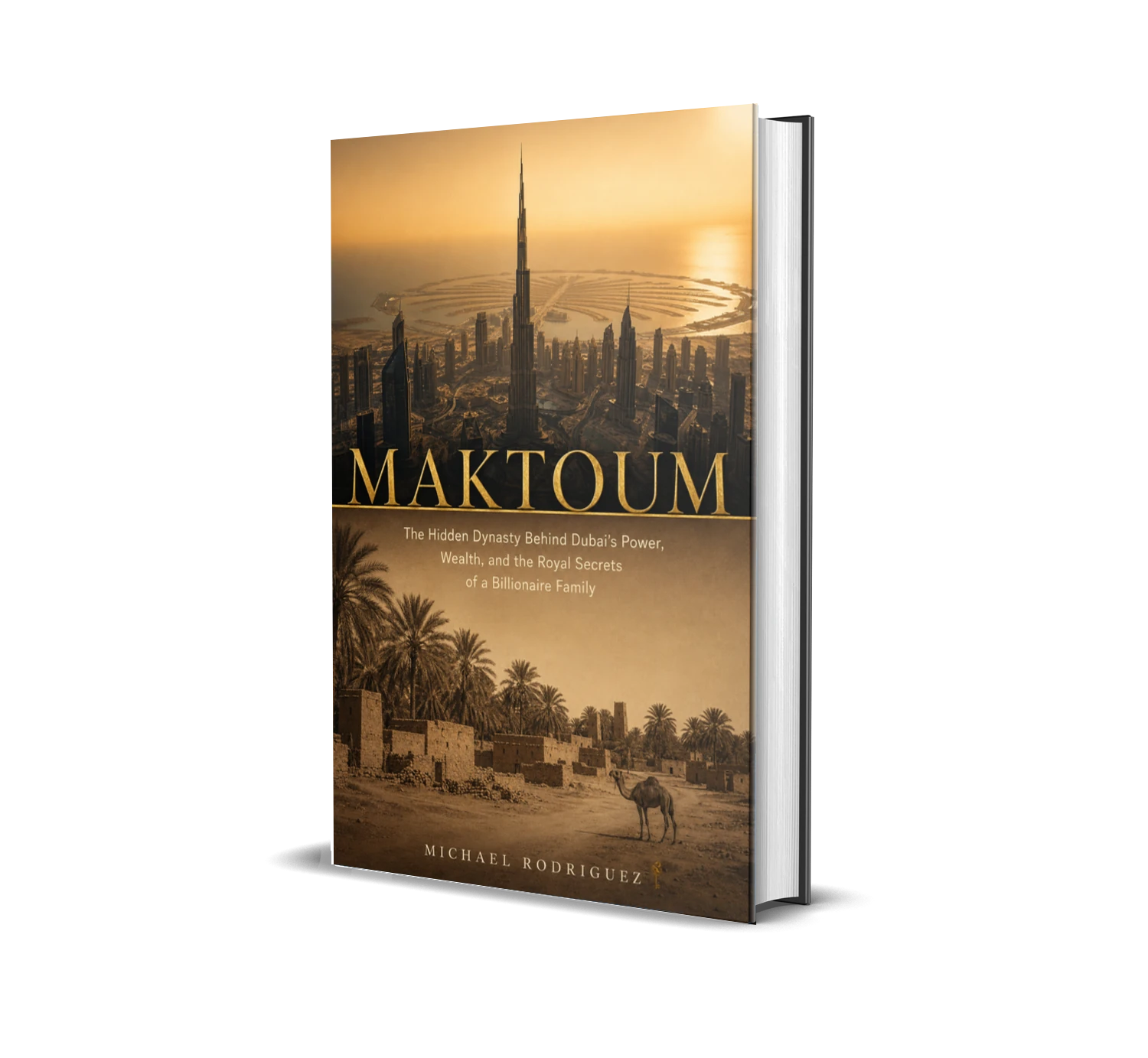
Maktoum: The Hidden Dynasty Behind Dubai's Power, Wealth, and the Royal Secrets of a Billionaire Family
190 years of the Maktoum dynasty — from the 1833 secession to the £554M Princess Haya divorce, the Burj Khalifa, and the 2024 record GDP. Seven rulers, one playbook, one cost ledger.
ISBN: 9798235188716 (eBook) · 9798235685314 (Hardcover)
Publisher: Resource Economics Press
Also available at libraries via OverDrive, Hoopla, BorrowBox
About this Investigation: Maktoum is based on UK High Court Family Division judgments, declassified British India Office residency records, Bani Yas genealogical archives, Emirates Airline official corporate timeline, Dubai Public Debt Management Office quarterly reports, MONEYVAL anti-money-laundering assessments, and investigative reporting from the BBC, CNN, the Financial Times, Gulf News, and Reuters. All factual claims are sourced. Where evidence is contested or absent, the book says so explicitly.
📚 Related Articles
- How the Maktoum Family Built Dubai: 190 Years, Seven Rulers, One Playbook
- Vatican Bank Scandal FAQ: Holy Money Explained
- Henry Kissinger and Realpolitik: The Architect of Power FAQ